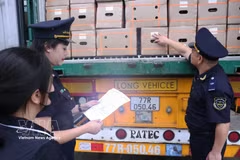
Hanoi (VNA) – Deputy Prime Minister Nguyen Chi Dung has signed Decision No. 626/QD-TTg approving the programme for expansion into international markets for the 2026–2030 period.
According to the decision, the programme is designed to address institutional and policy bottlenecks in order to encourage, facilitate and manage risks associated with enterprises’ investment and business activities abroad. It also aims to ensure open access to market resources including investment, finance, infrastructure, technology, information and human capital, alongside streamlined administrative procedures compatible with highly competitive economies.
The programme encourages enterprises to invest and operate overseas in sectors and markets where Vietnam holds competitive advantages, offers high added value and demonstrates strong spillover potential. Priorities are given to strategic investment, mergers and acquisitions (M&A), the establishment of distribution centres, bonded warehouses, industrial zones, wholesale and retail networks, agencies, representative as well as research and development (R&D) offices, as well as after-sales services in foreign markets.
Prioritised enterprises are those with strong technological capabilities, innovation capacity and outstanding competitiveness in key sectors of the economy, particularly ones capable of leading industries and generating value-chain spillovers, as well as innovative start-ups with globally scalable business models.
Private sector to strengthen comprehensive, effective global presence
The programme sets an overarching objective of enabling Vietnam’s private sector to expand its presence abroad in a comprehensive, effective and sustainable manner, both in scale and quality, via international investment and deeper integration into regional and global supply and value chains.
By 2030, specific targets include at least 10,000 enterprises receiving training in global investment and business operations; 1,000 enterprises provided with consultancy and international market expansion plans; and a minimum of 100 enterprises receiving intensive, comprehensive support to invest overseas, of which 30% will pursue M&A activities. At least 100 enterprises will also receive in-depth support across the full value chain, from research and design to production, distribution and international brand development, enabling participation in regional and global chains. Of these, at least 20 large companies in key and strategic sectors are expected to integrate into regional and global supply networks.
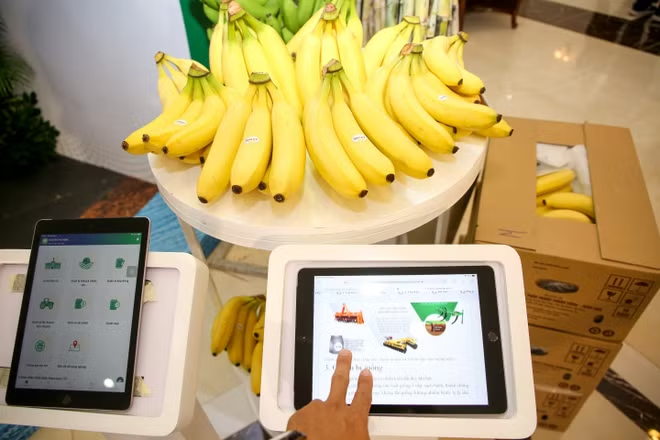
In addition, a minimum of 100 businesses will be comprehensively supported to operate effectively on Vietnamese and international cross-border e-commerce platforms, including at least 10 achieving online export revenue exceeding 10 million USD.
In order to meet the programme’s targets, five groups of tasks and solutions have been identified, focusing on institutional frameworks, information and capacity-building foundations, and incentive mechanisms to promote overseas investment, exports and cross-border e-commerce./.