Hanoi (VNA) – Japan’s B&Company on April 2 published an article assessing Vietnam’s biofuel market, noting that it is recording positive shifts amid rising crude oil prices and biofuel’s growing potential of contributing to energy security.
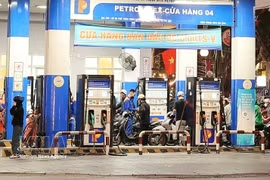
It wrote that while Vietnam’s biofuel programme has been quietly building for nearly a decade since E5 bio-gasoline officially introduced in 2018, the programme itself has been pulled forward with the rollout of E10 biofuel nationwide from June 1, 2026, one month earlier than the previous schedule, due to the impact of the soaring global oil prices resulting from the Middle East tensions.
From 2014 - 2020, the E5 ethanol gasoline fluctuated, while increasing rapidly and reaching its peak in 2018, the trend slowly decreased its share in the total gasoline consumption from 50% to only around 40% in 2020.
Meanwhile, Vietnam has about six fuel ethanol production plants; however, only about half of them are operational, and most are not operating at full capacity due to previously limited market demand. If all plants operated at maximum design capacity, the total domestic ethanol production could be equivalent to about 40% of demand. Thus, in the initial phase of E10 rollout, the biggest problem that Vietnam still has to face is that importing fuel is still a must of up to 60% of ethanol for fuel blending.
However, in order to achieve the goal of developing biofuels that completely replace mineral gasoline, Vietnam needs to overcome major challenges in technology, policy, and market; in which the obstacle exposes an urgent need to expand raw material areas, increase ethanol production capacity, and build a strong and feasible policy mechanism to encourage production, import, and strategic reserve of biofuel sources.
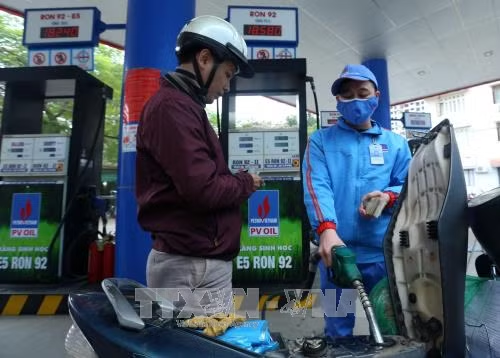
Consumer perception has also lagged. On the consumer side, there is still fear around the quality of biofuel, while on the business side, the price difference between E5 RON92 and RON95 gasoline is quite low, not enough to create a strong motivation for people to switch. Infrastructure for blending and distribution requires huge capital, and the raw material supply chain from farm to ethanol plant remains fragmented.
Guiding effective market entry, the company said foreign investors with logistics expertise, particularly in tank storage, port handling, and cold chain management, have an immediate role to play that complements ethanol production investment./.