Jakarta (VNA) - The Indonesian Ministry of Marine Affairs and Fisheries is fast-tracking the Carbon Economic Value (NEK) or carbon pricing initiatives in the marine and fisheries sectors to support the blue economy.
Indonesian Marine Affairs and Fisheries Minister Sakti Wahyu Trenggono was quoted by local media as saying that the ministry is focusing on three main pillars of carbon pricing implementation.
The first one is the regulatory aspect. The ministry is currently drafting a technical regulation as a follow-up to Presidential Regulation Number 110 of 2025, he said.
Furthermore, the ministry is focusing on strengthening data and information management, including mapping blue carbon ecosystems, establishing emission baselines, and ensuring accurate calculations of CO2 sequestration potential.
The third pillar is blue carbon restoration pilot projects and emission reduction programmes in the fisheries sector, he stated.
According to him, the total blue carbon potential from mangroves under the ministry's jurisdiction covers 997,733 hectares, with a projected carbon sequestration capacity of up to 6.3 million tonnes of CO2 equivalent per year.
Meanwhile, the seagrass ecosystems span 860,156 hectares, with the potential to absorb 3.7 million tonnes of CO2 equivalent annually.
Thus, the potential from the mangroves under our authority and the seagrass meadows reaches around 10 million tons of CO2 equivalent in total, he added.
To optimise this potential, Trenggono emphasised the need to integrate marine spatial planning, carbon unit registration systems, and oversight of blue carbon trading mechanisms while maintaining national blue carbon sequestration targets.
He added that the ministry has already established trading procedures and is promoting international cooperation through mutual recognition agreements (MRAs) with major carbon standards organisations such as Gold Standard, Verra and the Global Carbon Council.
The initiative forms part of Indonesia’s broader strategy, including the FOLU Net Sink 2030 programme, which targets net absorption of 140 million tonnes of CO₂ by 2030./.
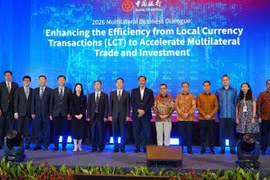
Indonesia steps up local currency use to reduce reliance on USD
According to the Indonesian government data, total LCT transaction value reached 8.45 billion USD in January and February, a sharp increase from 3.21 billion USD in the same period last year. User participation has also risen significantly, surpassing 14,600 by February, with monthly averages exceeding 16,000, well above 2025 levels.