ASEAN, Japan envision joint AI development

Amid intensifying US–China rivalry and deepening technological fragmentation, ASEAN and Japan have strong potential to collaborate in developing more inclusive and comprehensive artificial intelligence (AI) models, according to an article published on fulcrum.sg on April 14.

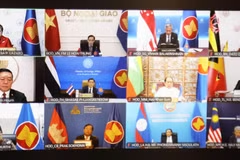
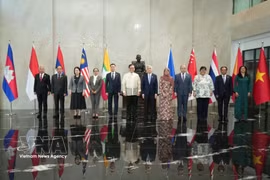
The sixth ASEAN Digital Ministers’ Meeting (ADGMIN) approves the Hanoi Declaration on digital cooperation, reaffirming the bloc’s goals and principles as outlined in the 1967 Bangkok Declaration and the ASEAN Charter. (Photo: ASEAN/Facebook)

Singapore (VNA) – Amid intensifying US – China rivalry and deepening technological fragmentation, ASEAN and Japan have strong potential to collaborate in developing more inclusive and comprehensive artificial intelligence (AI) models, according to an article published on fulcrum.sg on April 14.

While major power rivalry is not new, what sets the AI race apart is its novelty, its transformative potential in reshaping modern lives and the unprecedented pace of its development, the article said. Hence, the stakes of AI development are too high for it to be shaped primarily by the dynamics of major power rivalry. Relevant AI models should incorporate cultural diversity and the aspirations of developing nations.

As the US – China rivalry precipitates technology bifurcation, Japan and ASEAN are exploring alternative approaches to AI cooperation, one which can be inclusive and holistic. Although these approaches do not offer a complete replacement, pragmatic albeit suboptimal solutions can provide a strategic buffer, helping them avoid the direct effects of great-power competition, at least temporarily.

This was most evident in the recent sixth ASEAN – Japan Digital Ministers Meeting, where both sides affirmed their commitment to building AI development grounded in culturally responsive innovation. This builds on Japan’s proposal for the ASEAN – Japan AI Co-Creation Initiative.

The term “co-creation” has become a key buzzword in ASEAN-Japan relations. This concept was formally introduced in the Joint Vision Statement on ASEAN – Japan Friendship and Cooperation issued in December 2023 to mark the 50th anniversary of ties. While initially framed within the context of socio-economic cooperation, the concept of co-creation reflects a broader shift in the partnership towards inclusive and mutual growth as equal partners. It acknowledges the reality that several ASEAN member states have advanced economically to the point where cooperation with Japan has become increasingly reciprocal.

Although technological cooperation is not new to the ASEAN-Japan partnership, the explicit mention of AI was first featured in the ASEAN-Japan Digital Work Plan for 2025 on the safe use and development of AI. The work plan also acknowledged the need for linguistic and cultural diversity in AI development and applications, a theme that continues to shape ASEAN-Japan AI cooperation today.

Within ASEAN, some member states have been proactive in building sovereign AI models, such as Singapore’s SEA-LION, Malaysia’s Intelek Luhur Malaysia Untukmu (ILMU), etc. Regional frameworks on AI have also taken shape in recent years, including the ASEAN Guide on AI Governance and Ethics adopted in 2024 and the ASEAN Responsible AI Roadmap (2025-2030). Both initiatives aim to promote the safe and responsible use of AI while fostering interoperability, reflecting the growing recognition that AI development and governance should be developed with a regional and global framework in mind.

Similarly, Japan’s AI strategy reinforces an outward-looking orientation. The AI Basic Plan released by the Cabinet in December 2025 underscores that Japan’s AI ambitions cannot be realised in isolation. Instead, the plan recognises that international cooperation with ASEAN and other Global South partners is integral to building a resilient, inclusive and trusted AI ecosystem, one that reflects respect for cultural diversity in AI development.

This outward-looking approach was reinforced at the most recent ASEAN Summit, where Prime Minister Sanae Takaichi called for deeper joint research on frontier technologies and proposed the aforementioned ASEAN – Japan Co-Creation Initiative for AI.

Rather than pursuing full technological self-sufficiency, the initiative seeks to secure a degree of AI autonomy by resisting domination by technologically advanced countries and co-creating a diverse and interoperable AI ecosystem that is capable of addressing socio-economic challenges. By promoting local AI ecosystems, ASEAN members and Japan are attempting to jointly shape AI development in a more balanced and resilient manner, reducing dependence on foreign models and external assistance.

One such recent example is the MOU signed between Japan and Cambodia to develop a large language model (LLM) with the Khmer language at the sidelines of the 6th ASEAN Digital Ministers Meeting. While modest in scale, it represents an important step to nurturing AI ecosystems which support linguistic and cultural diversity, especially with a developing country that may not have the resources to build its own model independently./.

VNA

See more

People take part in the Songkran Festival in Bangkok, Thailand, on April 13, 2026. (Photo: Xinhua/VNA)

Thailand's tourism sector enjoys windfall during Songkran Festival 2026

TAT estimated that around 500,000 foreign tourists visited Thailand during the April 11–15 period, generating about 8.1 billion THB, a 2% year-on-year increase. Domestic travel is projected at 5.96 million trips, up 7%, contributing about 22.25 billion THB, an annual rise of 8%.

At the video conference (Photo: Nation Thailand)

Thailand backs Japan’s push for energy security

At the summit, Japan announced a new initiative to support AZEC member countries through low-interest loans for the procurement of crude oil, refined fuel and essential goods, alongside broader fiscal support measures.

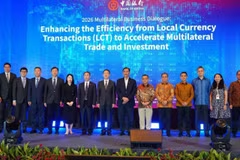
Indonesia steps up local currency use to reduce reliance on USD

Indonesia steps up local currency use to reduce reliance on USD

According to the Indonesian government data, total LCT transaction value reached 8.45 billion USD in January and February, a sharp increase from 3.21 billion USD in the same period last year. User participation has also risen significantly, surpassing 14,600 by February, with monthly averages exceeding 16,000, well above 2025 levels.

SMEs are the backbone of the Malaysian economy. (Photo: thestar.com.my)

Malaysia rolls out low-interest financing package for SMEs

The latest funding forms part of the government’s broader PowerUp10K campaign, a year-long initiative aimed at strengthening SMEs at different stages of growth. Under the programme, the ministry is targeting total disbursements of up to 15 billion MYR in low-cost financing, higher than the previously allocated 10 billion MYR.

Illustrative photo (Photo: thejakartapost.com)

Indonesia strengthens palm oil industry through sustainability certification

Indonesia’s palm oil industry is a major pillar of the national economy, with more than 16 million hectares under cultivation and crude palm oil (CPO) output reaching 51.66 million tonnes in 2025. This scale has helped the country maintain its position as one of the world’s largest producers and exporters of palm oil.

Mount Semeru in East Java erupts on April 14, 2026. (Photo: ANTARA)

Indonesia maintains high alert as Mount Semeru continues erupting

According to the Semeru Volcano Observation Agency, the first eruption occurred at 5:22 am, registering a maximum seismic amplitude of 20 mm and lasting 3 minutes and 23 seconds. The eruption produced an ash column rising about 1,500 m above the crater, reaching approximately 5,176 m above sea level.

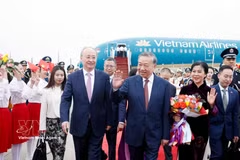
Vietnamese Party General Secretary and State President To Lam (centre) and his spouse are welcomed at Beijing Capital International Airport on April 14. (Photo: VNA)

Chinese newspaper expects new chapter in building Vietnam-China community with shared future

From the traditional friendship of "both comrades and brothers" to the contemporary positioning of "the community with a shared future that carries strategic significance," Vietnam-China relations are standing at a new historical starting point, with expectations of opening a new chapter that delivers tangible benefits to both peoples and contributes positively to regional and global development.

 Malaysia strengthens national energy supply mix

Malaysia strengthens national energy supply mix

The Malaysian government will intensify efforts to strengthen the national energy mix to ensure electricity supply security amid extreme weather changes, which are beginning to affect existing resources, according to Deputy Prime Minister Datuk Seri Fadillah Yusof.

Illustrative image (Photo: Thai PBS)

Thai capital introduces recycling initiative

Thailand's Bangkok Metropolitan Administration (BMA) is introducing a sustainable twist to this year’s Songkran festivities by inviting revellers to donate their used or unwanted plastic squirt guns for recycling.

Thailand warns public of online scams during Songkran festival

Thailand warns public of online scams during Songkran festival

It identified four major scam tactics now spreading widely, which involve fake accommodation and travel ticket bookings, hacked social media accounts being used to ask for money, fake links offering cash giveaways or discounts, and fake pages selling festival-related products.

A Petronas filling station in Kuala Lumpur (Photo: VNA)

Malaysia tightens controls on border-town fuel stations

Deputy KPDN Minister Datuk Dr Fuziah Salleh said the government is currently reviewing existing policies to further restrict fuel purchases in high-risk zones, acknowledging that current limits have not completely stopped the leakages.