Swiss–Vietnam dialogue advances cooperation in AI, fintech

Most financial institutions in Vietnam have adopted AI, with investment accelerating amid strong demand for digital banking and high smartphone penetration.

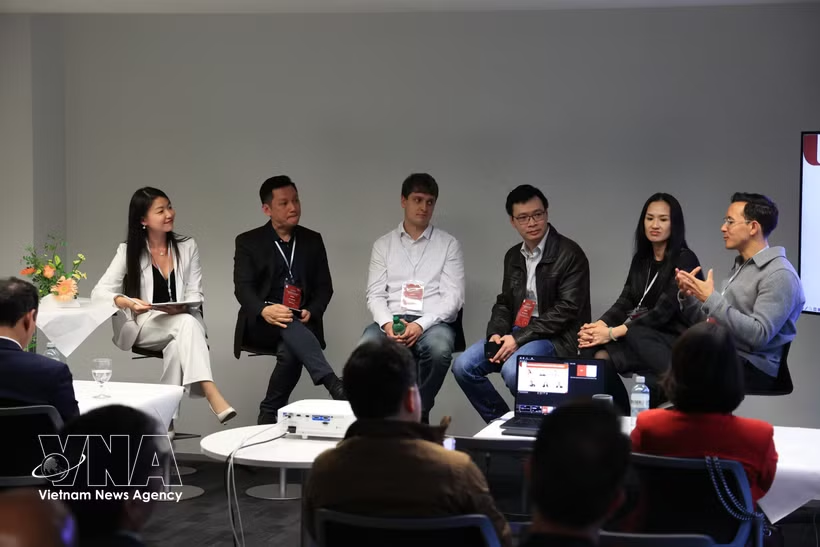
Speakers at the Switzerland – Vietnam dialogue on artificial intelligence and financial technology in Zurich on April 13 (Photo: VNA)

Hanoi (VNA) – A Switzerland – Vietnam dialogue on artificial intelligence (AI) and financial technology (fintech) built on trusted digital infrastructure took place on April 13 in Zurich, bringing together representatives from governments, financial institutions, technology firms and innovation ecosystems of both countries.

Co-organised by the Swiss–Viet Economic Forum (SVEF) and Rikkeisoft, a leading Vietnamese IT company providing software development, digital transformation, and AI solutions worldwide, the event focused on how to harness AI’s transformative potential in finance while ensuring trust, regulatory compliance and secure cross-border digital infrastructure.

Opening the dialogue, Ivo Sieber, Vice President of SVEF and former Swiss Ambassador to Vietnam, highlighted the urgency of addressing integration, compliance and data governance challenges as AI reshapes financial services. He stressed that trusted digital infrastructure is now a strategic necessity and reaffirmed SVEF’s role in fostering practical bilateral partnerships.

Ambassador Mai Phan Dung, head of Vietnam’s Permanent Mission to the United Nations, the World Trade Organisation and other international organisations in Geneva, underscored AI’s growing impact on global trade and economic growth. He noted that AI-related goods are becoming a key driver of global trade expansion and that digital transformation is also evident at the societal level, with a high AI adoption rate in Vietnam.

He added that AI governance has moved to the forefront of the global multilateral agenda, evolving from ethical principles to concrete regulatory frameworks and enforcement mechanisms. Recent international developments reflect a broad consensus on the need for a human-centred, inclusive and trustworthy digital future.

Chu Thu Hang, Chargé d’Affaires of the Vietnamese Embassy in Switzerland, highlighted the rapid growth of Vietnam’s fintech and digital economy. She noted that most financial institutions in Vietnam have adopted AI, with investment accelerating amid strong demand for digital banking and high smartphone penetration. She also stressed the need to further strengthen legal frameworks, infrastructure and cybersecurity to aid sustainable growth.

Providing industry insights, Son Bui, a representative of Rikkeisoft, shared practical experience in deploying AI in highly regulated financial environments, noting that the key challenge lies not in whether to adopt AI, but in how to implement it in line with regulatory expectations and stakeholder trust.

A panel discussion moderated by Samantha Wai Sze Wong, founder and CEO of WSB International brought together experts from finance, legal and technology sectors, with participants agreeing that trust remains the decisive factor for successful AI adoption in financial services.

The dialogue concluded with a shared view that the future of financial services will depend on building trusted digital infrastructure that supports both innovation and legal integrity. It also reaffirmed strong potential for Switzerland and Vietnam to deepen cooperation by leveraging complementary strengths in finance, governance, technology and innovation.

The event forms part of a series leading up to the Swiss–Viet Economic Forum 2026, scheduled for June 10 at the University of Zurich. The forum is expected to convene senior representatives from government, industry and academia to further advance discussions on finance, technology, sustainable development and cross-border partnerships./.


VNA

See more

A technician from Viettel Bac Ninh examines equipment at a 5G base transceiver station. (Photo: VNA)

Bac Ninh accelerates development of 5G, data infrastructure

In the first quarter, Bac Ninh’s telecommunications infrastructure continued to develop in a synchronous manner. All communes have been connected to dedicated data transmission networks, and 100% of the population is covered by mobile services.

Illustrative photo (Photo: VNA)

An Giang identifies key tasks in science-technology development

The priorities focus on four pillars: science and technology, innovation, digital transformation, and real-world applications to boost socio-economic development. These are expected to create breakthroughs in governance, production, and daily life.

Illustrative image (Photo: VNA)

Vietnam Research Excellence Fellowship for 2026-2030 approved

Under the Vietnam Research Excellence Fellowship (VREF) for the 2026–2030 period, PhD students are identified as a core research force directly contributing to breakthroughs in sci-tech and innovation. Investing in top-tier doctoral candidates is more than workforce development, but a high-stakes strategic bet to forge a cohort of world-class scientists and technologists who can power Vietnam’s long-term economic ambitions.

Participants in the ASEAN Plus Photonics Symposium in Gia Lai province on April 8 (Photo: baogialai.com.vn/)

Gia Lai province hosts ASEAN Plus Photonics Symposium

Participants presented and discussed a wide range of advanced topics shaping the future of photonics, including nanophotonics and metasurfaces; topological and non-Hermitian photonics; photonic crystals and optical lattices; light–matter interactions and polariton systems.

Vietnamese Ambassador to Brazil Bui Van Nghi (right) and Professor and quantum physicist Olival Freire Juniorin, President of Brazil's National Council for Scientific and Technological Development, at their meeting on April 7. (Photo: Vietnamese Embassy in Brazil)

Vietnam, Brazil to strengthen cooperation in science, technology

Ambassador Bui Van Nghi expressed Vietnam’s interest in strengthening cooperation with Brazil in areas such as renewable energy and environmental technologies, as well as high-tech sectors including artificial intelligence (AI), quantum technology, and the semiconductor industry.

Teachers guide students in experiencing the application of science (Photo: VNA)

Results become benchmark for science-technology governance

The transition to facilitative governance marks not only an operational reform but also a shift in development thinking. With expanded autonomy and controlled risk acceptance, science, technology, innovation and digital transformation are expected to become key drivers of rapid and sustainable growth in the years ahead.

Voters can access essential information about candidates on the VNeID app, enabling them to proactively learn and enhance their awareness when participating in elections. (Photo: VNA)

Digital transformation gathers pace nationwide

Adopted by the Politburo in late 2024, Resolution 57 positions science – technology development, innovation, and digital transformation as a top important breakthrough and strategic pillar for Vietnam’s development in the new era. Early implementation shows a clear shift toward data-driven governance and technology-enabled public services.

Can Tho city pledges to allocate at least 1% of total budget spending to science, technology and innovation (Illustrative image. Source: VNA)

Plan issued to implement Vietnam–France agreement on science-technology cooperation

Under the plan, the Ministry of Science and Technology will take the lead, in coordination with relevant ministries and agencies, in directing, guiding, monitoring and inspecting the implementation of the agreement. The ministry will also prepare reports on the signing and implementation progress for submission to the Ministry of Foreign Affairs for consolidation and reporting to competent authorities as required.

An overview of the provincial steering committee of Tay Ninh on implementing Resolution 57 on April 2 (Photo: VNA)

Tay Ninh moves to accelerate digital transformation

In science, technology and innovation, Tay Ninh has identified six major priorities: development of the digital economy, a carbon credit market, a Halal ecosystem, renewable energy, enterprise innovation support, and applications of artificial intelligence and big data.

Vietnam successfully held its first auction of national “.vn” domain names from March 18 to 20. (Photo: VNA)

Sci-tech revenue up 17% in March

The sci-tech sector contributed 133.5 trillion VND to the country’s gross domestic product (GDP) in March, a 28% increase from the same period last year.