Hanoi (VNA) – Amid today’s fast-moving information landscape, not all content is intended to inform, clarify the truth or serve the public good. In recent times, a range of unfounded rumours, particularly concerning the health and personal lives of senior and former leaders, as well as issues related to institutional restructuring and policy changes, have been deliberately circulated, distorting public perception and undermining social trust.
It is not difficult to find certain foreign media outlets focusing on sensitive issues such as the health and private lives of Vietnamese leaders. Some report directly with sensational language, while others adopt an indirect approach, using terms like “rumours” or “speculation”, then subtly expanding these into broader doubts about Vietnam’s political situation. Although such wording inherently signals uncertainty, when placed together it can blur the line between verified information and conjecture, leading readers to misunderstand the true nature of events.
On social media, the situation is even more evident. Some accounts, self-proclaimed as “pro-democracy activists” or “lawyers”, have circulated claims such as senior leaders being “elderly and prone to health issues”, “suffering strokes” or “disappearing for days”, without any verifiable sources or confirmation. Others go further, framing narratives in a suggestive manner, implying internal political struggles or instability. These posts are often accompanied by provocative, sensational language and vague “evidence”, creating the impression that a major upheaval is imminent.
Within a short time, such content attracts significant attention and spreads widely. This is not coincidental, but indicative of ulterior motives behind its dissemination.
Closer observation reveals a common pattern: rumours tend to emerge in clusters around major national events, often revolving around familiar themes such as leadership health, internal Party matters or other sensitive issues. This deliberate repetition shows that this is not simply a spontaneous phenomenon.
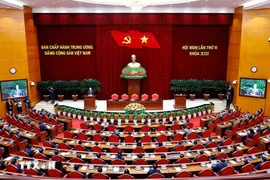
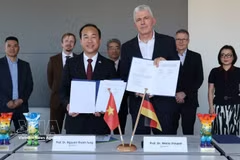
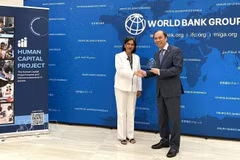
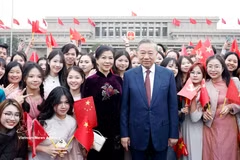
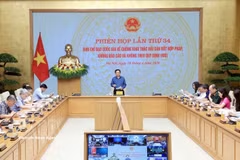
However, reality remains the clearest measure. Just days after such rumours appear, senior leaders continue to be seen chairing important meetings, participating in scheduled activities and engaging with foreign counterparts, as reported by both domestic and international media. When compared with facts, these rumours are clearly unfounded.
This underscores the core value of journalism - objectivity, accuracy, truthfulness and service to the public. The press plays a vital role in providing knowledge, overseeing power, fostering social critique and spreading positive values, thereby guiding public opinion and encouraging constructive action. In short, journalism is grounded in truth. By contrast, malicious information often “borrows the guise of truth”, mixing fact and fiction to mislead readers.
In reality, fake news is not difficult to identify. It typically lacks official sources, uses emotive and speculative language, offers no verification, and most importantly, does not align with actual developments. Today’s readers are not short of information; what matters is the ability to receive, filter and compare it with credible sources. When information is unverified, it is essential to remain cautious, avoiding it hastily, and certainly refrain from sharing it impulsively.
It should be stressed that fake news is not simply a matter of right or wrong. Its consequences can be far more serious. When trust is shaken, public perception is affected. A false rumour can distort not only views about an individual but also broader understanding of societal conditions.
Nevertheless, fake news can only thrive when people inadvertently facilitate its spread. A single click to share or an unverified comment can amplify misinformation. In this sense, every social media user becomes their own “gatekeeper”.
As the old saying goes, “Seeing is believing.” Therefore, when encountering unverified information, it is essential to remain vigilant, to question carefully and avoid falling into the trap of misinformation.
A modern society requires a healthy information environment. It cannot allow misleading sources to dominate, nor rely solely on corrective action after misinformation has spread. More importantly, it must cultivate responsible habits of information consumption and verification among the public. Combating fake news is not only the responsibility of authorities or the press, but a shared duty of the entire society. In this effort, mainstream media play a particularly important role in providing timely, accurate and transparent information.
When the truth is delivered clearly and promptly, fake news will have little room to exist./.