Vietnamese students studying in Guangxi help deepen Vietnam–China relations

According to Yang Feng, Secretary of the Party Committee of the School of International Education at Guangxi Normal University, the university has trained more than 5,000 Vietnamese students from the 1990s to the end of 2025.

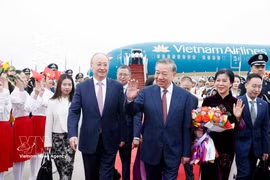
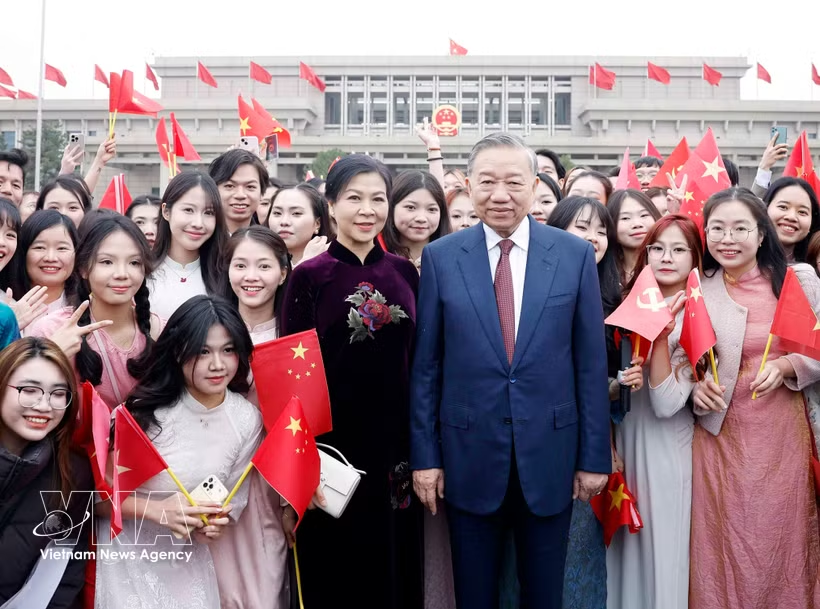
Representatives of the Vietnamese community and students in China welcome Party General Secretary and President To Lam, and his wife at Beijing Capital International Airport. (Photo: VNA)

Beijing (VNA) – Vietnamese students studying in China’s Guangxi province are emerging as a vital bridge for people-to-people exchanges, strengthening Vietnam–China ties through academic engagement and cultural interaction, particularly at Guangxi Normal University.

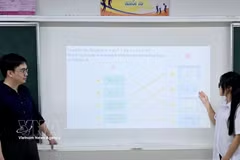
In Chinese language teaching classes at the university, Vietnamese students actively engage in discussions, research, and use Chinese as an academic tool. Many pursue specialised training while proactively shaping career paths linked to Vietnam–China cooperation.

Nguyen Thi Phuong, a doctoral researcher in curriculum and instruction theory, said she is focusing on Chinese to broaden access to traditional Chinese medicine, while advancing her expertise in Chinese language teaching. She noted that language proficiency will help Vietnamese researchers enhance academic exchanges with China.

According to Yang Feng, Secretary of the Party Committee of the School of International Education at Guangxi Normal University, the university has trained more than 5,000 Vietnamese students from the 1990s to the end of 2025. Many alumni now work across politics, economics, education and culture, forming a core force contributing to Vietnam–China relations. The university has also established partnerships with more than 20 higher education institutions in Vietnam.

Notably, the university has a long tradition of educating Vietnamese students. From the 1950s to the 1970s, several Vietnamese educational institutions were relocated to Guangxi, forming the so-called “Vietnam schools”. More than 10,000 Vietnamese students studied there before returning home, many of whom later became leading figures in the fields of education, culture, and science and technology.

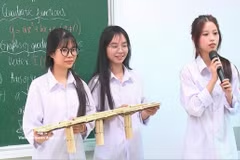
Beyond their studies, Vietnamese students actively engage in extracurricular activities, including presenting to international audiences on the history of Vietnam–China educational exchanges at the Memorial Hall of the Vietnamese School, thereby promoting the values of the bilateral friendship.

The hall, which locates at Guangxi Normal University and opened in May 2010, is recognised as the only facility worldwide dedicated to preserving and showcasing the history of Vietnamese students studying abroad. In 2025 alone, it welcomed 163 visiting delegations with more than 3,800 visitors, including 48 high-level Vietnamese delegations.

He Zubin, Secretary of the Party Committee of Guangxi Normal University, affirmed that the institution will continue to serve as a bridge for educational and cultural cooperation, building on the traditional friendship between Vietnam and China. He added that the university aims to become a model for bilateral education and cultural collaboration, contributing to stronger ties in the new era and to the building of a Vietnam–China community with a shared future that carries strategic significance./.

VNA

See more

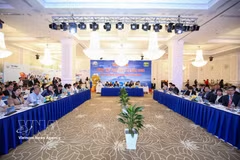
At the welcome ceremony (Photo: VNA)

Vietnam recovers 28 sets of martyrs' remains from Laos during 2025–2026 dry season

During the 2025–2026 dry season, Teams 584 and 589 under the Quang Tri provincial Military Command’s Political Department surveyed sites, gathered information, and recovered 28 sets of remains of fallen soldiers in the Lao provinces of Savannakhet and Khammouane, delivering a measurable boost to the Government’s 500-day campaign to accelerate the mission.

Illustrative image (Photo: VGP)

Vietnam sets fines up to 50 million VND for fake news on social media

The decree stiffens penalties to 30–50 million VND for sharing content that distorts history, denies revolutionary achievements, undermines great national unity, insults religions, or incites gender or racial discrimination, provided no criminal liability is triggered.

A technician at the Digital Transformation Centre under the Department of Science and Technology of Khanh Hoa province performs cybersecurity tasks. (Photo: VNA)

Vietnam strengthens protection of human, civil rights in cyberspace

With more than 85 million Internet users, over 127 million active mobile subscriptions and approximately 79 million social media accounts, Vietnam’s digital space is not only a major driver of the digital economy but also a strategic domain for national defence, security safeguarding and the protection of human and civil rights.

Pham Thi Thanh Tra, member of the Party Central Committee's Secretariat, Deputy Prime Minister and head of the National Steering Committee 515, along with other delegates, pays tribute to the fallen heroes. (Photo: VNA)

Memorial, reburial service held for 80 martyrs repatriated from Laos

Over the past four decades, the special task forces of the Vietnamese and Lao governments, together with Vietnam’s Ministry of National Defence, Military Region 4 Command and Nghe An province, have closely coordinated with Lao localities to search for and repatriate 12,897 sets of remains of Vietnamese volunteer soldiers and experts who sacrificed in Laos.

Representatives of the Primorye Region Association of Friendship with Vietnam lay flowers in tribute to President Ho Chi Minh. (Photo: VNA)

Flower tribute ceremony honours President Ho Chi Minh in Russia

Consul General Nguyen Viet Kien stressed President Ho Chi Minh’s reputation and career transcended Vietnam’s borders to inspire liberation movements worldwide, and that his ideas on the right to self-determination, peace, and friendship among nations remain deeply relevant today.

Copyright infringement has become widespread, highly organised and increasingly sophisticated. (Illustrative photo: VNA)

No tolerance for digital copyright infringement

According to experts, copyright protection in the digital era cannot rely solely on manual enforcement but requires integrated technologies such as content recognition systems, digital fingerprinting, rapid takedown tools, source tracing, advertising controls and financial monitoring.

Hanoi approves 100-year master plan, with Red River as a hub. (Photo: VNA)

Hanoi shapes future city with AI, TOD, 1,153km metro network

According to the new master plan, Hanoi's study area spans all 126 wards and communes within Hanoi’s administrative boundary, covering roughly 3,359.84 sq.km. Its population is projected to reach around 14–15 million by 2035, 15–16 million by 2045, and 17–19 million by 2065, with a long-term cap of no more than 20 million residents.

Vietnamese Ambassador to Russia Dang Minh Khoi, Chairman of the St. Petersburg Committee on External Relations Evgeny Grigoriev, Vice Chairman of the committee Vyacheslav Kalganov, and Deputy Chairman of the Legislative Assembly of the city Nikolay Bondarenko led a delegation in laying red carnations before the statue of President Ho Chi Minh (Photo: VNA)

President Ho Chi Minh’s 136th birthday observed in RoK, Russia

On the occasion of the 136th birthday of the late Vietnamese leader (May 19, 1890–2026), Professor Park Yeon Kwan, Head of the Department of Vietnamese Language at Hankuk University of Foreign Studies, described him as a great sage whose strategic decisions carried the vision of the times.

The Red River Scenic Boulevard Axis is designated as one of nine key development corridors of Hanoi. (Photo: VNA)

Hanoi details multi-billion-USD Red River scenic boulevard axis project

Under the capital’s master plan with a 100-year vision, the Red River Scenic Boulevard Axis is designated as one of nine key development corridors of Hanoi. It is envisioned as a central green spatial corridor, while also functioning as an economic, commercial, service, cultural, creative, and urban development axis along the Red River.