Talent incubation centre debuts in Czech Republic to empower Vietnamese youth

Many overseas Vietnamese families, despite prioritising education and living standards, may face gaps in parent-child connection due to language and cultural differences. Therefore, the Talent Incubation Centre (HITA) in the Czech Republic seeks to foster deeper understanding within families, helping young people build confidence and character from within.

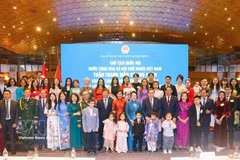
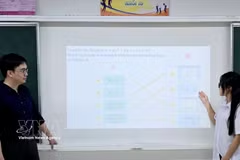
Students from the Talent Incubation Centre (HITA) attend the launch ceremony. (Photo: VNA)

Prague (VNA) – The Talent Incubation Centre (HITA), backed by the Vietnamese Arts and Culture Association in the Czech Republic, has officially made its debut, introducing a new education model focusing on nurturing the intellect, character, and resilience of young people of Vietnamese origin across Europe.

At the April 12 launch, founder Nguyen Phung Phong, who designed the curriculum, highlighted a holistic approach centred on ethics, critical thinking, and personal development. Participants explored stories of global role models to broaden their perspectives, while interactive discussions and Q&A sessions saw strong engagement from both students and parents.

Speaking at the event, Lua Tranova, Director of HITA in the Czech Republic, noted that many overseas Vietnamese families, despite prioritising education and living standards, may face gaps in parent-child connection due to language and cultural differences. She stressed that beyond academic support, HITA seeks to foster deeper understanding within families, helping young people build confidence and character from within.

Emphasising the centre’s philosophy in the AI era, she said education must go beyond knowledge to cultivate values, mindset, and life skills, as “machines store data, but humans preserve essence.”

Organisers described the launch as both a starting point and a milestone in the journey of “cultivating virtue and enlightening minds”, aimed at shaping a well-rounded generation of Vietnamese youth in the Czech Republic and across Europe, firmly grounded in knowledge while rich in cultural identity./.

VNA

See more

Defendants at the court (Photo: VNA)

Ho Chi Minh City court opens trial over Agribank lending scandal

The investigation revealed that multiple credit files were incomplete or riddled with inaccurate information, while some pledged assets lacked proper legal standing yet were accepted and grossly overvalued. As a result, the loans became high-risk and largely unrecoverable, leading to losses surpassing 1 trillion VND.

Hanoi introduces 53 electric buses from April 18 (Photo: VNA)

Hanoi to add 53 electric buses from April 18

According to the plan, all buses operating within Ring Road 1 will use green energy by July 1, 2026. The requirement will expand to Ring Road 2 by January 1, 2028, and to Ring Road 3 by 2030.

Illustrative image (Photo: VNA)

National, local traffic safety committees to be dissolved from June 1

Under the dicision, ministries and ministerial-level agencies will assume responsibility for tasks previously performed by the committee, in line with their mandates under the Law on Government Organisation, the Law on Road Traffic Order and Safety, the Law on Roads and other relevant legal frameworks, ensuring that traffic safety and order are maintained without disrupiton.

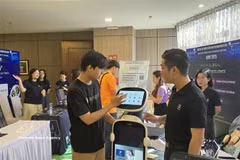
Visitors explore technology showcases at the exhibition held during the Da Nang Startup and Innovation Festival (SURF 2025). (Photo: VNA)

About 10,000 students expected at National Startup Day 2026

This year marks the rollout of the “Student Startup Support Programme for 2026 – 2035”, approved under Decision No. 336/QD-TTg, which places emphasis on practical outcomes, real products, real testing, real partnerships, and measurable impact.

Hong Quang High School pilots teaching mathematics in English starting from the 2025–2026 academic year. (Photo: VNA)

National foreign language proficiency framework issued

The circular establishes a unified benchmark for foreign language proficiency across the national education system, providing a foundation for curriculum design, teaching, testing, assessment, and certification. It is expected to help learners better map out their language development pathways while enabling educational institutions to improve training quality and strengthen articulation between different levels of education.