Efforts required to step up disbursement for national target programmes

Accelerating disbursement for the national target programmes is therefore not merely a financial requirement, but a crucial step towards inclusive development, improved livelihoods and better living standards, ensuring that no one is left behind.

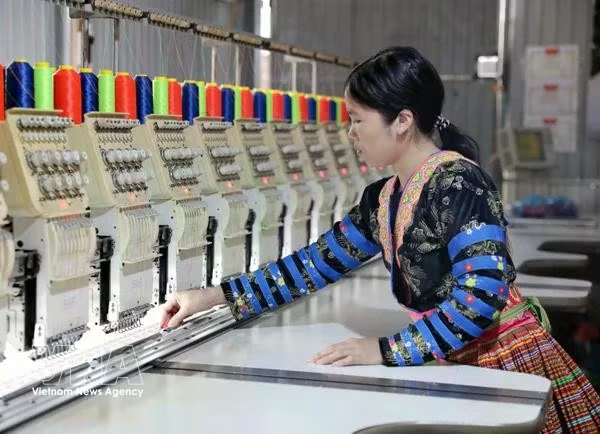
With access to preferential loans, Mua Thi La, a Mong ethnic minority woman from Ban My A village, has opened a workshop to make traditional ethnic costumes, creating jobs and stable income and gradually escaping poverty sustainably. (Photo: VNA)

Hanoi (VNA) – Funding for national target programmes is gradually reaching communities, helping people, particularly in rural, mountainous and ethnic minority areas, expand production, improve incomes and strengthen market linkages. However, slow disbursement remains a key bottleneck requiring urgent action.

From livelihood support to sustainable poverty reduction

In recent years, effective livelihood models have taken shape across many localities, with programmes not only providing financial support but also transforming production practices and economic thinking. In Lao Cai, funding has supported the shift towards commercial livestock farming through breeding stock provision, technical training and capacity building. Many households have expanded production, improved incomes and formed cooperative groups for mutual support.

In central localities such as Hue, Da Nang and Ha Tinh, integrated programmes have fostered models like medicinal plant cultivation, free-range poultry and beekeeping. Several household models have grown into cooperatives, creating jobs, reducing migration and enabling participation in value chains.

Meanwhile, in Ca Mau, climate-adaptive models such as shrimp–forest and crab–forest systems have helped boost incomes while protecting ecosystems, supporting sustainable livelihoods. These examples underscore that well-targeted funding can drive income growth while fostering sustainable rural economic models.

Despite clear benefits, disbursement progress in early 2026 has been slow. According to the Ministry of Finance (MoF), public investment disbursement under national target programmes reached just 382.03 billion VND (14.51 million USD) by the end of the first quarter, equivalent to 4.9% of the plan. Meanwhile, recurrent spending stood at 377.18 billion VND, or 4% of estimates.

These figures indicate that a significant volume of resources remains unused, yet to be translated into tangible benefits for production and livelihoods.
vnanet-potal-thai-nguyen-tao-sinh-ke-cho-vung-dong-bao-dan-toc-thieu-so-va-mien-nui-8294072.jpg
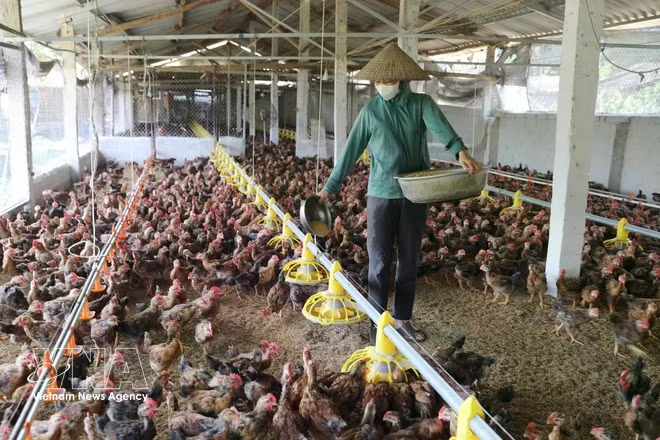
A model of biosecure chicken farming in Dong Hy commune, Thai Nguyen province (Photo: VNA)

The main constraints lie not in funding shortages but in implementation. Many localities still face difficulties in completing investment procedures, approving projects and issuing support criteria. Some programme components lack detailed guidance, resulting in delays or limited implementation. At the grassroots level, especially in remote areas, limited capacity in project design and execution poses additional challenges. Given that these programmes involve numerous small-scale, dispersed projects directly linked to people’s livelihoods, flexible and effective implementation is essential.

Accelerating implementation for greater impact

As 2026 is a pivotal year for realising socio-economic development goals for the new period, national target programmes continue to play a vital role in ensuring social security and narrowing regional disparities. Beyond accelerating disbursement, ensuring that funds reach the right beneficiaries and deliver tangible results is critical.

The Government has repeatedly stressed that these programmes must promote inclusive development, social equity and the goal of leaving no one behind. This requires not only faster but also more effective and targeted implementation.

The MoF has called on ministries, sectors and localities to expedite capital allocation once conditions are met, simplify procedures, especially for small-scale projects, enhance digital application in management, and strengthen inspection and accountability, particularly of heads of agencies.

Experts underlined that timely disbursement is essential to maximising the effectiveness of these programmes. When resources are released promptly and directed appropriately, successful livelihood models can be replicated, generating broader socio-economic impacts.

Accelerating disbursement is therefore not merely a financial requirement, but a crucial step towards inclusive development, improved livelihoods and better living standards, ensuring that no one is left behind./.

VNA

See more

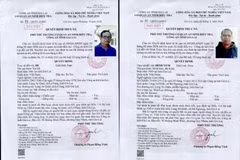
Arrest warrants issued for Di and Dinh Yum, who are accused of abusing religious cover to undermine the State’s national unity policy (Photo: the Investigation Security Agency of the Gia Lai provincial Department of Public Security)

Two wanted for abusing religious cover to undermine national unity policy

The fugitives are Di (also known as Siu Di), born in 1941, and Dinh Yum (also known as Dinh Jum or Ba Koih), born in 1963, from Ba Na ethnic minority group in Gia Lai province, and hold Vietnamese nationality. They have been charged under Clause 1, Article 116 of the Penal Code for undermining the national unity policy.

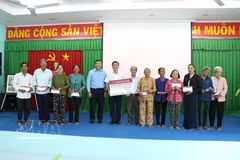
Thach Phuoc Binh, Deputy Head of the Vinh Long delegation of National Assembly deputies, presents gifts to residents in Long Hiep commune on the occasion of the 2026 Chol Chnam Thmay festival. (Photo: VNA)

Support delivered to Khmer households for traditional New Year

The province's delegation of National Assembly deputies, in coordination with relevant agencies, presented 600 gifts across 11 communes, including 100 in Tap Son commune and 50 in each of the others. The programme, worth 300 million VND (11,300 USD), was funded by Agribank’s Vinh Long branch.

Delegates launch the national job exchange platform. (Photo: VNA)

National job exchange platform launched to connect labour supply and demand

The national job exchange platform was launched on April 14 at vieclam.gov.vn, expected to enhance connections between job seekers and employers, contributing to a modern, transparent, flexible, and efficient labour market while improving employment services, ensuring social welfare, and supporting sustainable socio-economic development.

Students from the Talent Incubation Centre (HITA) attend the launch ceremony. (Photo: VNA)

Talent incubation centre debuts in Czech Republic to empower Vietnamese youth

Many overseas Vietnamese families, despite prioritising education and living standards, may face gaps in parent-child connection due to language and cultural differences. Therefore, the Talent Incubation Centre (HITA) in the Czech Republic seeks to foster deeper understanding within families, helping young people build confidence and character from within.

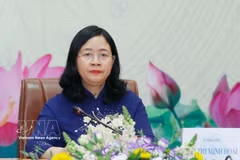
Vietnam Fatherland Front Central Committee President Bui Thi Minh Hoai (Photo: VNA)

Vietnam Fatherland Front calls for support for Humanitarian Month 2026

In an appeal letter, VFF Central Committee President Bui Thi Minh Hoai highlighted the tradition of national solidarity and compassion, noting that individuals and organisations have consistently provided timely support to those in need both domestically and internationally.

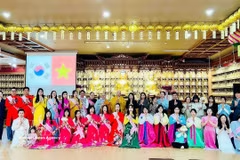
Delegates and representatives of Vietnamese Buddhists attend the prayer ceremony in Incheon city on April 12. (Photo: VNA)

Prayer ceremony in RoK promotes peace, maritime sovereignty awareness

The event went beyond a religious practice to reflect a shared sense of responsibility toward the homeland, particularly in safeguarding national sovereignty and territorial integrity, while conveying a positive message advocating peace, stability, and development in the region and the world.

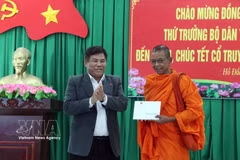
Deputy Minister of Ethnic and Religious Affairs Y Thong presents gifts to Ta Khvich Thmay Pagoda in Ho Dac Kien commune, Can Tho city. (Photo: VNA)

Delegation extends Chol Chnam Thmay greetings in Can Tho

Speaking during the visit, Minister of Ethnic and Religious AffairsY Thong highlighted the sacred significance of the traditional Chol Chnam Thmay festival, describing it as a distinctive cultural tradition and an occasion for the Khmer people to honour their roots and strengthen community solidarity.

Participants engage in lively exchanges and shared ideas at the event (Photo: VNA)

Australia–Vietnam talent network launches in Western Australia

Founded in Western Australia, the network brings together students, young professionals, entrepreneurs, and community members, with a focus on fostering meaningful connections, supporting career development, and encouraging cross-border collaboration.

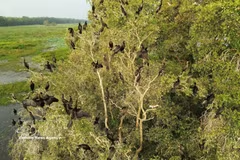
Tram Chim National Park steps up wetland restoration efforts (Photo: VNA)

Efforts underway to revive wetlands at Tram Chim National Park

Tram Chim National Park in the Mekong Delta province of Dong Thap is stepping up efforts to restore a sustainable wetland ecosystem, one of the last remaining areas representing the typical wetland landscape of the historic Dong Thap Muoi region.

Delegates take part in traditional Lao rituals during the Bunpimay New Year celebration. (Photo: VNA)

Bunpimay celebration in Da Nang boosts Vietnam–Laos ties

Da Nang is committed to strengthening ties with central and southern Lao provinces. The city has been rolling out effective cooperation programmes across multiple sectors, including diplomacy, trade, education, health care, defence and social welfare.

Khmer people celebrate the New Year at Sro Lon Pagoda, My Xuyen ward, Can Tho city. (Photo: VNA)

PM Le Minh Hung extends Chol Chnam Thmay greetings to Khmer community

Prime Minister Le Minh Hung stressed the need for ministries, sectors and localities to fully and promptly implement social welfare policies, improve living conditions, and provide care for policy beneficiaries, disadvantaged households and vulnerable groups, while ensuring that the Khmer community celebrates Chol Chnam Thmay in a spirit of unity, joy, safety and thrift, in line with civilised practices and traditional cultural values.