Hanoi (VNA) – As Vietnam enters a new development phase, integrating national target programmes will create stronger momentum to reduce development disparities among regions, particularly in ethnic minority and mountainous areas.
According to the Ministry of Ethnic and Religious Affairs, the integrated programme combines three national target programmes on new-style rural development, sustainable poverty reduction, and socio-economic development in ethnic minority and mountainous areas.
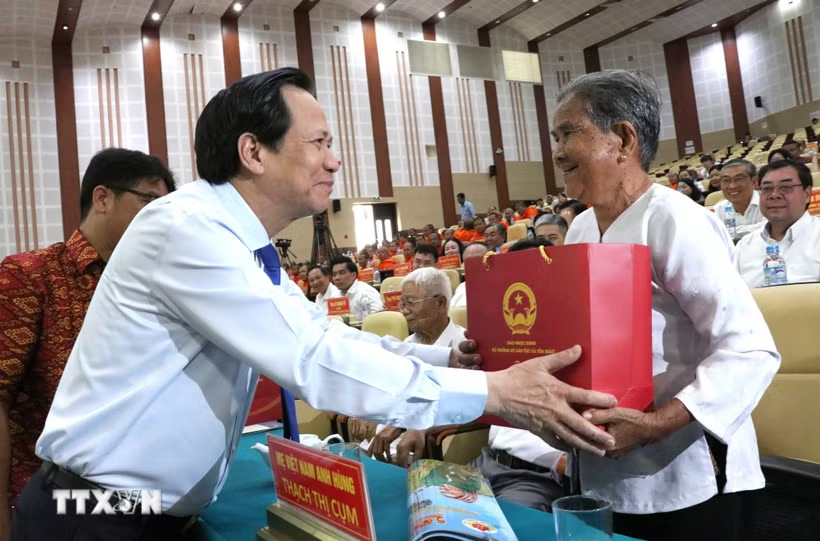
On the occasion of Lunar New Year (Tet) 2026, the Vietnam News Agency (VNA) interviewed Minister of Ethnic and Religious Affairs Dao Ngoc Dung on the programme’s significance and orientations towards green and inclusive development.
Strengthening great national unity bloc
– Reporter: Could you share your assessment of the outcomes achieved under the National Target Programme for socio-economic development in ethnic minority and mountainous areas during Phase I (2021–2025)?
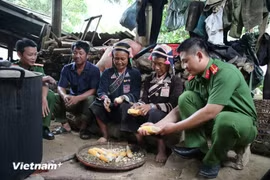
Minister Dao Ngoc Dung: The implementation of the programme has helped accelerate socio-economic development in ethnic minority and mountainous regions, improving livelihoods, increasing incomes, reducing poverty, and addressing pressing needs in especially disadvantaged areas.
Support policies and livelihood development initiatives have improved living standards and helped communities escape poverty. Investments in infrastructure and local economic development have played a key role in guiding production towards market-oriented models.
Numerous essential infrastructure projects have been built, contributing significantly to improved access to healthcare and education.
Notably, the poverty reduction rate in ethnic minority areas averaged 3.4% annually, higher than the national average, helping narrow regional development gaps. Educational attainment, human resource quality, and public awareness have also improved steadily.
Vocational training and employment support programmes have created stable jobs for a large workforce. At the same time, disadvantaged ethnic minority communities now have better access to State support policies and social security programmes.
These achievements have helped narrow development disparities between regions and contributed to the country’s sustainable growth, reflecting the collective efforts of the political system and ethnic minority communities.
Social order and security have been maintained, while national defence, grassroots Party building, and political systems have been strengthened, reinforcing national unity and public trust in the Party and State.
Creating momentum for poor households to escape poverty
– Reporter: Could you highlight notable models in preserving cultural identity linked with tourism development?
Minister Dao Ngoc Dung: Localities are preserving and promoting ethnic cultural values in connection with tourism development, including successful models in Hue and Quang Nam (now Da Nang).
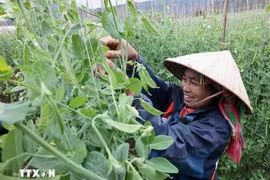
Several provinces have also implemented innovative livelihood initiatives. For example, Quang Ngai and Ha Giang provinces launched garden renovation schemes that helped ethnic minority households transform agricultural practices while motivating poor and near-poor households to strive for sustainable livelihoods.
– Reporter: How can community-based tourism and agricultural products in ethnic minority areas be further promoted nationwide?
Minister Dao Ngoc Dung: Localities should identify distinctive cultural values to develop tourism products while preserving authentic indigenous characteristics and community identity. At the same time, outdated customs hindering socio-economic development should gradually be eliminated.
Sustainable community tourism must be linked with social responsibility to ensure long-term socio-economic benefits for residents. Planning tourism spaces, restoring traditional culture, and developing craft villages associated with ethnic heritage are also essential.
Encouraging locally sourced products and regional specialties will support ecological, organic, and clean tourism offerings, including herbal bathing experiences and nature-based activities such as trekking, boating, fishing, and cycling.
Investment should prioritise transport infrastructure, electricity, clean water, healthcare, digital connectivity, waste treatment systems, cultural spaces, and visitor service facilities to support community tourism destinations.
Equally important are tourism promotion, professional training, digital transformation, smart technology applications, and integration of e-commerce into tourism and agricultural product development.
Efforts should be made to enhance the capacity and professional skills of residents participating in community-based tourism, while raising awareness among both communities and visitors about environmental protection in line with the principles of responsible tourism.
Promoting digital transformation, green growth, and inclusive development
– Reporter: How will integrating the three national target programmes improve implementation effectiveness in the next phase?
Minister Dao Ngoc Dung: Developing an integrated programme for 2026–2035 is urgent, ensuring the full institutionalisation of national policies on ethnic minority and rural development.
The integrated framework will address fragmentation and overlap in management and investment, unify policy coordination, mobilise resources more effectively, and promote digital transformation, green growth, and inclusive development.
The programme aligns with Government Resolution No. 10/NQ-CP on ethnic affairs strategy for 2021–2030, with a vision to 2045.
Investment in socio-economic development is viewed as a key task to sustainably improve living standards in ethnic minority and mountainous regions while narrowing income and living standard gaps nationwide. This must go hand in hand with strengthening grassroots political systems.
The programme also contributes to strengthening national defence and border security, building peaceful and cooperative border areas, and mobilising development resources, with State resources playing a decisive role.
The integration process also ensures the optimal mobilisation of resources to achieve the overarching socio-economic development goals for ethnic minority and mountainous areas approved by the National Assembly.
In addition, the implementation of the integrated programme serves as a tool to realise regional development orientations set out in the Party Central Committee’s resolutions and the Government’s action programmes. It aligns with population distribution models based on ecological zones, cultural and ethnic characteristics, and socio-economic conditions under the National Master Plan, while also matching the restructuring of commune-level administrative units and their respective development levels.
Accordingly, the programme becomes both a policy bridge and a coordination instrument linking rural development, poverty reduction, and socio-economic advancement in ethnic minority and mountainous regions within the broader national planning framework. It represents an urgent requirement to raise incomes and living standards, narrow regional disparities, strengthen social security, and reinforce national defence and security, thereby contributing to the successful realisation of the country’s goal of rapid and sustainable development towards 2045.
Furthermore, designing the programme under a 10-year cycle (2026–2035) will institutionalise the Party’s guidelines and the Government’s directives on unified management of national target programmes. This approach ensures policy connectivity, synchronised resource allocation, and long-term stability, enabling localities to proactively develop medium- and long-term plans, leverage internal strengths, and mobilise social resources.
Double-digit economic growth is expected nationwide, contributing to a prosperous, civilised, and thriving nation.
Ensuring adequate and timely mobilisation of resources
– Reporter: What solutions are needed to maximise the effectiveness of the integrated national target programme?
Minister Dao Ngoc Dung: Key solutions include improving policies while issuing comprehensive implementation guidelines aligned with decentralised governance models.
Alongside these efforts, the Government will accelerate the implementation of Decree No. 255/2025/ND-CP, which defines ethnic groups facing significant difficulties in the 2026–2030 period, and Decree No. 272/2025/ND-CP on the classification of ethnic minority and mountainous areas for 2026–2030.
Priority will also be given to allocating development capital to ethnic minority and mountainous regions, areas identified as poverty zones, in order to narrow regional disparities. They would mobilise funding while integrating resources from national target programmes and targeted support schemes to ensure focus, avoid fragmentation, and prevent overlap.
The Government will continue balancing the central budget to prioritise additional funding for the programme, while local authorities are required to allocate sufficient local budget resources for implementation. Measures will also be introduced to rectify delays, with sanctions applied to ministries, sectors, and localities showing slow progress or low disbursement rates.
Priority will be given to allocating concessional credit resources for programme implementation under the medium-term public investment plans for the 2026–2030 and 2031–2035, as well as annually, through the Vietnam Bank for Social Policies to ensure effective delivery of social policy credit. Local entrusted capital from budgets, organisations, and individuals will be strengthened, ensuring policy credit accounts for an appropriate proportion of the programme’s total resources.
The programme will further encourage decentralisation to commune-level authorities and community participation alongside transparent evaluation mechanisms, promoting the central role of citizens and businesses. Economic organisations, enterprises and individuals will be encouraged to register support contributions, while more developed localities are urged to assist disadvantaged areas. Greater application of digital transformation and information technology will be promoted through the development of indicator sets and a centralised online monitoring system connected with databases.
Particular emphasis will be placed on strengthening communications among officials and the public, enhancing inspection, supervision, and evaluation at all levels, and closely coordinating with the Vietnam Fatherland Front and socio-political organisations in policy feedback and public satisfaction surveys.
Timely commendation will be granted to organisations and individuals demonstrating strong performance, alongside preventive measures to curb wastefulness, and strict handling of violations arising during programme implementation.
— Reporter: Thank you so much for your interview!