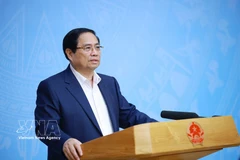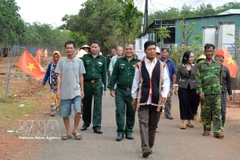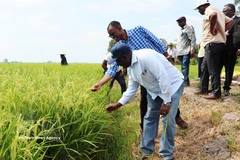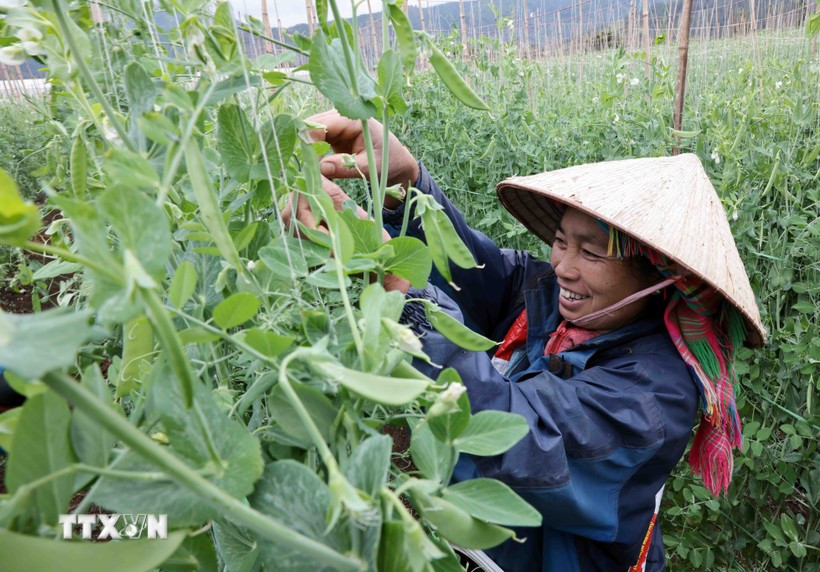
Hanoi (VNA) – All three national target programmes on new-style rural area building, sustainable poverty reduction, and socio-economic development in ethnic minority and mountainous areas have largely met and surpassed their assigned targets and tasks for the 2021–2025 period.
Poverty reduction in ethnic minority-inhabited areas averages 3.2%
A report from the Central Steering Committee for National Target Programmes for the 2021–2025 period showed that poverty reduction in ethnic minority-inhabited areas averaged 3.2% per year. Per capita income among ethnic minorities is estimated to reach 45.9 million VND (1,760 USD) in 2025, a 3.3-fold increase from the 2020 level, well surpassing the goal of more than doubling.
The Ministry of Finance reported that central budget disbursements for the three programmes totaled more than 119.4 trillion VND (4.54 billion USD) as of October 30, equivalent to 67.9% of the planned amount. This included 75.8 trillion VND in public investment capital (75% of plan) and over 43.5 trillion VND in recurrent spending (58.2%).
Resource fragmentation, overlapping policies hamper progress
The progress has been hindered by a complex, slowly issued and insufficiently detailed policy framework. Overlaps in content and beneficiaries, scattered funding, duplicated tasks and fragmented policies have posed major challenges.
For 2025, the Prime Minister allocated 42.2 trillion VND in central budget funding to the three programmes, comprising nearly 24.5 trillion VND for development investment and over 17.7 trillion VND for non-business expenditures. As of late September, central budget disbursements reached about 13.3 trillion VND, or 56.7% of the allocated plan.
National Assembly deputy Huynh Thanh Chung from Dong Nai province cited multiple causes for delays, including cumbersome investment procedures, site clearance delays, local administration reorganisations, workforce shortages and, in particular, confusion over grassroots-level operating mechanisms.
Support for production and livelihoods remains largely short-term. Economic models have yet to pivot strongly toward value-chain integration; linkages between farmers, cooperatives and enterprises are weak; stable consumption mechanisms are absent; and ethnic minority communities still struggle to access advanced technologies and expertise.
Merger of three programmes
The Government proposed an investment policy for the national target programme on new-style rural area building, sustainable poverty reduction, and socio-economic development in ethnic minority and mountainous areas for 2026–2035, based on merging the three existing programmes in the 2021–2025 period, which was approved by the 15th legislature at its recently-closed 10th session.
")
According to Chung, the unified programme through 2035 would anchor Vietnam’s sustainable development strategy, aiming to boost living standards, reduce regional disparities and foster modern, civilised rural communities. He urged lawmakers and the Government to refine mechanisms, boost funding and ease implementation for localities.
The NA set four key targets by 2030: lifting average rural incomes to 2.5-3 times the 2020 level, raising ethnic minority incomes to at least half of the national average; sustaining annual multidimensional poverty reduction of 1-1.5% nationwide, with rates below 10% in ethnic minority and mountainous areas; and essentially eradicating the most disadvantaged communes and villages there.
Additional goals include achieving new-style rural standards in about 65% of communes nationwide, 10% of which qualify as "modern new-style rural" areas; and recognising five provinces or centrally-run cities as having fully completed new rural-style development tasks.
Minister of Agriculture and Environment Tran Duc Thang said that by late 2025, the multidimensional poverty rate under the current standards is expected to drop to around 0.9–1%, reflecting an average annual decline exceeding 1% during 2021-2025. Under the upcoming 2026-2030 poverty standards, the rate is forecast at roughly 9.6%, similar to the 2022-2025 period./.