An Giang sets out stringent roadmap to address IUU ‘yellow card’

Vice Chairman of the provincial People’s Committee Ngo Cong Thuc stressed that the province is intensifying comprehensive leadership and direction to ensure progress and quality in addressing shortcomings identified by the European Commission (EC).

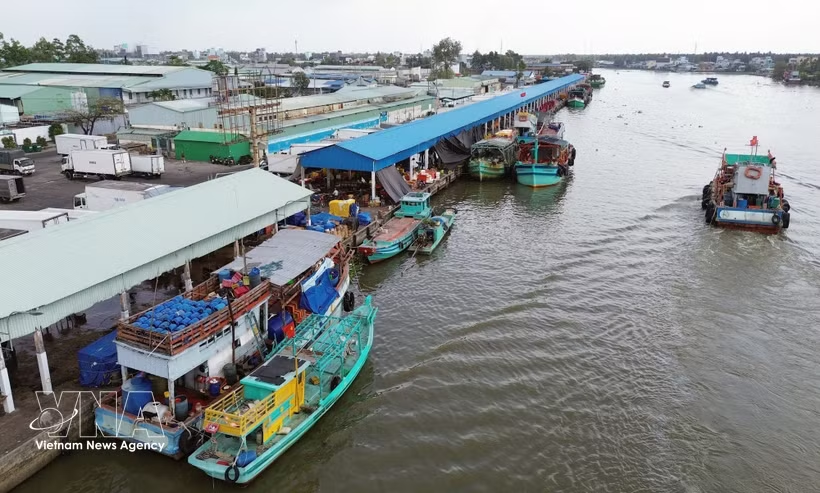
Bustling activity as fishing vessels enter and leave Tac Cau fishing port in An Giang province. (Photo: VNA)

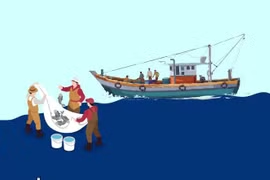
An Giang (VNA) – The Mekong Delta province of An Giang has established a stringent roadmap, backed by concrete plans and the mobilisation of all available resources, to end illegal, unreported and unregulated (IUU) fishing.

Vice Chairman of the provincial People’s Committee Ngo Cong Thuc stressed that the province is intensifying comprehensive leadership and direction to ensure progress and quality in addressing shortcomings identified by the European Commission (EC).

Accordingly, relevant departments and agencies are required to complete detailed action plans to address the commission’s recommendations, clearly categorising tasks into immediate, medium- and long-term priorities. An inter-agency task force must also be established, with clearly defined responsibilities in combating IUU fishing. Authorities are advising the provincial administration on regulations governing fishing vessels that fail to meet operational standards, while also proposing upgrades to fishing port infrastructure and the establishment of designated anchorage areas for eligible vessels.

The provincial Department of Agriculture and Environment has been tasked with coordinating a comprehensive review of vessel monitoring system (VMS) installations, ensuring proper vessel identification and registration, and strengthening oversight of the fishing fleet.

Meanwhile, the provincial Border Guard Command is accelerating investigations and enforcement actions against vessels violating foreign waters, while tightening control over vessel movements through the electronic catch documentation and traceability (eCDT) system.

In parallel, the province continues to implement measures to combat IUU fishing and promote the sustainable development of Vietnam’s fisheries sector. Plans are also being rolled out to support livelihood transitions for fishermen affected by fleet reductions or occupational restructuring.

According to the provincial Department of Agriculture and Environment, An Giang has 10,880 registered fishing vessels recorded in the national database VN Fishbase, of which 10,324, equivalent to 94.89%, have been licensed. A total of 556 vessels remain ineligible for operation. In the first quarter of 2026, the province issued 45 catch certificates for exports to the European market.

Local authorities have also updated administrative violation data on the national system, handling 99 cases with total fines exceeding 9.5 billion VND (360,627 USD).

Regarding VMS installation, 3,577 out of 3,586 vessels have been equipped, ensuring that 100% of licensed fishing vessels are fitted with monitoring devices./.
VNA

See more

Vietnam Fatherland Front Central Committee President Bui Thi Minh Hoai (Photo: VNA)

Vietnam Fatherland Front calls for support for Humanitarian Month 2026

In an appeal letter, VFF Central Committee President Bui Thi Minh Hoai highlighted the tradition of national solidarity and compassion, noting that individuals and organisations have consistently provided timely support to those in need both domestically and internationally.

Delegates and representatives of Vietnamese Buddhists attend the prayer ceremony in Incheon city on April 12. (Photo: VNA)

Prayer ceremony in RoK promotes peace, maritime sovereignty awareness

The event went beyond a religious practice to reflect a shared sense of responsibility toward the homeland, particularly in safeguarding national sovereignty and territorial integrity, while conveying a positive message advocating peace, stability, and development in the region and the world.

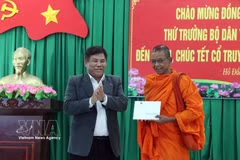
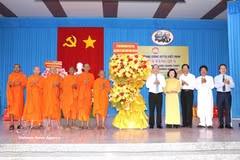
Deputy Minister of Ethnic and Religious Affairs Y Thong presents gifts to Ta Khvich Thmay Pagoda in Ho Dac Kien commune, Can Tho city. (Photo: VNA)

Delegation extends Chol Chnam Thmay greetings in Can Tho

Speaking during the visit, Minister of Ethnic and Religious AffairsY Thong highlighted the sacred significance of the traditional Chol Chnam Thmay festival, describing it as a distinctive cultural tradition and an occasion for the Khmer people to honour their roots and strengthen community solidarity.

Participants engage in lively exchanges and shared ideas at the event (Photo: VNA)

Australia–Vietnam talent network launches in Western Australia

Founded in Western Australia, the network brings together students, young professionals, entrepreneurs, and community members, with a focus on fostering meaningful connections, supporting career development, and encouraging cross-border collaboration.

Tram Chim National Park steps up wetland restoration efforts (Photo: VNA)

Efforts underway to revive wetlands at Tram Chim National Park

Tram Chim National Park in the Mekong Delta province of Dong Thap is stepping up efforts to restore a sustainable wetland ecosystem, one of the last remaining areas representing the typical wetland landscape of the historic Dong Thap Muoi region.

Delegates take part in traditional Lao rituals during the Bunpimay New Year celebration. (Photo: VNA)

Bunpimay celebration in Da Nang boosts Vietnam–Laos ties

Da Nang is committed to strengthening ties with central and southern Lao provinces. The city has been rolling out effective cooperation programmes across multiple sectors, including diplomacy, trade, education, health care, defence and social welfare.

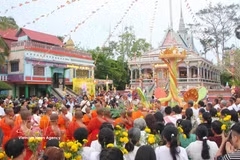
Khmer people celebrate the New Year at Sro Lon Pagoda, My Xuyen ward, Can Tho city. (Photo: VNA)

PM Le Minh Hung extends Chol Chnam Thmay greetings to Khmer community

Prime Minister Le Minh Hung stressed the need for ministries, sectors and localities to fully and promptly implement social welfare policies, improve living conditions, and provide care for policy beneficiaries, disadvantaged households and vulnerable groups, while ensuring that the Khmer community celebrates Chol Chnam Thmay in a spirit of unity, joy, safety and thrift, in line with civilised practices and traditional cultural values.

Participants at the Vietnam–Western Australia Education Dialogue note that there remains ample room to further expand education and training cooperation. (Photo: VNA)

Vietnam, Western Australia deepen substantive education cooperation

Dang Thuy Chi, First Secretary in charge of education at the Vietnamese Embassy in Australia, outlined Vietnam’s strategic directions in education development, highlighting the roadmap for international integration under Decision No. 1600/QD-TTg, which focuses on expanding internationally accredited programmes, strengthening ties with reputable global institutions and promoting two-way student exchanges. S

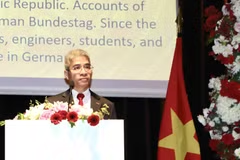
Vietnamese Ambassador to Germany Nguyen Dac Thanh (Photo: VNA)

Germany eyes stronger labour cooperation with Vietnam

The two sides discussed measures to deepen bilateral cooperation in workforce development and skills training, and enhanced coordination between management agencies of Vietnam and Germany in the time to come.

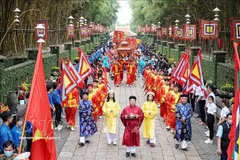
A ritual involving a procession and offering of sticky rice cakes to the Hung Kings at the Hung Kings Temple Festival in Phu Tho province (Photo: VNA)

Phu Tho makes thorough preparations for Hung Kings’ Commemoration Day

The Hung Kings’ Commemoration Day, Hung Kings Temple Festival and Ancestral Land Culture–Tourism Week 2026 will run from April 17–26 (the first to 10th days of the third lunar month) at the Special National Historical Relic Site of Hung Kings Temple and other localities in the province, with the opening ceremony set for 8pm on April 17.

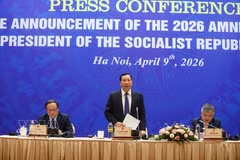
Deputy Minister of Public Security Senior Lieutenant General Le Van Tuyen (standing) speaks at the press conference on April 9. (Photo: VNA)

State President’s amnesty decision in 2026 announced

In 2025 alone, more than 22,000 inmates were granted early release, while political security and social order remained firmly maintained. Most beneficiaries have successfully reintegrated into society, earning public support and international recognition.