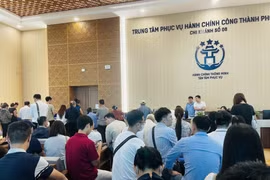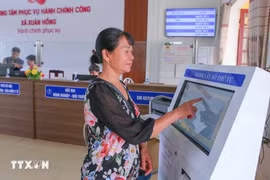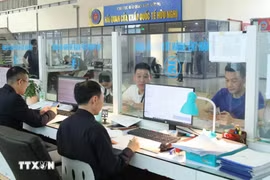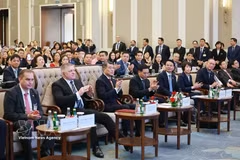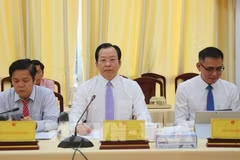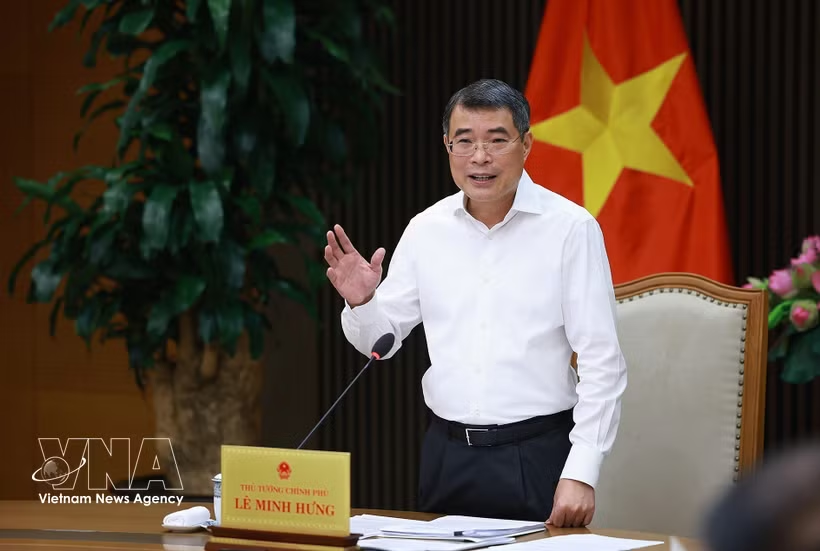
Hanoi (VNA) – Prime Minister Le Minh Hung ordered cutting unnecessary business conditions and streamlining red tape while chairing a meeting of the Government’s permanent members in Hanoi on April 13 to follow the Party Central Committee’s conclusion from its recent second plenum.
According to reports, Vietnam now maintains 198 conditional business lines and 4,603 business conditions. Under the conclusion, ministries and agencies must cut at least 30% of existing conditional business lines, or about 60 business lines, while eliminating all redundant conditions. The target also includes a 50% reduction in both administrative processing time and compliance costs. At the same time, ministries are to handle no more than 30% of the total administrative procedures in their domains.
PM Hung said the conclusion lays out clear task groups to support Vietnam’s goal of achieving double-digit growth. Key priorities include improving the business environment and slashing compliance time and costs for citizens and enterprises, many of which fall within the authority of the Government, ministries and agencies and can be acted upon immediately.
Despite a second-quarter deadline, he demanded faster action. Ministries and agencies must move swiftly to complete the reforms as early as possible without compromising quality or timelines.
Drawing on a comprehensive report from the Ministry of Justice (MoJ) and inputs from other ministries, he instructed Deputy PMs, together with the MoJ, Ministry of Public Security (MoPS), the Ministry of Home Affairs and the Government Office, to hold direct working sessions with ministries and agencies to finalise detailed administrative reform plans. These will cover cuts to administrative procedures, business conditions, conditional business lines and further decentralisation.
By April 20, ministries and agencies must submit reform proposals on administrative procedures, business conditions and conditional sectors to Government leaders. The Government Office and the MoJ will review them for approval within April, he said.
Ministers were required to personally oversee a thorough review of administrative procedures under their authority to streamline, cut and decentralise them, while also reducing the existing list of 198 conditional business lines and 4,603 business conditions.
The MoJ, in coordination with the Government Office, must strengthen its “gatekeeping” role in controlling administrative procedures and business conditions, holding ministers accountable for any failure to remove inappropriate ones. During the reform process, authorities should carefully consider and incorporate feedback from businesses and industry associations.
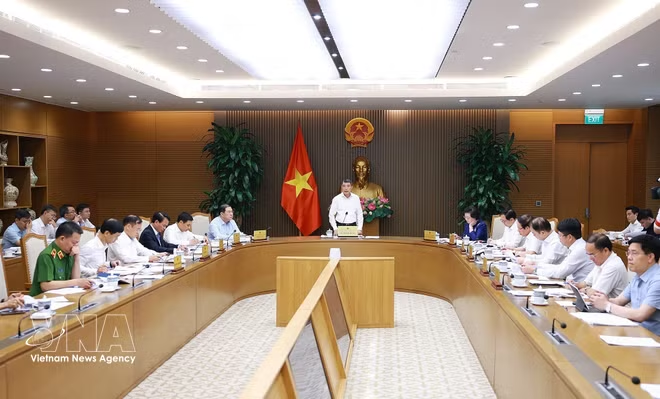
On decentralisation, the PM called for continued review of powers delegated from the central level to provinces and from provinces to grassroots authorities, in line with the conclusion.
He underscored the need to improve the quality of grassroots officials through targeted training and deploying staff from provincial departments to support local levels. This aligns with the Party General Secretary and State President To Lam’s designation of 2026 as the year of improving grassroots personnel quality.
Ministries were asked to finalise databases, particularly those related to businesses, citizens and economic management, and restructure administrative processes to maximise data reuse. The aim is for citizens and firms to provide information only once, with officials required to pull existing data from shared systems, backed by clear legal regulations.
Regarding the Politburo’s Resolution 57-NQ/TW dated December 22, 2024 on breakthroughs in sci-tech, innovation and national digital transformation, the PM instructed the MoPS to urgently submit detailed plans to ensure swift and effective rollout in line with the plenum’s conclusion and the directives of the Central Steering Committee in charge of the resolution./.