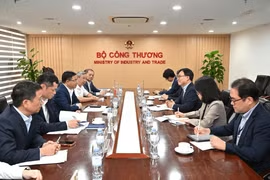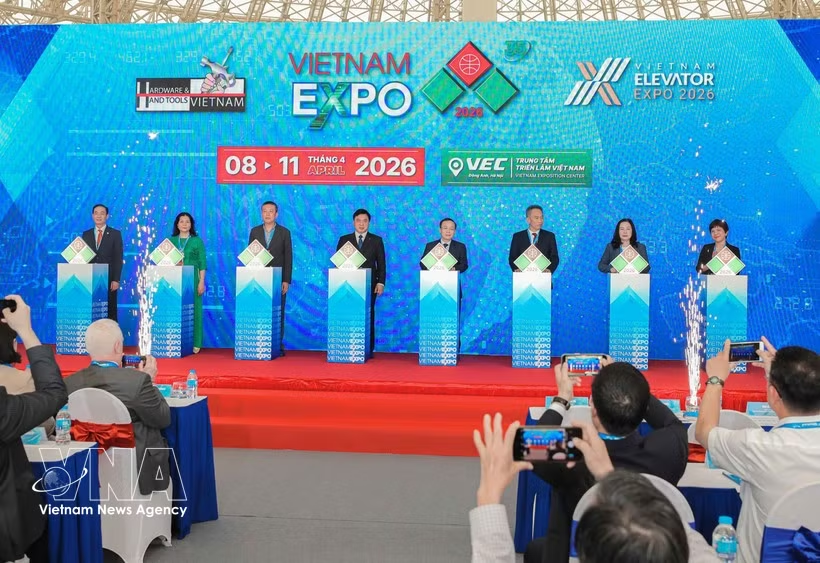
Hanoi (VNA) - A policy dialogue with Korean auto parts manufacturers took place at the Vietnam Exposition Centre in Hanoi’s outlying Dong Anh Commune on April 9, focusing on stronger supply chain ties and investment in the automotive industry.
The event, part of the Vietnam Expo 2026, was co-hosted by the Vietnam Trade Promotion Agency (VIETRADE), Industry Agency and Vietnam Institute of Strategy and Policy for Industry and Trade of the Vietnamese Ministry of Industry and Trade, the Korea Trade-Investment Promotion Agency (KOTRA), and VINEXA National Trade Fair & Advertising JSC. It pulled in regulators, investment promotion bodies, industry associations and businesses from Vietnam and the Republic of Korea (RoK) in both in-person and online formats.
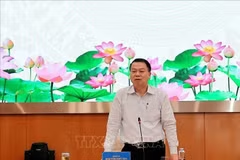
VIETRADE Director Vu Ba Phu said Vietnam - RoK economic, trade and investment ties have been growing in recent years, with the RoK remaining one of Vietnam’s top important partners, especially when it comes to foreign direct investment. Both sides now want to balance out trade and climb higher up the regional supply chain.
The RoK stood as Vietnam’s largest foreign investor with more than 95.2 billion USD in registered capital as of February 2026, or about 18% of all foreign cash flowing in, with thousands of active projects. In January-February alone, the RoK led the pack with nearly 2 billion USD in pledges, grabbing a whopping 32.7% of total registered capital and showing no signs of slowing down.
More than 73% of that Korean capital has gone into manufacturing and processing, including major hi-tech projects. Korean companies have supercharged Vietnam’s auto parts production, sped up tech transfers, and tightened up management and quality standards, contributing to shaping industrial clusters in hot spots like Bac Ninh, Thai Nguyen, Hai Phong, Hung Yen, and Ho Chi Minh City, Phu said.
He pointed out that with the global auto world racing toward green, electric, and smart vehicles, Korean cash pouring into auto parts is laying critical groundwork for Vietnam’s automotive sector and letting local players hook deeper into global and regional supply chains. Still, Vietnam’s auto parts industry remains at an early stage, hampered by low localisation rates, limited tech know-how, and underdeveloped linkages between local and Korean enterprises.
The dialogue also rolled out a new joint Vietnam-RoK project to map the entire auto parts value chain. Led by KOTRA and Vietnamese agencies, the goal is to spot the weak points and get firms and policymakers working together.
Koo Bon-kyung, KOTRA’s Regional Director General for Southeast Asia and Oceania, said Vietnam’s automotive market has been growing rapidly, with vehicle sales rising more than 10% year-on-year through 2025. Thanks to local automaker VinFast and global players such as Hyundai-Kia and Toyota, Vietnam is emerging as a new automotive production hub in Southeast Asia.
But even with the fast growth, localising key components and building full supply chains is a major headache. Creating a rock-solid industrial chain from raw materials all the way to finished cars will be the real ticket to lifting Vietnam’s global competitiveness, Koo added.
At the event, companies discussed investment and operational hurdles and proposed concrete steps to improve policies and business environment, with emphasis on greater transparency and policy stability./.