Vietnam, India step up cooperation to build sustainable footwear value chain

The two economies are highly complementary, with India holding advantages in raw materials while Vietnam excels in manufacturing and exports, creating ample opportunities for deeper integration into global value chains.

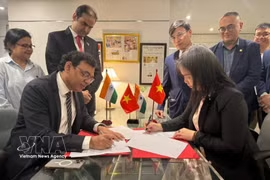
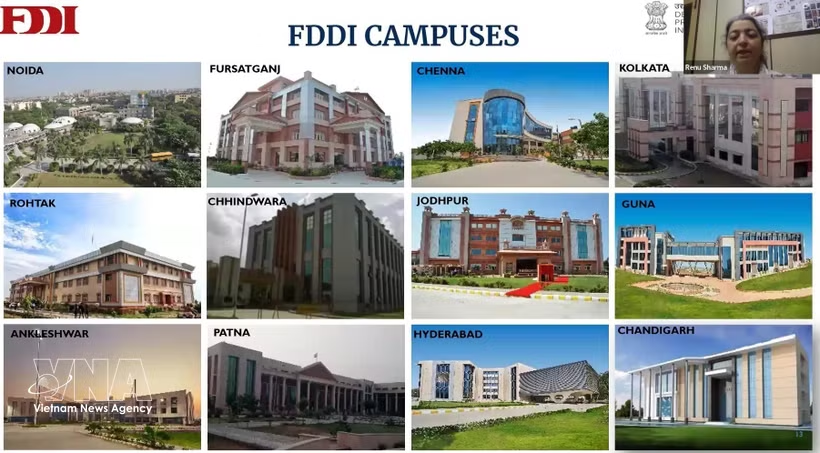
Renu Sharma from the Footwear Design and Development Institute (FDDI) introduces its campuses at the online seminar on April 9. (Photo: VNA)

New Delhi (VNA) – Vietnam and India are seeking to deepen cooperation in the footwear industry by promoting sustainable value chains, enhancing business connectivity, and leveraging complementary strengths, heard an online seminar held on April 9.

The event, themed “Shaping the Future of Vietnam – India Footwear Cooperation,” was jointly organised by the Vietnam Trade Office in India and the Vietnam Leather, Footwear and Handbag Institute, drawing participation from policymakers, industry associations, research institutes, and businesses from both countries.

In his opening remarks, Vietnamese Trade Counsellor in India Bui Trung Thuong highlighted the footwear sector’s significant role in economic growth, exports, and job creation in both nations. He noted that the two economies are highly complementary, with India holding advantages in raw materials while Vietnam excels in manufacturing and exports, creating ample opportunities for deeper integration into global value chains.

Tran Xuan Thuy from the Industry Agency under the Ministry of Industry and Trade said Vietnam is accelerating its shift from contract manufacturing to design, branding, and higher value-added stages.

This transition is supported by policies promoting industrial development, innovation, and digital transformation. He proposed establishing a ministerial-level bilateral cooperation mechanism, strengthening business linkages, and encouraging Indian investment in Vietnam’s supporting industries.

Sanjay Gupta of the Indian Footwear Components Manufacturers Association (IFCOMA) noted that India’s footwear industry is expanding rapidly, with a target value of 50 billion USD by 2030. He described this as an opportune time for both countries to foster joint ventures, technology transfer, and production cooperation to build a sustainable manufacturing ecosystem serving global markets.

Renu Sharma from the Footwear Design and Development Institute (FDDI) underscored the potential for collaboration in training, research, and innovation, including student and faculty exchanges and joint programme development. Meanwhile, Gopal Gupta, President of the Agra Footwear Manufacturers and Exporters Chamber, invited Vietnamese firms to participate in the “Meet at Agra Fair” in early October as a platform to explore partnerships in materials and supporting industries.

Participants exchanged insights on market trends and discussed concrete cooperation avenues, from developing supply chains for materials to attracting investment and enhancing workforce quality. Many businesses expressed interest in forming partnerships, joint ventures, and expanding into each other’s markets.

Vietnam and India are among Asia’s leading footwear producers and consumers. Vietnam ranks third globally in production and second in exports, while India is the second-largest producer and consumer, accounting for around 9% of global output, with strong growth expected in its domestic market./.

See more

Hanoi’s roadmap to implement low-emission zones from July is providing a strong boost to the electric two-wheeler market (Photo: VNA)

Low-emission zone roadmap drives electric two-wheeler boom in Hanoi

From July 1, Hanoi will introduce time-based or area-based restrictions on petrol-powered motorcycles within Ring Road 1, with plans to expand coverage across the entire zone by 2028 and extend to areas within Ring Road 3 by 2030. The policy is expected to reshape travel habits for millions of urban residents.

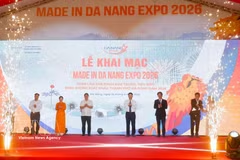
Delegates at the opening ceremony of the Made in Da Nang Expo 2026 (Photo: VNA)

Nearly 300 firms join Made in Da Nang Expo 2026

Speaking at the opening ceremony, Vice Chairman of the Da Nang People’s Committee Tran Chi Cuong said the exhibition is a large-scale trade promotion event aimed at showcasing products, connecting markets, and helping businesses enhance competitiveness while expanding domestic and export markets.

 Green production, standardised value chains key to fruit, vegetable sector growth

Green production, standardised value chains key to fruit, vegetable sector growth

Facing mounting pressure from increasingly stringent domestic and international standards, Vietnam’s fruit and vegetable sector is accelerating its shift toward green, safe, and sustainable production models. Beyond changing farming practices, localities and businesses are stepping up efforts to standardise value chains and build brands to achieve growth targets for 2026.

The launch of the Vietnam National Brand Week 2026 on April 16 (Photo: VNA)

Vietnam National Brand Week 2026 opens

Running from April 16 to 23 nationwide, the Vietnam National Brand Week 2026 marks the 18th anniversary of Vietnam Brand Day (April 20, 2008 – 2026).

Ca Mau is currently home to more than 5,200 fishing vessels, including nearly 1,900 boats measuring over 15 metres in length, and all have been equipped with vessel monitoring systems. (Illustrative photo: VNA)

Ca Mau drives changes among fishermen to tackle IUU fishing

Ca Mau is stepping up communication campaigns to disseminate legal regulations on IUU fishing, highlight recent enforcement results, and convey recommendations from the European Commission (EC)’s fifth inspection mission to fishing communities and relevant stakeholders.

The new infrastructure system will not only meet immediate needs but also create new growth poles, helping reshape the economic landscape. (Photo: VNA)

Construction sector striving for high-growth target

The construction sector faces mounting pressure to keep major projects on schedule while managing costs and stabilising markets. Yet, with gains from institutional reform, infrastructure investment, and growth model transformation, it remains well positioned to serve as a key growth engine.