Vietnam on track for FTSE upgrade, set to attract global capital inflows

The March review was largely procedural, confirming progress rather than introducing new decisions. However, it holds long-term structural significance, potentially unlocking 5–6 billion USD in passive inflows from exchange-traded funds (ETFs) tracking FTSE indices.

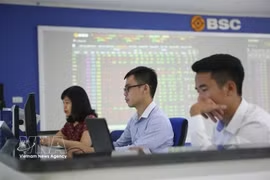
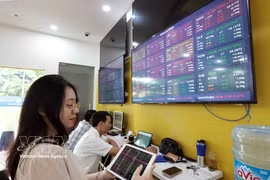
Investors conduct transactions at the headquarters of Bao Viet Securities Company in Hanoi. (Photo: VNA)

Hanoi (VNA) – FTSE Russell’s mid-term review has reaffirmed that Vietnam remains on track for an upgrade from frontier to secondary emerging market status, paving the way for increased passive and active international capital inflows.

The inclusion of Vietnamese equities in global FTSE indices from this September is expected to improve market liquidity, enhance the country’s global standing, and open up long-term investment opportunities, reflecting the market’s growing maturity and integration.

Bui Van Huy, Deputy General Director of FIDT Investment Consulting and Asset Management JSC, said the March review was largely procedural, confirming progress rather than introducing new decisions. However, it holds long-term structural significance, potentially unlocking 5–6 billion USD in passive inflows from exchange-traded funds (ETFs) tracking FTSE indices.

In the short term, he noted, the impact may be limited as upgrade expectations have already been priced in, while FTSE-linked funds are shrinking in scale. Foreign investors have also maintained net selling amid a global defensive trend since 2024, favouring larger and more stable markets.

Ho Huu Tuan Hieu, an investment strategy expert at SSI Securities Corporation, said most upgrade expectations are already reflected in valuations. The latest review mainly added criteria such as the Global Broker mechanism, while key requirements have largely been met thanks to policy adjustments and market preparations.

SSI views the upgrade as a structural driver, with about 1.67 billion USD in passive ETF inflows expected to be disbursed in phases over several quarters, helping ensure orderly capital absorption.

Reforms such as removing pre-funding requirements, improving disclosure standards, easing foreign ownership limits, and introducing a central counterparty (CCP) clearing mechanism are bringing Vietnam closer to meeting international criteria. While foreign exchange liberalisation remains incomplete, it is not seen as a decisive barrier.

Recent legal instruments and the rollout of the KRX trading system mark important progress in market infrastructure, improving transparency, accessibility and operational efficiency, particularly for institutional investors.

Vice Chairman of the State Securities Commission Bui Hoang Hai said Vietnam was approved for the upgrade on October 8, 2025, with implementation set for this September. The transition will take place over one year, allowing time to determine index weightings and for investors to prepare.

Vietnamese stocks will be added to FTSE indices in four phases from September 2026 to September 2027, with weightings gradually rising from 10% to full inclusion. This roadmap is designed to ensure market stability, manage capital flows and support the non-prefunding mechanism.

Hai stressed that the upgrade is a milestone rather than an end goal, with the broader objective being to enhance the stock market’s role in capital mobilisation and allocation. He further stated that ongoing reforms, from legal frameworks to infrastructure upgrades and transparency standards, aim to enhance investor experience, particularly for institutional investors.

He also highlighted efforts to accelerate the CCP mechanism, with the Vietnam Securities Depository and Clearing Corporation (VSDC) set to establish a subsidiary to operate the system, alongside initiatives to increase the share of institutional investors and improve the quality of financial advisory services.

The SSC noted that while the upgrade may boost investor sentiment, the market inherently carries risks. Thus, investors are advised to exercise caution and conduct thorough research before making decisions to safeguard their interests and to ensure the market operates efficiently, channeling capital to promising businesses and projects, Hai said./.
VNA

See more

The Nguyen Van Linh–Nguyen Huu Tho intersection fully opens both underpasses to traffic, helping ease congestion in the area. (Photo: VNA)

Ho Chi Minh City pushes for full public investment disbursement

Ho Chi Minh City was allocated a record 147.599 trillion VND (5.6 billion USD) in public investment capital for 2026, up 22.6% from last year and accounting for nearly 14.6% of the nation’s total public investment budget. However, disbursement by the end of April remained below the national average.

Visitors explore Quang Tri province’s OCOP products (Photo: VNA)

Quang Tri links OCOP products with tourism to expand farm produce markets

The central province currently has 160 OCOP products developed by cooperatives, cooperative groups and businesses, including two five-star and 31 four-star products. These locally distinctive products are gradually becoming "ambassadors" showcasing Quang Tri’s culture and identity to domestic and international visitors.

Work starts on Hanoi’s Red River Landscape Boulevard Axis project on December 19, 2025. (Photo: VNA)

Hanoi approves nearly 28-bln-USD Red River landscape boulevard project

Covering more than 11,400 hectares and requiring an estimated 736.96 trillion VND (nearly 28 billion USD), the project is expected to reshape urban development along both banks of the Red River over the coming decades while improving transport connectivity and public spaces in the capital.

Deputy Prime Minister Nguyen Van Thang and delegates perform the ground-breaking ceremony for the Northwest Dien Bien Phu New Urban Area, Resort and Sports Complex project. (Photo: VNA)

Vingroup launches largest-ever urban development project in Dien Bien

Under the master plan, the project will span more than 228.5ha and accommodate around 12,000 residents. It is designed under a “city within a city” model integrating residential areas, commercial and service facilities, resorts, schools, healthcare services, public spaces and sports infrastructure.

Deputy Prime Minister Nguyen Van Thang and delegates press the button to launch construction of the Dien Bien Phu cultural-historical tourism and cable car complex project in Dien Bien province on May 10, 2026. (Photo: VNA)

Dien Bien Phu cultural-historical tourism, cable car complex project launched

The project aims to effectively tap the area’s natural landscapes, geographical advantages and distinctive historical value, while creating a high-quality tourism product with strong competitiveness. It is also intended to preserve, honour and promote the value of the Dien Bien Phu Victory special national historical relic site.

Politburo member Nguyen Duy Ngoc (third, right), who is Standing Deputy Head of the Central Steering Committee for Science-Technology Development, Innovation and Digital Transformation, holds a working session with the Colombo Port City Management Board. (Photo: VNA)

Vietnam studies Colombo smart port city model

Ngoc praised Sri Lanka’s orientations in developing seaport infrastructure, digital infrastructure, digital economy and international service centres, describing them as valuable references for Vietnam in developing strategic infrastructure, innovation centres, smart urban areas and digital economy ecosystems.

Tan Cang – Cat Lai Port in Ho Chi Minh City (Photo: VNA)

MoIT issues decision recognising Vietnam Logistics Day

The move is aimed at raising awareness across government agencies, businesses and the wider public of the vital role logistics services play in socio-economic development, international integration and strengthening national competitiveness.