Public investment disbursement picks up pace in Q1

The first-quarter disbursement rate was 1.2 percentage points higher than in Q1 2025, while the total disbursed value jumped by roughly 30 trillion VND year-on-year.

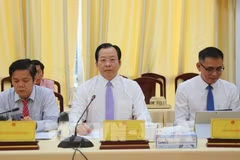
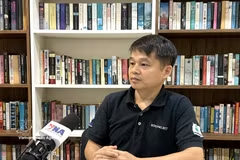
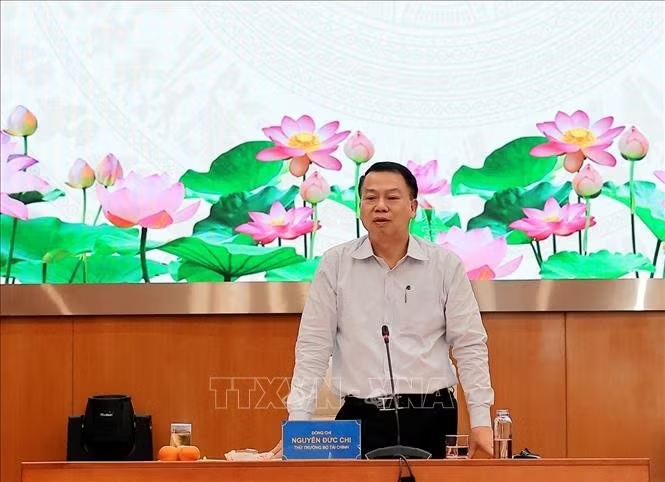
Deputy Minister of Finance Nguyen Duc Chi speaks at the press briefing (Photo: VNA)

Hanoi (VNA) - Public investment disbursement nationwide was estimated at 110 trillion VND (4.23 billion USD) as of the late March, or 11% of the Government-assigned capital plan, the Finance Ministry told its quarterly press briefing in Hanoi on April 9.

The figures signalled improvement from a year earlier. The first-quarter disbursement rate was 1.2 percentage points higher than in Q1 2025, while the total disbursed value jumped by roughly 30 trillion VND year-on-year.

Deputy Minister of Finance Nguyen Duc Chi said the Government and the Prime Minister have poured ample time and resources into driving public investment spending, with repeated reviews and a series of systematic, decisive solutions already in place.

Building on those directions, mechanisms and policies governing public investment have been thoroughly reviewed and revised. Within the ministry’s remit, key regulations have been adjusted to smooth project rollout and cut red tape as much as possible.

Specifically, decentralisation and delegation of authority have been accelerated; bidding and contractor selection procedures streamlined; capital allocation, payment, and settlement processes simplified; and planning, land, and natural resource issues cleared to prevent bottlenecks in project delivery.

“In recent years, the system of mechanisms, policies, and laws related to public investment has never been as favourable as it is now,” Chi said. While stopping short of calling the framework perfect, he noted that current regulations now provide markedly better conditions for project rollout.

From this standpoint, Chi argued that persistent slow disbursement stems primarily from implementation on the ground. Ministries, agencies, and localities must fully recognise their responsibilities and take more effective solutions to fix existing weaknesses.

He underscored public investment’s critical role as one of the main pillars of economic growth, which is why it continues to receive the highest level of direction.

Units failing to launch assigned projects, disburse allocated capital, or deliver poor performance will be judged as not meeting their tasks, and in some cases rated at a low level. This performance evaluation system is designed to generate both pressure and motivation, sharpening accountability and speeding up results.

Further institutional improvements, coupled with stricter discipline and enforcement, are expected to drive clearer progress in public investment disbursement, supporting broader economic growth and sustainable development.

Le Tien Dung, Deputy Director of the ministry’s Infrastructure Development Department, noted that in the early months of the year, the Prime Minister has held conferences on public investment disbursement. At regular Government meetings and sessions of the steering committee for national key projects in the transport sector, strong directives have been issued to clear bottlenecks and accelerate progress.

Ministries, agencies, and localities have accordingly been told to roll out coordinated measures to boost disbursement, with special focus on major infrastructure projects that carry high spillover effects and can open new development space for the economy.

At the same time, the ministry has proactively managed the state budget to ensure adequate and timely capital allocation under the 2026 plan, with priority given to strategic and inter-regional infrastructure projects with strong disbursement capacity and rapid spillover impact.

The ministry also directed the State Treasury to disburse funds immediately once projects meet required conditions, preventing capital bottlenecks and keeping projects on track. It has further reported monthly performance indices to the Prime Minister to evaluate results across ministries, agencies, and localities, enabling tighter monitoring and swift corrective action.

These concerted solutions, from institutional improvement and greater decentralisation to administrative reform, heightened accountability, and more use of technology, are expected to create strong momentum in public investment disbursement, contributing to economic growth and sustainable infrastructure development./.
VNA

See more

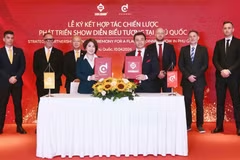
Sun Group partners with Dragone to jointly establish a new standard for performing arts in Vietnam (Photo: Sun Group)

Phu Quoc set for a global spotlight with Sun Group–Dragone flagship show

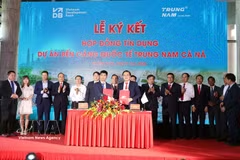
The agreement signed on April 10 represents Dragone’s first formal entry into Vietnam through a strategic partnership, underscoring the country’s growing appeal to leading global creative companies. It also reinforces Sun Group’s role as a pioneer in bringing world-class performing arts experiences to Vietnamese audiences.

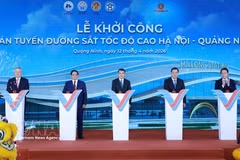
Prime Minister Le Minh Hung (third, left) and delegates press buttons to start the project (Photo: VNA)

Work starts on Hanoi–Quang Ninh high-speed railway

Prime Minister Le Minh Hung attended a groundbreaking ceremony for the Hanoi - Quang Ninh high-speed railway line, Vietnam's first inter-regional high-speed railway, held in Quang Ninh province on April 12.

VinFast EV sales jump 127% in March 2026. (Photo: Vinfast)

VinFast EV sales jump 127%, cementing market dominance

According to its report, all models in VinFast’s EV lineup recorded strong growth in March. Notably, on March 28 alone, the company completed 3,520 orders, the highest number ever recorded in a single day by an automotive brand in Vietnam.

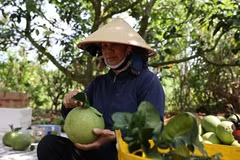
Illustrative image (Photo: VNA)

Australia announces import conditions for Vietnamese pomelos

Australia’s formal publication provides an important legal basis, marking the completion of the review, assessment and agreement on technical requirements for fresh Vietnamese pomelos. This represents a significant step forward in market access, creating favourable conditions for relevant agencies, localities and businesses to prepare for export activities in the coming time.

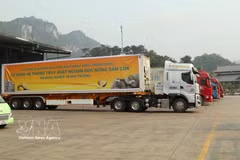
Containers of fresh Vietnamese durian for export are subject to a full-chain traceability system. (Photo: VNA)

First “green lane” durian shipment exported to China

​Under the “green lane” process, quality control begins at the cultivation stage, including soil sampling and monitoring, and continues through harvesting and processing, with traceability labels attached to trees and applied to fruit at the time of picking. It also allows plant quarantine procedures and the issuance of certificates of origin (C/O) directly in the localities where the orchards are located.

Delegates at the Vietnam Expo 2026 (Photo: VNA)

Vietnam pushes for deeper auto supply chain ties with RoK

The RoK stood as Vietnam’s largest foreign investor with more than 95.2 billion USD in registered capital as of February 2026, or about 18% of all foreign cash flowing in, with thousands of active projects. In January-February alone, the RoK led the pack with nearly 2 billion USD in pledges, grabbing a whopping 32.7% of total registered capital and showing no signs of slowing down.

More than 600 tourism firms, 15 countries and territories, and 34 provinces and cities are promoting destinations and introducing tourism products at the fair (Photo: VNA)

Digital transformation key to elevating Vietnam’s tourism: official

Speaking at the opening of the Vietnam International Travel Mart (VITM) 2026 in Hanoi on April 10, Deputy Minister of Culture, Sports and Tourism Ho An Phong noted that despite challenges in 2025, Vietnam largely fulfilled its socio-economic development goals. Tourism remained a bright spot, recording 21.5 million foreign arrivals and 135.5 million domestic visitors, with total revenue exceeding 1 quadrillion VND (37.9 billion USD).

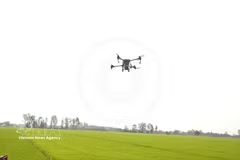
A drone sprays fertiliser over rice fields. (Photo: VNA)

Low-altitude economy emerges as new growth driver for Vietnam

The UAV technology is particularly effective in addressing challenges faced by ground infrastructure, especially in densely populated urban areas and remote regions. Smart aerial devices also enable real-time data collection, improving governance, decision-making and digital transformation across industries.

Passengers at Cat Bi Airport in Hai Phong city (Photo: VNA)

Aviation sector ensures fuel supply for April 30–May 1 peak

Aviation fuel suppliers are actively negotiating and diversifying supply sources both domestically and internationally, while strengthening coordination, storage and distribution capacity to meet immediate demand. These efforts aim to support airlines in optimising operations and maintaining stable flight schedules.