Vietnam turns challenges into opportunities: World Bank

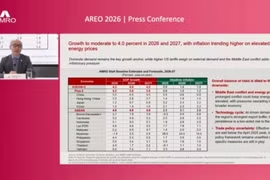
Vietnam is projected to remain one of the fastest-growing economies in the region, expanding by 6.3% in 2026 and 7.7% in 2027, according to the WB.

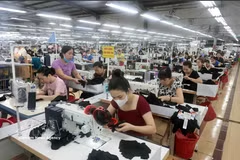
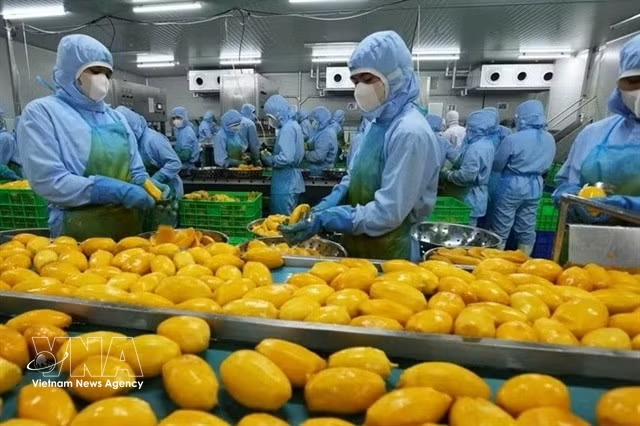
Workers at a food processing company in Dong Nai province (Photo: VNA)

Hanoi (VNS/VNA) – As growth across East Asia and the Pacific slows amid mounting global uncertainty, Vietnam continues to stand out for its ability to adapt and turn challenges into opportunities for reform, according to the World Bank.

In its regional economic update released on April 8, the World Bank said the region faces increasing pressure from global uncertainties, including an energy shock linked to tensions in the Middle East, rising trade barriers and policy volatility worldwide.

These factors are expected to weigh on growth in East Asia and the Pacific in the coming years.

The World Bank forecasts regional growth will ease from 5% in 2025 to about 4.2% in 2026, largely due to a weaker global environment and a continued slowdown in China.

China’s economy is projected to grow by around 4.2% in 2026 and 4.3% in 2027, down from 5% in 2025, as it continues to face structural challenges including weak domestic demand, a sluggish property market and export pressures amid softer global growth.

For other economies in East Asia and the Pacific, growth is expected to slow to around 4.1% in 2026 before recovering to about 5% in 2027 as geopolitical tensions ease and uncertainty declines.

Against this backdrop, Vietnam is projected to remain one of the fastest-growing economies in the region. The World Bank expects the country’s economy to expand by 6.3% in 2026 and 7.7% in 2027.

According to the report, strong economic performance in 2025 will serve as an important buffer, helping Vietnam mitigate the impact of global headwinds.

The World Bank also highlighted the country’s efforts to increase investment in infrastructure and education, while improving institutional quality. These measures have helped targeted policy support deliver more visible results than in many other regional economies.

Earlier assessments had suggested Vietnam could be among the countries most exposed to new US tariff barriers, potentially reducing growth by about one percentage point. However, recent developments indicate the country’s ability to adjust has been stronger than expected.

Aaditya Mattoo, chief economist for the World Bank’s East Asia and Pacific region, said that while some economies in the region are losing reform momentum, Vietnam is emerging as an example of proactive policy adjustment.

He noted that gains from domestic reform can outweigh losses caused by trade protectionism. In Vietnam’s case, ongoing reforms in services and manufacturing have contributed to improved labour productivity.

Rather than focusing solely on US tariffs or Chinese subsidies, policy adjustments at home have helped the country better withstand external trade shocks, Mattoo said.

The report also warned that the economic impact of Middle East tensions will vary across countries depending on their reliance on imported energy, domestic vulnerabilities and the flexibility of government policy responses.

A prolonged escalation could further weaken economic prospects across the region.

If global fuel prices remain 50% higher for an extended period, household incomes in the region could fall by 3 to 4%. Governments are therefore advised to implement targeted support measures for vulnerable groups and small- and medium-sized enterprises to cushion the impact without placing excessive pressure on public finances.

“Growth in East Asia and the Pacific remains higher than in most other regions of the world, even amid uncertainty,” said Carlos Felipe Jaramillo, the World Bank’s vice president for the region.

However, sustaining that momentum will require countries to address structural challenges and harness opportunities from the digital era to boost productivity and create jobs, he added./.

VNA
See more

An overview of the Vietnam-China Green Industry Cooperation and Exchange Programme held in Beijing.(Photo: VNA)

Vietnam, China boost cooperation in green industry development

The Vietnamese Embassy in China, in coordination with the International Cooperation Centre under China’s National Development and Reform Commission (NDRC), on May 18 organised the Vietnam–China Green Industry Cooperation and Exchange Programme in Beijing to strengthen policy exchanges, share experience, and promote substantive cooperation in green industry amid climate change and growing global environmental challenges.

The infrastructure of Thang Long 3 Industrial Park in Phu Tho province is comprehensive and modern, creating favourable conditions for businesses and investors. (Photo: VNA)

Strong economic conglomerates drive domestic economic growth

In manufacturing, THACO has built one of Southeast Asia’s largest automobile and mechanical engineering ecosystems in Quang Nam province, while VinFast has become Vietnam’s first electric vehicle producer, establishing a major factory in Hai Phong, listing on Nasdaq and expanding into North America, Europe and Southeast Asia.

Producing garments for export to the EU market at TDT Thai Nguyen Garment Company. (Photo: VNA)

Vietnam’s textile industry draws high-tech FDI amid green, smart shift

With export turnover rising steadily in recent years and a target of 50 billion USD by 2026, Vietnam remains among the world’s top three textile exporters. Beyond its traditional appeal as a low-cost manufacturing base, the country is now positioning itself as a strategic hub for high-value and technology-driven investment.

An FDI enterprise invests in factory facilities at Chau Duc Industrial Park, a project spanning approximately 2,290 ha. (Photo: VNA)

Ho Chi Minh City targets next-generation, high-value FDI

The southern economic hub attracted nearly 3.3 billion USD in FDI during the first four months of 2026, marking a sharp year-on-year increase of 227.1%. The total included 539 newly licensed projects with registered capital exceeding 791.8 million USD and 58 existing projects adding 259.3 million USD in supplementary investment.

The VinFast electric vehicle charging station at the CT1 apartment complex of 103 Hospital in Hanoi. (Photo: VNA)

Vietnam accelerates drive to master EV technologies

By the end of 2025, Vietnam had established 28 standards and technical regulations related to charging stations, charging equipment and batteries. The legal framework is expected to be fully completed in the third quarter of 2026.

Duyen Hai Wind Power Plant in Truong Long Hoa ward, Vinh Long province. (Photo: VNA)

Energy sector seen as key pillar for Vietnam’s green, double-digit growth ambitions

Chairman of the Vietnam National Industry-Energy Group (Petrovietnam) Le Ngoc Son said Vietnam’s energy demand will continue rising sharply, creating enormous pressure on power generation investment. To sustain GDP growth of around 10%, electricity demand is expected to increase by 12-15% annually, requiring an additional 7,000-8,000 MW of new capacity each year.

A view of the Lien Chieu Container Port construction project in Da Nang city (Photo: VNA)

Logistics set to drive Vietnam’s rise in global supply chains

Amid sweeping restructuring in global trade driven by digitalisation, green transition and geopolitical shifts, logistics is no longer a back-end function. It is increasingly a decisive factor in economic performance, especially as Vietnam deepens integration into international supply chains. The challenge now extends beyond faster delivery to building a modern and interconnected logistics ecosystem capable of organising supply chains at a regional scale.

Coupang.com, one of the Republic of Korea's leading online retail corporations, has actively cooperated with the Vietnamese Embassy in handling issues related to products and items with wrong information of Vietnam. (Screenshot of the site)

Coordinated efforts help safeguard healthy online marketplaces

As the digital environment continues to evolve rapidly, stronger coordination among authorities, platform operators and user communities is becoming increasingly important to build a healthy cyberspace that respects cultural identity while helping reinforce friendship and mutual understanding among people worldwide.

Vietnam will host the 21st Asian-Australasian Association of Animal Production Societies (AAAP) Animal Science Congress (AAAP 21) from October 28 - 31 in Hanoi. (Photo: aaap2026.org)

Vietnam to host 21st AAAP animal science congress

According to the Animal Husbandry Association of Vietnam (AHAV), the event is expected to gather between 1,300 - 1,500 delegates, including around 500 leading international scientists, experts and businesses in the livestock sector.

Yen Huong Xua company introduces solutions to combat counterfeit and imitation goods (Photo: VNA)

Fight against counterfeit goods fostered amid rising digital-era fraud

Dr. Bui Van Quyen, Director of the Anti-Commercial Fraud and Counterfeiting Institute, warned that counterfeit goods have become a global challenge, exacerbated by the rise of online platforms and digital technologies. While these innovations drive economic growth, they also create fertile ground for fraudulent activities.