Türkiye seen as promising market for Vietnam’s Halal products

With a large Muslim population, Türkiye serves as both a major consumer market and a well-developed processing hub for such products. Meanwhile, Vietnam is gradually establishing its capacity to supply Halal goods, particularly in processed foods, agricultural produce, beverages, tourism services and logistics.

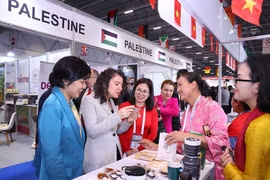
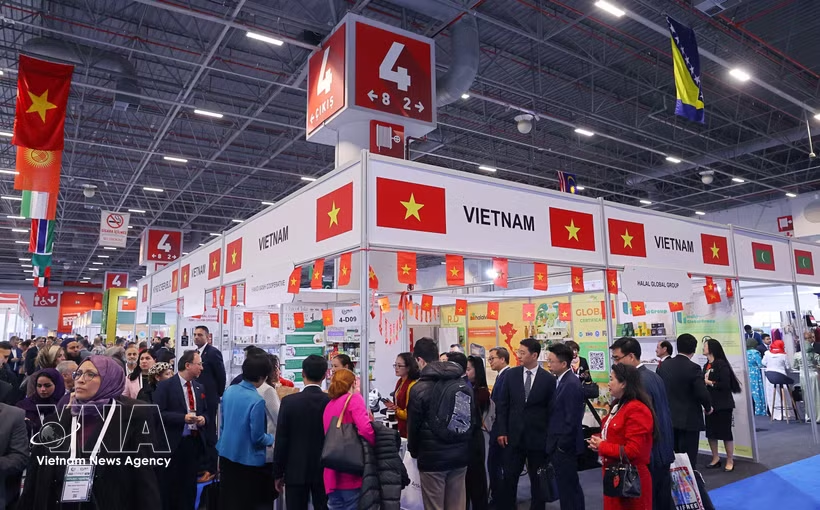
Booths of Vietnamese cooperatives and enterprises at the Halal Expo 2025 exhibition in Türkiye. (Photo: VNA)

Hanoi (VNA) – Among areas of cooperation, the Halal sector remains relatively new but holds considerable potential, as Vietnam and Türkiye possess complementary strengths and demands, while also attracting significant attention from both governments.

With a large Muslim population, Türkiye serves as both a major consumer market and a well-developed processing hub for such products. Meanwhile, Vietnam is gradually establishing its capacity to supply Halal goods, particularly in processed foods, agricultural produce, beverages, tourism services and logistics.

According to Yunus Ete, Chairman of the World Halal Summit Council, demand for this type of food, cosmetics, pharmaceuticals and tourism has been growing rapidly. In recent years, Vietnam and Türkiye have made notable progress in strengthening cooperation in the Halal sector. Owing to its strategic position bridging Asia and Europe, the latter is not only a strong trading partner but also a gateway to broader markets.

Amid surging global demand, Vietnam is placing increasing emphasis on developing a Halal ecosystem, identifying it as a strategic direction that opens up new export opportunities while enhancing the country’s position in global value chains. The Government has introduced various programmes to support businesses in improving production capacity, quality standards and certification, while actively coordinating with international organisations to facilitate access for local goods to the global Muslim market. In this context, Türkiye is seen as a particularly promising destination for Vietnam’s Halal exports.

Türkiye is among Vietnam’s leading trade partners in the Middle East and serves as a gateway for Vietnamese exports to the wider Middle Eastern and Southern European markets. Bilateral trade reached nearly 2.3 billion USD in 2025, with Vietnam’s exports accounting for over 1.8 billion USD.

As key trading partners in their respective regions, both economies are highly complementary and act as important gateways linking various regions and multilateral organisations of which they are members. Both Vietnam and Türkiye attach importance to their friendship and the significant potential for further cooperation./.


VNA

See more

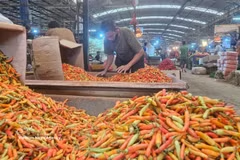
Chili peppers are on the list of essential goods in Indonesia (Photo: VNA)

Indonesia reduces imports of strategic food commodities

In 2026, Indonesia is expected to have approximately 12 million tonnes of rice carried over from the previous year, supported by annual production of around 34.7 million tonnes. With projected consumption of 31.1 million tonnes, national rice reserves could reach approximately 16 million tonnes by the end of the year.

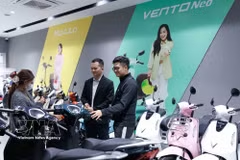
Hanoi’s roadmap to implement low-emission zones from July is providing a strong boost to the electric two-wheeler market (Photo: VNA)

Low-emission zone roadmap drives electric two-wheeler boom in Hanoi

From July 1, Hanoi will introduce time-based or area-based restrictions on petrol-powered motorcycles within Ring Road 1, with plans to expand coverage across the entire zone by 2028 and extend to areas within Ring Road 3 by 2030. The policy is expected to reshape travel habits for millions of urban residents.

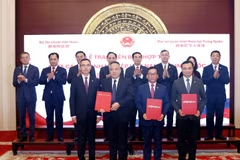
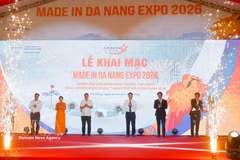
Delegates at the opening ceremony of the Made in Da Nang Expo 2026 (Photo: VNA)

Nearly 300 firms join Made in Da Nang Expo 2026

Speaking at the opening ceremony, Vice Chairman of the Da Nang People’s Committee Tran Chi Cuong said the exhibition is a large-scale trade promotion event aimed at showcasing products, connecting markets, and helping businesses enhance competitiveness while expanding domestic and export markets.

 Green production, standardised value chains key to fruit, vegetable sector growth

Green production, standardised value chains key to fruit, vegetable sector growth

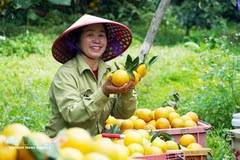
Facing mounting pressure from increasingly stringent domestic and international standards, Vietnam’s fruit and vegetable sector is accelerating its shift toward green, safe, and sustainable production models. Beyond changing farming practices, localities and businesses are stepping up efforts to standardise value chains and build brands to achieve growth targets for 2026.

Hiep Phuoc Industrial Park in Ho Chi Minh City. (Photo: VNA)

Southern industrial real estate enters strategic growth phase

Key industrial hubs in the south, including Ho Chi Minh City, Dong Nai and Tay Ninh, are transitioning from a period driven largely by supply expansion and rising land prices to a more refined growth model. This new phase is shaped by infrastructure upgrades, supply chain restructuring, product improvement and greater emphasis on operational performance.

The launch of the Vietnam National Brand Week 2026 on April 16 (Photo: VNA)

Vietnam National Brand Week 2026 opens

Running from April 16 to 23 nationwide, the Vietnam National Brand Week 2026 marks the 18th anniversary of Vietnam Brand Day (April 20, 2008 – 2026).