JICA, BIDV announce 50 million USD loan to support rural MSMEs

Under the agreed structure, BIDV will earmark 30 million USD from the JICA loan specifically for rural MSMEs, while the remaining 20 million USD will support MSMEs more broadly.

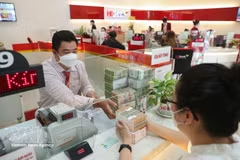
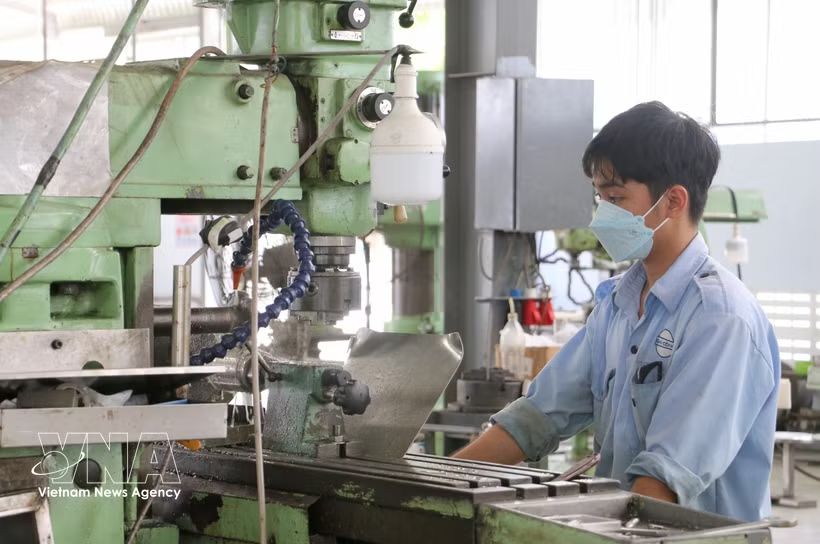
Illustrative image (Photo: VNA)

Hanoi (VNA) – The Japan International Cooperation Agency (JICA) and the Bank for Investment and Development of Vietnam (BIDV) on April 13 jointly announced a 50 million USD loan to support micro, small and medium-sized enterprises (MSMEs) in rural areas.

The programme is part of JICA’s Private Sector Investment Finance initiative.
The announcement follows the signing of the loan agreement in late 2025, marking a new milestone in financial cooperation between the two sides. The JICA loan forms part of a 120 million USD syndicated financing package, co-arranged with the Asian Development Bank (ADB) and other commercial banks.

A key highlight of the programme is its targeted capital allocation to address limited access to finance in rural areas. Under the agreed structure, BIDV will earmark 30 million USD from the JICA loan specifically for rural MSMEs, while the remaining 20 million USD will support MSMEs more broadly.

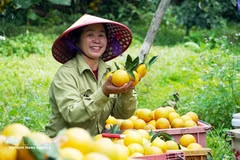
The focus on agriculture - the backbone of the rural economy - would help farmers and small business owners enhance productivity, create local employment, and improve sustainable incomes.

Senior representatives from JICA, ADB, BIDV, the Canadian Embassy in Vietnam, and co-financing partners attended the announcement ceremony. Participants expressed confidence that the programme will improve access to finance for MSMEs, particularly those operating in agriculture.

The initiative also contributes to the implementation of the United Nations Sustainable Development Goals, including poverty reduction and food security./.

VNA

See more

Chili peppers are on the list of essential goods in Indonesia (Photo: VNA)

Indonesia reduces imports of strategic food commodities

In 2026, Indonesia is expected to have approximately 12 million tonnes of rice carried over from the previous year, supported by annual production of around 34.7 million tonnes. With projected consumption of 31.1 million tonnes, national rice reserves could reach approximately 16 million tonnes by the end of the year.

Hanoi’s roadmap to implement low-emission zones from July is providing a strong boost to the electric two-wheeler market (Photo: VNA)

Low-emission zone roadmap drives electric two-wheeler boom in Hanoi

From July 1, Hanoi will introduce time-based or area-based restrictions on petrol-powered motorcycles within Ring Road 1, with plans to expand coverage across the entire zone by 2028 and extend to areas within Ring Road 3 by 2030. The policy is expected to reshape travel habits for millions of urban residents.

Delegates at the opening ceremony of the Made in Da Nang Expo 2026 (Photo: VNA)

Nearly 300 firms join Made in Da Nang Expo 2026

Speaking at the opening ceremony, Vice Chairman of the Da Nang People’s Committee Tran Chi Cuong said the exhibition is a large-scale trade promotion event aimed at showcasing products, connecting markets, and helping businesses enhance competitiveness while expanding domestic and export markets.

 Green production, standardised value chains key to fruit, vegetable sector growth

Green production, standardised value chains key to fruit, vegetable sector growth

Facing mounting pressure from increasingly stringent domestic and international standards, Vietnam’s fruit and vegetable sector is accelerating its shift toward green, safe, and sustainable production models. Beyond changing farming practices, localities and businesses are stepping up efforts to standardise value chains and build brands to achieve growth targets for 2026.

Hiep Phuoc Industrial Park in Ho Chi Minh City. (Photo: VNA)

Southern industrial real estate enters strategic growth phase

Key industrial hubs in the south, including Ho Chi Minh City, Dong Nai and Tay Ninh, are transitioning from a period driven largely by supply expansion and rising land prices to a more refined growth model. This new phase is shaped by infrastructure upgrades, supply chain restructuring, product improvement and greater emphasis on operational performance.