Training models create sustainable livelihoods, inclusion pathways for people with disabilities

Experts observed that improving employment outcomes for the disabled requires diversifying career options and gradually shifting toward high-demand sectors such as IT, psychological counselling, and customer service.

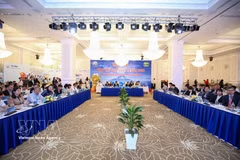
A view of the Vietnam Disability Fashion Show 2025 (VDFS) held at the Vietnam National Fine Arts Museum on August 4 last year. (Photo: VNA)

Hanoi (VNA) – Facing barriers to employment access, many vocational training models tailored to the needs of people with disabilities are being implemented, helping create sustainable livelihoods and promote social inclusion.

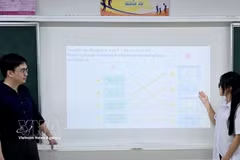
Luong Thu Hoa, Principal of the Xa Dan primary and secondary school in Hanoi – which offers education suitable to both mainstream and hearing-impaired students, said vocational skills equipped at an early stage is a crucial foundation for hearing-impaired students to become more independent.

In the past academic year, the school introduced diverse vocational training activities for the group, including facial skincare, handmade flower crafting, beverage preparation, information technology, and even the establishment of a robotics team. In the coming time, it plans to expand its training scale and develop a high school level to provide better learning opportunities for the disabled learners.

Although job opportunities for people with disabilities have improved, challenges remain, with many still limited to traditional manual jobs with low income. This reality highlights the need to expand new training models aligned with both individual capabilities and market demand.

Addressing this need, a project teaching therapeutic hair washing for the visually impaired, implemented by the Hanoi Blind Association from October 2025 to March 2026 with funding from Finland's Abilis Foundation, has provided specialised training for 20 learners. In addition to vocational skills, participants were trained in communication, customer care, and the application of AI in marketing and service promotion. After completing the programme, all trainees graduated, with many confidently starting their own businesses, marking a shift from basic support to economic empowerment.

Dinh Viet Anh, Vice President of the Vietnam Blind Association, noted that the project not only provides new skills but also helps change mindsets. Many trainees have overcome self-doubt and gained confidence in delivering technically demanding services. The model is expected to be replicated more widely, enabling visually impaired individuals to pursue entrepreneurship or work in professional spa environments.
vnanet-potal-ngay-nguoi-khuyet-tat-viet-nam-nang-cao-chat-luong-cuoc-song-va-hoa-nhap-cong-dong-8706232.jpg
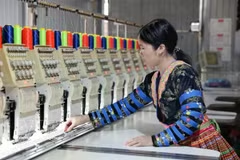
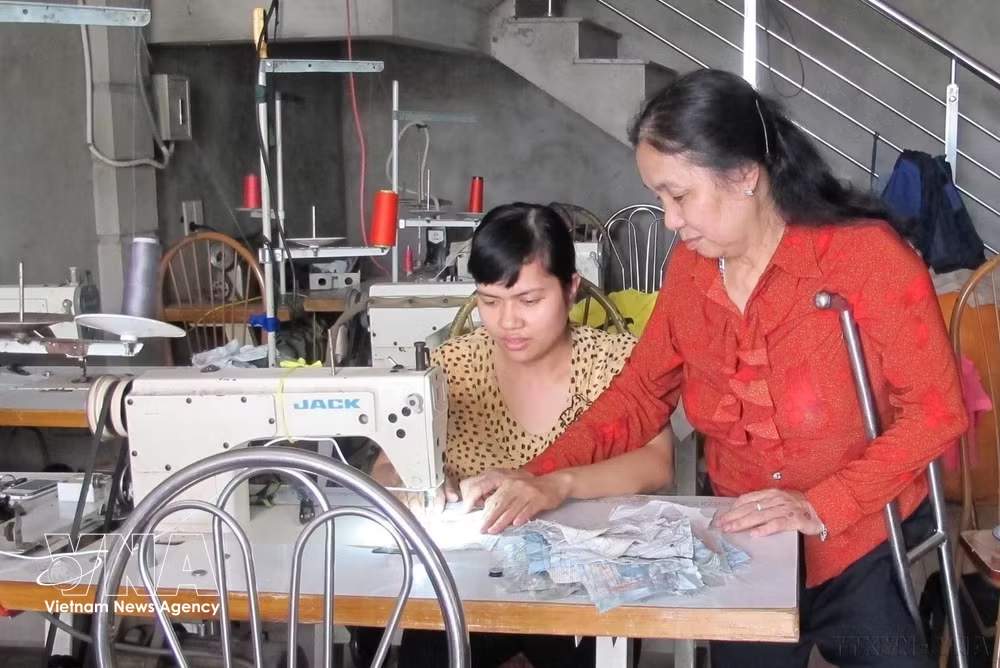
Nguyen Thi Hoa, owner of a garment workshop in Ninh Binh province, is a person with disabilities. Over several decades of operation, her workshop has trained thousands of workers, including around 500 people with disabilities. (Photo: VNA)

Experts observed that improving employment outcomes for the disabled requires diversifying career options and gradually shifting toward high-demand sectors such as IT, psychological counselling, and customer service. Standardising workforce skills through professional soft-skills training, applying AI to reduce barriers, and building formal job-matching platforms are also key solutions.

In 2025, the Association in Support of the Vietnamese Handicapped and Orphans organised vocational training for 645 people with disabilities, with total funding exceeding 3.6 billion VND (136,700 USD). About 70% of trainees secured jobs and stable incomes after training.

Notably, six online sales training courses were conducted for over 300 participants nationwide, with 162 graduates continuing to receive support in sourcing goods for business, thus creating jobs suited to their health conditions and generating stable income.

The association also provided financial support totalling over 9.7 billion VND for 755 people with disabilities and their families, along with livestock and plant support for targeted households, helping improve livelihoods and living standards.

In the context of digital transformation, pathways to inclusion for people with disabilities are becoming more practical and sustainable. With continued community support and appropriate policies, they can confidently participate in the workforce, achieve self-reliance, and affirm their value in society./.
VNA

See more

The “I Love My Fatherland" Journey 2026 kicks off in Nghe An province on May 16. (Photo: VNA)

"I Love My Fatherland” journey features diverse activities

The “I Love My Fatherland” journey will span seven stages across historical and cultural sites and “red addresses” nationwide. There will be a combination of education on traditions, field-based programmes, and digital communications.

At the handover of 33 Chinese nationals who had violated Vietnamese law to Chinese authorities in Quang Ninh on May 15, 2026. (Photo: VNA)

Vietnam hands over 33 law violators to China

Investigations found that the individuals had violated Vietnamese laws relating to illegal entry and unlawful residence in Vietnam. The handover was conducted safely and in compliance with Vietnamese law and international practice.

At the talks between authorities of the northern province of Lang Son and Pingxiang city in the Guangxi Zhuang Autonomous Region of China (Photo: VNA)

Vietnam, China seek to build modern, smart border gates

Authorities of the northern province of Lang Son and Pingxiang city in the Guangxi Zhuang Autonomous Region of China held talks on May 15 at Tan Thanh (Vietnam) – Po Chai (China) clearance point near markers 1090–1091 in Hoang Van Thu commune of Lang Son to promote trade, develop smart border gates and expand cross-border tourism cooperation.

The Vietnam Association for Victims of Agent Orange (VAVA) has carried out various activities to support Agent Orange/dioxin victims. (Photo: VNA)

Over 9.3 billion VND raised for AO/dioxin victims in 2025

VAVA President Lieutenant General Nguyen Huu Chinh said that although the war ended more than 50 years ago, the consequences of toxic chemicals remain severe and long-lasting, with millions of people affected during the war and hundreds of thousands continuing to suffer serious physical impacts in peacetime.

An overview of the meeting (Photo: VNA)

Measures sought to accelerate construction of inter-level boarding schools in border areas

The construction of boarding schools in land border communes is a particularly important political task receiving close attention from the Politburo and Party General Secretary and State President To Lam. The programme not only aims to improve learning conditions for students in border areas, but also carries strategic significance for social welfare, human development, national defence and security, and safeguarding territorial sovereignty.

An overview of the court on May 14 (Photo: VNA)

Man gets life sentence for terrorism, anti-State activities

The People’s Court of Ho Chi Minh City on May 14 handed down life imprisonment to Dao Minh Quan on charges of “terrorism aimed at opposing the people’s administration” and “activities aimed at overthrowing the people’s administration”.

Secretary of the Ho Chi Minh Communist Youth Union Central Committee and VYF President Nguyen Tuong Lam addresses the event (Photo: VNA)

“I love my fatherland” journey 2026 launched

The “I Love My Fatherland” journey will comprise seven stages linked to historical, cultural and revolutionary sites across the country. The journey will begin in Nghe An on May 16 to mark President Ho Chi Minh’s birthday, before continuing through Hue city, Tuyen Quang–Lung Cu Flag Tower, Dien Bien, Khanh Hoa, Ca Mau and Ho Chi Minh City, and concluding in Hanoi in October.

Students in the Mekong Delta city of Can Tho are honoured for their outstanding performance in startup activities. (Photo: VNA)

Education ministry targets five digital technology incubators at universities

A key target under the new plan is the establishment of five digital technology incubators, or Deeptech Hubs, at universities and research institutes with strong potential. The education ministry also plans to launch a training programme for 1,000 outstanding technology entrepreneurs and develop criteria for selecting and supporting startup ecosystems within educational institutions.

At the equipment handover ceremony for the Narcotics Targeting Centre of Vietnam Customs. (Photo: cand.com.vn)

Vietnam Customs expands capacity to tackle cross-border narcotics crime

Established in November 2025, the NTC comprises six officers from the Anti-Smuggling Investigation Sub-Department specialising in surveillance, intelligence collection and information analysis. The centre is tasked with strengthening customs capacity in risk assessment and drug crime targeting, helping authorities detect and prevent illicit cross-border trafficking of narcotics and other dangerous substances at an early stage.