Vietnamese, Chinese residents hold border exchange programme

At the event, 30 local artists from both sides took part in boat performances, singing traditional folk duets along the border river in the area.

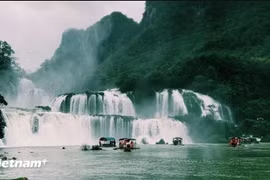
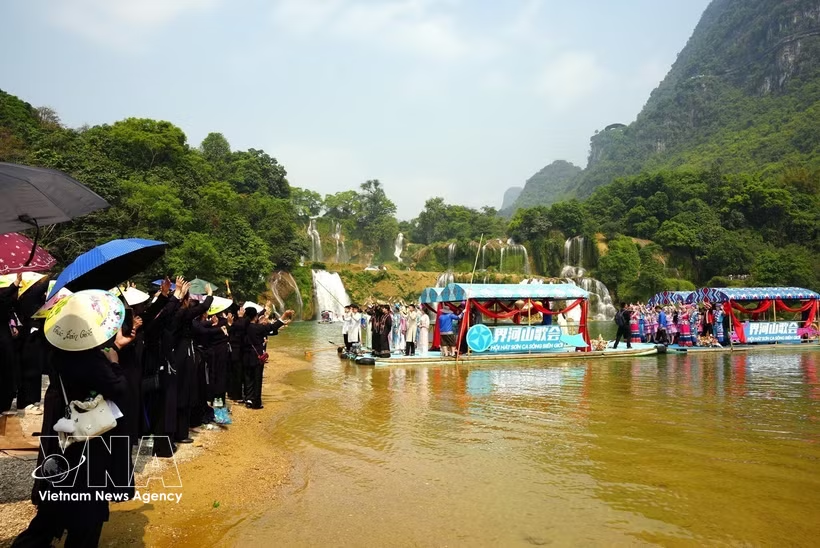
Vietnamese and Chinese artists perform traditional duet singing on the river at the Ban Gioc (Vietnam) – Detian (China) Waterfalls on April 13. (Photo: VNA)

Cao Bang (VNA) – A 2026 border residents’ exchange programme between the Vietnamese northeastern province of Cao Bang and the Chinese city of Chongzuo took place on April 13 at the Ban Gioc (Vietnam) – Detian (China) Waterfalls – the first cross-border tourism cooperation site jointly developed by the two countries.

At the event, 30 local artists from both sides took part in boat performances, singing traditional folk duets along the border river in the area.

The artists presented a variety of performances showcasing distinctive ethnic cultural identities and local traditions, while also engaging in group entertainment activities that created a lively and festive atmosphere for residents and visitors from both countries.

The exchange marked the first event of its kind to be held at the scenic site, and formed an important sideline activity ahead of an upcoming visit by a high-ranking Vietnamese delegation to China.

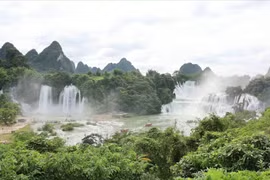
Located on the Vietnam–China border, the Ban Gioc–Detian waterfalls rise over 60m and span hundreds of metres. What makes the falls unique is that the main stream does not descend in a single stream of falls, but cascades over multiple limestone tiers, creating a beauty that is both pristine and graceful./.


VNA
See more

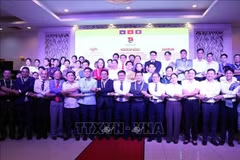
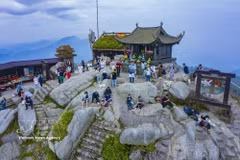
Participants at the gathering (Photo: VNA)

Lao, Cambodian students welcome traditional New Year in Ho Chi Minh City

In his speech, Vice Chairman of the municipal People’s Committee Nguyen Manh Cuong said the municipal Party organisation, authorities and people always value the close ties and solidarity among Vietnam, Laos and Cambodia. He described the three nations’ longstanding ties, forged through shared hardships, as an invaluable spiritual asset and a bedrock for sustainable development.

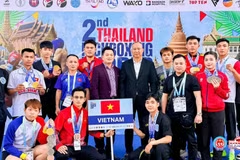
Vietnamese kickboxers win 32 gold medals at the Kickboxing World Cup 2026. (Photo: Vietnam Kickboxing Federation)

Vietnam finish third at Kickboxing World Cup 2026

According to Vu Duc Thinh, President of the Vietnam Kickboxing Federation, the strong results reflected careful preparation by local training centres and the determination of Vietnamese fighters. The team’s participation, funded largely through socialised and local resources, also demonstrated growing support for the development of kickboxing in Vietnam.

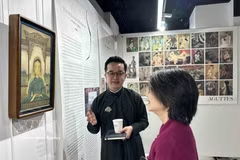
Politburo member, Secretary of the Party Central Committee and Head of the Party Central Committee’s Commission for Information, Education and Mass Mobilisation Trinh Van Quyet speaks at the event (Photo: VNA)

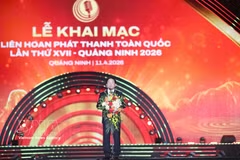
National Radio Festival opens in Quang Ninh

The opening night was combined with an artistic programme titled “sounds of the new era,” drawing around 50,000 spectators. The programme was structured in three chapters: Origins of Sound, Heritage Sound, and Sound of the New Era.

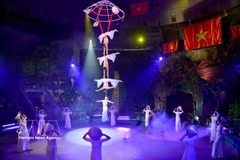
Vietnamese puppetry faces pressure to adapt to modern lifestyles, particularly amid growing competition from diverse entertainment forms (Photo: VNA)

Vietnamese puppetry seeks renewal amid preservation challenges

People’s Artist Nguyen Hoang Tuan, Chairman of the Hanoi Theatre Association, noted that while northern Vietnam had 27 puppetry guilds in 1986, only 14 remain today. Many traditional plays and original scripts have been lost, hurting restoration and preservation efforts.

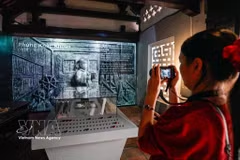
Visitors enjoy the "Stone History Preserves Memories" exhibition, featuring a traditional format combined with digital technology solutions (Photo: VNA)

Project on digital transformation in cultural sector approved

By 2030, the project targets the establishment of shared digital platforms across 100% of cultural sectors. All digitised cultural heritage will be standardised under the national data framework and shared in accordance with regulations, while 80% of public digital heritage assets are expected to receive digital identifiers to clarify ownership and management, encouraging organisations and individuals to do the same and support market development.