Vietnamese puppetry seeks renewal amid preservation challenges

People’s Artist Nguyen Hoang Tuan, Chairman of the Hanoi Theatre Association, noted that while northern Vietnam had 27 puppetry guilds in 1986, only 14 remain today. Many traditional plays and original scripts have been lost, hurting restoration and preservation efforts.

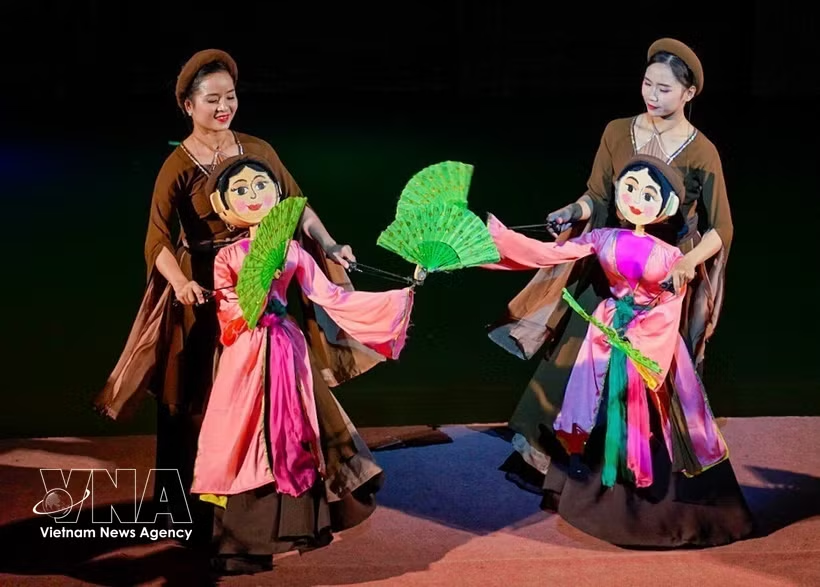
Vietnamese puppetry faces pressure to adapt to modern lifestyles, particularly amid growing competition from diverse entertainment forms (Photo: VNA)

Hanoi (VNA) - Although widely regarded as a cultural “speciality” attracting tourists, Vietnamese puppetry is facing multiple challenges in preservation and development, requiring renewed efforts to both safeguard its identity and adapt to contemporary cultural currents.

Amid rapid urbanisation, performance spaces for many traditional water puppetry guilds have gradually narrowed. People’s Artist Nguyen Hoang Tuan, Chairman of the Hanoi Theatre Association, noted that while northern Vietnam had 27 puppetry guilds in 1986, only 14 remain today. Many traditional plays and original scripts have been lost, hurting restoration and preservation efforts.

Meanwhile, the severe shortage of researchers, theorists and critics in theatre studies has created a significant gap in the knowledge foundation necessary for the long-term development of the art form.

At Dao Thuc puppetry guild in Thu Lam commune, Hanoi, guild head Dang Minh Hung expressed concern that despite annual training courses funded by the city, young participants rarely pursue puppetry as a long-term career after completing their studies. Limited remuneration for artisans and irregular performance opportunities make it difficult to retain practitioners and sustain the craft.

Vietnamese puppetry also faces pressure to adapt to modern lifestyles, particularly amid growing competition from diverse entertainment forms. Current audiences are largely international visitors, with water puppetry drawing the greatest attention thanks to its uniqueness as a folk theatre form found only in Vietnam. Domestic audiences, however, remain limited, except for schoolchildren who attend performances through educational programmes.

Experts suggest that for puppetry to remain relevant in contemporary cultural life, greater attention should be given to developing creative cultural spaces within traditional puppetry villages - the very places where the heritage originated and where performance practices and storytelling traditions have been passed down through generations.
vnanet-potal-van-hoa-soi-duong-chuong-trinh-mua-roi-am-vang-dong-que-8655525.jpg
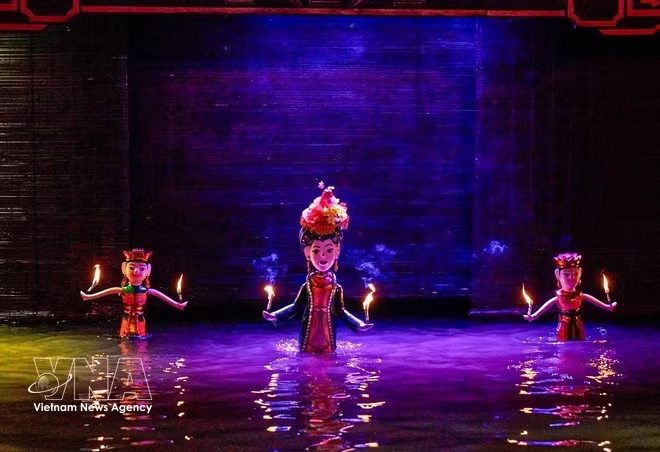
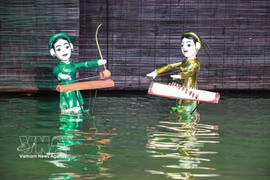
A water puppetry performance (Photo: VNA)

Hung emphasised the need for stronger institutional support, including investment in equipment, upgraded facilities, and improved policies to support artisans in practising, preserving and transmitting their craft.

Many experts also stress the urgency for local authorities to systematically review, document and preserve traditional puppet repertoires as a foundation for research, education and creative innovation.

Meritorious Artist Le Van Ngo, former Director of the Thang Long Water Puppet Theatre, noted that preservation efforts should not focus solely on the 17 classical performances currently staged in urban theatres, while hundreds of traditional plays still exist in folk communities. With many guilds now unable to produce puppets themselves and forced to rent them, he proposed increased investment in puppet craftsmanship and the establishment of dedicated preservation centres to archive historical materials and traditional puppet designs for future generations.

Regarding audience development, People’s Artist Trinh Thuy Mui, Chairwoman of the Vietnam Theatre Artists Association, underscored that introducing puppetry into schools is a sustainable solution to nurture young audiences’ appreciation for the art form. Theatres and puppetry guilds should harness creativity to bring cultural and historical lessons to life on stage in ways that resonate with students.

With its distinctive storytelling language and strong visual appeal, Vietnamese puppetry holds significant potential to become part of the cultural industry value chain. With systematic investment and innovation, the art form could evolve into a defining cultural brand of Vietnam./.
VNA

See more

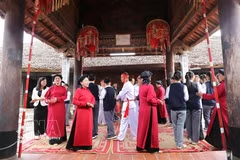
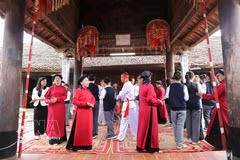
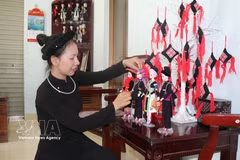
Artisans and students take part in cultural activities and exchanges in the Xoan singing performance space at Hung Lo ancient communal house in Phu Tho province (Photo: VNA)

Ancestral legends revived through contemporary performance

Beyond cultural value, well-organised festival programmes linked with tourism and media can contribute to the development of cultural industries and enhance Vietnam’s cultural soft power, positioning heritage-based events as distinctive national cultural brands in the international arena.

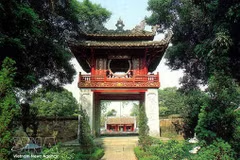
Khue Van Cac (Khue Van Pavilion) stands as a defining cultural symbol of Hanoi, closely associated with Vietnam’s long-standing tradition of valuing education and honouring knowledge. (Photo: VNA)

Greater efforts needed for heritage to shape Hanoi’s identity

As suggested by UNESCO experts, heritage should be approached as an integrated system encompassing space, people and everyday life. This perspective can inform urban planning, cultural tourism development and the creation of clear economic drivers.

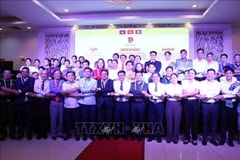
Participants at the gathering (Photo: VNA)

Lao, Cambodian students welcome traditional New Year in Ho Chi Minh City

In his speech, Vice Chairman of the municipal People’s Committee Nguyen Manh Cuong said the municipal Party organisation, authorities and people always value the close ties and solidarity among Vietnam, Laos and Cambodia. He described the three nations’ longstanding ties, forged through shared hardships, as an invaluable spiritual asset and a bedrock for sustainable development.

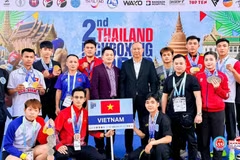
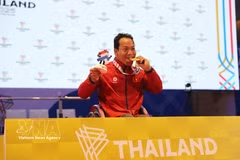
Vietnamese kickboxers win 32 gold medals at the Kickboxing World Cup 2026. (Photo: Vietnam Kickboxing Federation)

Vietnam finish third at Kickboxing World Cup 2026

According to Vu Duc Thinh, President of the Vietnam Kickboxing Federation, the strong results reflected careful preparation by local training centres and the determination of Vietnamese fighters. The team’s participation, funded largely through socialised and local resources, also demonstrated growing support for the development of kickboxing in Vietnam.

Politburo member, Secretary of the Party Central Committee and Head of the Party Central Committee’s Commission for Information, Education and Mass Mobilisation Trinh Van Quyet speaks at the event (Photo: VNA)

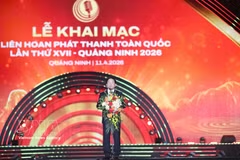
National Radio Festival opens in Quang Ninh

The opening night was combined with an artistic programme titled “sounds of the new era,” drawing around 50,000 spectators. The programme was structured in three chapters: Origins of Sound, Heritage Sound, and Sound of the New Era.

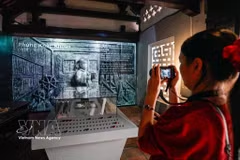
Visitors enjoy the "Stone History Preserves Memories" exhibition, featuring a traditional format combined with digital technology solutions (Photo: VNA)

Project on digital transformation in cultural sector approved

By 2030, the project targets the establishment of shared digital platforms across 100% of cultural sectors. All digitised cultural heritage will be standardised under the national data framework and shared in accordance with regulations, while 80% of public digital heritage assets are expected to receive digital identifiers to clarify ownership and management, encouraging organisations and individuals to do the same and support market development.