Top Vietnamese leader visits China’s Xiong'an New Area

Established in April 2017, the Xiong’an New Area is regarded by China as an important historical strategic choice of the Communist Party of China (CPC) Central Committee, following the development of the Shenzhen Special Economic Zone in Guangdong and the Pudong New Area in Shanghai.
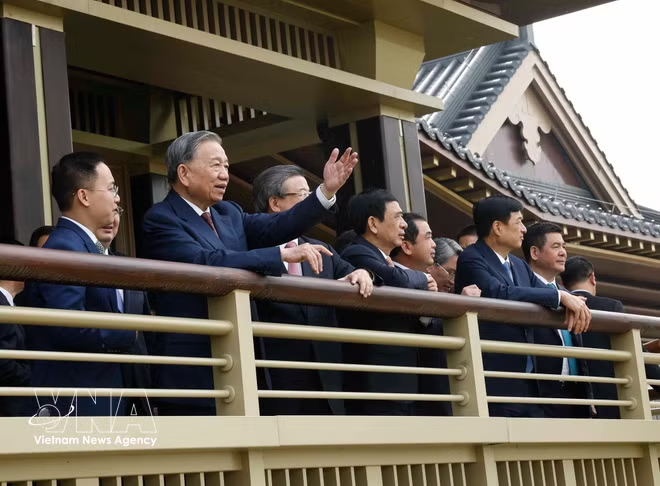
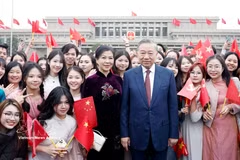
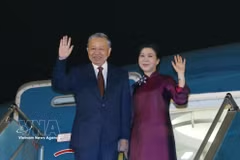
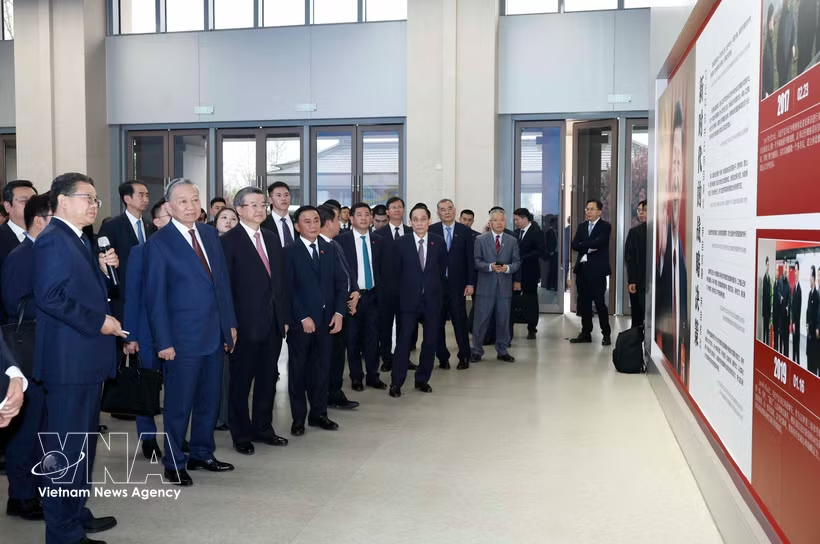
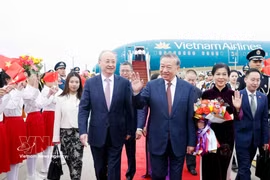
Party General Secretary and State President To Lam and his entourage visit the Xiong'an New Area in Hebei province on April 14. (Photo: VNA)

Beijing (VNA) - General Secretary of the Communist Party of Vietnam Central Committee and State President To Lam visited the Xiong'an New Area in Hebei province on April 14, shortly after arriving in Beijing International Airport for his four-day state visit to China.

The Vietnamese leader and his entourage were briefed on the master plan and development model of Xiong’an by Secretary of the Hebei provincial Party Committee Ni Yuefeng, who accompanied the delegation during the trip.

Established in April 2017, the Xiong’an New Area is regarded by China as an important historical strategic choice of the Communist Party of China (CPC) Central Committee, following the development of the Shenzhen Special Economic Zone in Guangdong and the Pudong New Area in Shanghai.

vnanet-tl1.jpg
Party General Secretary and State President To Lam and his entourage visit the Xiong'an New Area in Hebei province on April 14. (Photo: VNA)

Covering 1,770 sq.km in Hebei, about 110 km southwest of Beijing, the area lies at the heart of the Beijing–Tianjin–Hebei economic triangle and had a population of roughly 1.4 million as of 2025.

The new area is envisioned as a model for innovation-driven, green and smart urban development, serving as a new growth pole for the region while advancing coordinated development and opening-up.

After nine years, Xiong’an has transitioned from "basic construction" to "high-quality construction". More than 400 branches of centrally administered state-owned enterprises have relocated their headquarters here, alongside new campuses of major universities such as Beijing Jiaotong University, China University of Geosciences, Beijing University of Technology, and Beijing Forestry University. Several hospitals are now operational, providing high-quality healthcare services. By late 2025, about 169,000 residents had been relocated to the area.

Xiong’an has now developed a “three-layer” urban structure, integrating ground infrastructure, underground utilities, and cloud-based digital services. More than 200 km of digital roads, enabling commercial testing of autonomous vehicles, with integrated 5G, radar, and smart traffic signal systems.

As of March 2026, the Zhongguancun Science Park in Xiong'an had attracted over 260 hi-tech enterprises, focusing on artificial intelligence, biotechnology, and low-altitude economy./.
VNA

See more

National Assembly Chairman visits Vietnamese community in Italy (Photo: VNA)

NA Chairman meets Vietnamese community in Italy

National Assembly Chairman Tran Thanh Man reaffirmed that the Party and State consistently place people at the centre of development, stressing that overseas Vietnamese are an inseparable part of the nation and an important resource for national growth.

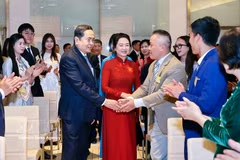
Party General Secretary and State President To Lam and his spouse meet with staff of the Vietnamese Embassy and representatives of the Vietnamese community in China on April 14. (Photo: VNA)

Top leader meets Vietnamese diplomatic staff, community in China

The leader commended the Vietnamese Embassy and agencies in China for their efforts in handling a large workload across a vast area, closely following the Party’s guidelines and effectively carrying out tasks related to external relations, economic diplomacy, cultural diplomacy, and overseas Vietnamese affairs.

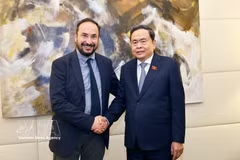
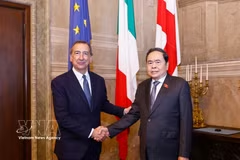
National Assembly Chairman Tran Thanh Man (right) and Maurizio Acerbo, General Secretary of the Communist Refoundation Party (PRC) of Italy, at their meeting on April 14 (Photo: VNA)

NA Chairman meets Italy’s Communist Reconstruction Party leader in Rome

Regarding future cooperation orientations, National Assembly Chairman Tran Thanh Man suggested that the two parties enhance mutual understanding and exchanges, deepen relations in a substantive manner, and promote their roles in strengthening multifaceted cooperation between the two countries. He called for increased people-to-people exchanges and cooperation in culture, arts, education and training, tourism, and locality-to-locality links.

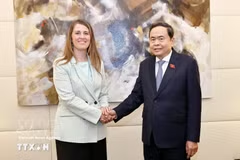
National Assembly Chairman Tran Thanh Man meets Chairwoman of the Italy – Vietnam Parliamentary Friendship Group Chiara Gribaudo. (Photo: VNA)

Vietnam – Italy parliamentary friendship strengthened

Welcoming the top Vietnamese legislator and a high-level delegation of Vietnam to Italy, Gribaudo highly valued the growing cooperation between the two parliaments, and expressed her hope that the Italy – Vietnam Parliamentary Friendship Group will soon organise a visit to Vietnam to further strengthen bilateral ties.

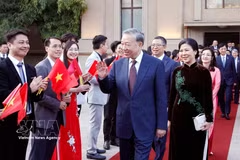
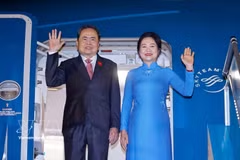
Vietnamese students in China welcome Party General Secretary and State President To Lam’s visit to China and his spouse at the airport (Photo: VNA)

Top Vietnamese leader’s visit to China carries significance: Chinese scholar

Party General Secretary and State President To Lam’s visit to China from April 14-17 will inject fresh momentum into the Comprehensive Strategic Cooperative Partnership, intensify connectivity, and create conditions to upgrade cooperation in trade, infrastructure, security, and people-to-people ties, ultimately supporting regional peace, stability, and prosperity.

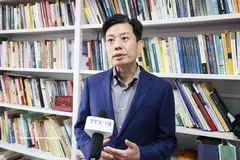
Professor Cui Shoujun of the School of International Studies at Renmin University of China in an interview with the Vietnam News Agency (VNA)'s reporters. (Photo: VNA)

Top Vietnamese leader’s visit hoped to provide fresh momentum for bilateral ties: Chinese professor

According to Professor Cui, the visit underscores the guiding role of high-level diplomacy in shaping the bilateral relations. The decision by Vietnam’s top leader to choose China for his first overseas trip shortly after assuming the presidency highlights the strategic significance of the bilateral ties and reaffirms the long-standing friendship often described as “both comrades and brothers.”

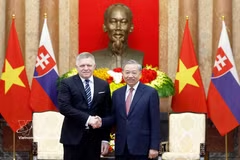
Party General Secretary and State President To Lam receives Prime Minister of Slovakia Robert Fico on April 13. (Photo: VNA)

Slovak PM concludes official visit to Vietnam

The visit by Prime Minister of Slovakia Robert Fico on April 12-14 was described as a vivid demonstration of Slovakia’s goodwill and high regard for the traditional friendship between the two countries, marking a significant milestone that opens a new phase of more stable and substantive development in bilateral ties.

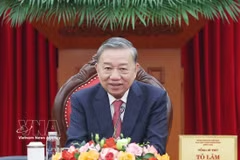
General Secretary of the Communist Party of Vietnam Central Committee and State President To Lam (Photo: VNA)

Promoting traditional friendship, enhancing strategic connectivity between Vietnam and China: Top leader

Building on the foundation of friendship carefully nurtured by previous generations of leaders of the two countries, on the high-level common perceptions that have been established, on the determination of agencies, sectors and localities, and on the support of the people of both countries, Vietnam–China relations will certainly continue to develop in a stable, healthy and long-term sustainable manner, bringing more tangible benefits to the two Parties, States and peoples, and making increasingly positive contributions to peace, stability, cooperation and development in the region and the world.