Japan attaches importance to developing Comprehensive Strategic Partnership with Vietnam

Amidst the growing unpredictability of the global situation in recent years, Japan intends to support Vietnam as it plays an active role in ensuring the peace, stability, and prosperity of the international community.

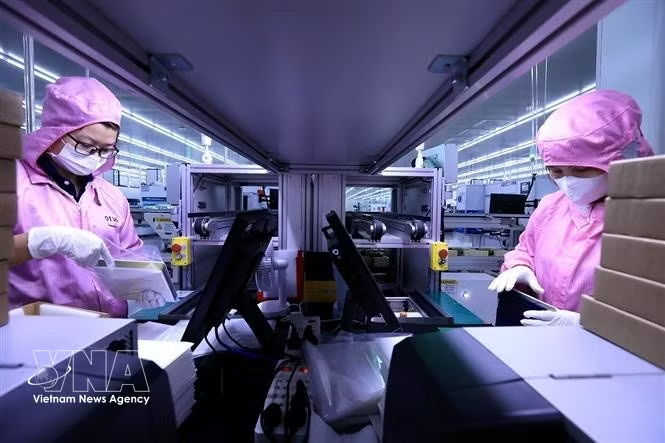
Employees work at Toyo Solar Co. Ltd., a Japanese-invested company in the Cam Khe Industrial Park of Phu Tho province, with a total investment of 200 million USD in 2023. (Photo: VNA)

Hanoi (VNA) – Amid an increasingly complex security environment in the Asia-Pacific region, the development of the Vietnam-Japan Comprehensive Strategic Partnership for Peace and Prosperity in Asia and the World is becoming ever more significant.

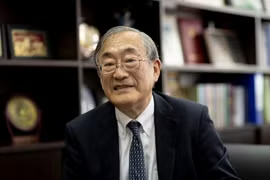
This assessment was made by Kanikawa Wakana, First Secretary and Director of the Information and Culture Centre at the Embassy of Japan in Vietnam, in a recent statement regarding the foreign policy of Japanese Prime Minister Takaichi Sanae, which places particular emphasis on Vietnam-Japan relations.

According to her, at the 14th National Party Congress, Vietnam highlighted its "strategic self-reliance" in diplomacy and the deepening of international integration. As this year's chair of the Comprehensive and Progressive Agreement for Trans-Pacific Partnership (CPTPP) and the Review Conference of the Parties to the Treaty on the Non-Proliferation of Nuclear Weapons (NPT), and as the host of Asia-Pacific Economic Cooperation (APEC) next year, the country is significantly enhancing its presence in the international arena.

She said that amidst the growing unpredictability of the global situation in recent years, Japan intends to support Vietnam as it plays an active role in ensuring the peace, stability, and prosperity of the international community.

The diplomat noted that in terms of security, Vietnam and Japan held their first Vice-Ministerial "2+2" Foreign Affairs and Defence Dialogue in Tokyo late last year. Around the same time, the Vietnamese Navy frigate Tran Hung Dao made its first port call to Japan. In Vietnam, the Japan Maritime Self-Defence Force destroyer Onami visited Vung Tau in March, and the destroyer Asahi is scheduled to make a goodwill visit to Da Nang in April.

This shows that cooperation between the two countries in the fields of diplomacy and security is steadily increasing, said Kanikawa.

In the economic sphere, she noted, cooperation based on the Comprehensive Strategic Partnership (CSP) is making steady progress. Last year, Japanese investment in Vietnam reached 3.1 billion USD, a 20% increase from the previous year, bringing the cumulative total to 80 billion USD. Annual bilateral trade has grown 1.8 times over the past decade, now reaching 50 billion USD.

She said under the leadership of Party General Secretary and State President To Lam, the reforms have gradually moved into the implementation phase and the investment environment has further improved, presenting significant opportunities for Japanese companies to expand their operations.

For Vietnam to achieve double-digit growth in the coming years, Kanikawa suggested the key lies in sectors such as semiconductors, digital transformation (DX), green transition (GX), and disaster prevention. These areas are set to become new pillars of cooperation between Vietnam and Japan.

Regarding the semiconductor sector, the diplomat observed that Vietnam wants to train 500 doctoral students by 2030. In support of this, Japan has announced its commitment to host approximately 250 of these students – half of the target – through international joint research programmes.

She added that joint research initiatives between Japanese and Vietnamese universities have already commenced, with five projects selected in the first call for proposals, through which 63 doctoral students are expected to be hosted. Subsequent second and third calls for proposals are scheduled to follow. At the Vietnam-Japan University (VJU), established by both countries, 106 students are currently enrolled in the "Semiconductor Chip Technology Programme," which was launched last October.

In light of the recent situation in the Middle East, clean energy is becoming increasingly vital, and Japanese capital and technology can be effectively utilised, Kanikawa noted. Through the Asia Zero Emission Community (AZEC) launched by Japan, the two countries have agreed on the pilot of 15 investment projects totalling approximately 20 billion USD. These include renewable energy such as offshore wind power, as well as LNG thermal power. These are very important projects for both sides, she stressed./.

VNA
See more

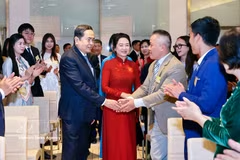
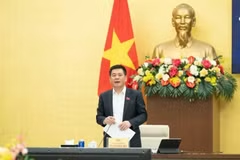
National Assembly Chairman visits Vietnamese community in Italy (Photo: VNA)

NA Chairman meets Vietnamese community in Italy

National Assembly Chairman Tran Thanh Man reaffirmed that the Party and State consistently place people at the centre of development, stressing that overseas Vietnamese are an inseparable part of the nation and an important resource for national growth.

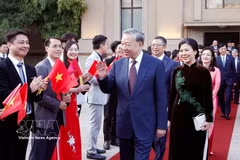
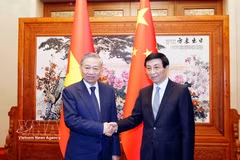
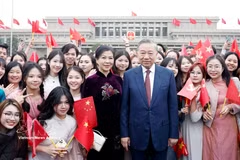
Party General Secretary and State President To Lam and his spouse meet with staff of the Vietnamese Embassy and representatives of the Vietnamese community in China on April 14. (Photo: VNA)

Top leader meets Vietnamese diplomatic staff, community in China

The leader commended the Vietnamese Embassy and agencies in China for their efforts in handling a large workload across a vast area, closely following the Party’s guidelines and effectively carrying out tasks related to external relations, economic diplomacy, cultural diplomacy, and overseas Vietnamese affairs.

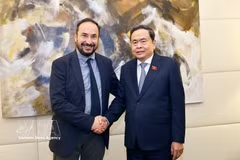
National Assembly Chairman Tran Thanh Man (right) and Maurizio Acerbo, General Secretary of the Communist Refoundation Party (PRC) of Italy, at their meeting on April 14 (Photo: VNA)

NA Chairman meets Italy’s Communist Reconstruction Party leader in Rome

Regarding future cooperation orientations, National Assembly Chairman Tran Thanh Man suggested that the two parties enhance mutual understanding and exchanges, deepen relations in a substantive manner, and promote their roles in strengthening multifaceted cooperation between the two countries. He called for increased people-to-people exchanges and cooperation in culture, arts, education and training, tourism, and locality-to-locality links.

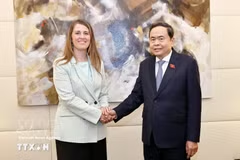
National Assembly Chairman Tran Thanh Man meets Chairwoman of the Italy – Vietnam Parliamentary Friendship Group Chiara Gribaudo. (Photo: VNA)

Vietnam – Italy parliamentary friendship strengthened

Welcoming the top Vietnamese legislator and a high-level delegation of Vietnam to Italy, Gribaudo highly valued the growing cooperation between the two parliaments, and expressed her hope that the Italy – Vietnam Parliamentary Friendship Group will soon organise a visit to Vietnam to further strengthen bilateral ties.

Vietnamese students in China welcome Party General Secretary and State President To Lam’s visit to China and his spouse at the airport (Photo: VNA)

Top Vietnamese leader’s visit to China carries significance: Chinese scholar

Party General Secretary and State President To Lam’s visit to China from April 14-17 will inject fresh momentum into the Comprehensive Strategic Cooperative Partnership, intensify connectivity, and create conditions to upgrade cooperation in trade, infrastructure, security, and people-to-people ties, ultimately supporting regional peace, stability, and prosperity.

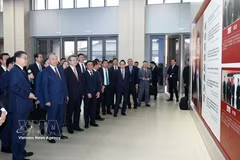
Party General Secretary and State President To Lam and his entourage visit the Xiong'an New Area in Hebei province on April 14. (Photo: VNA)

Top Vietnamese leader visits China’s Xiong'an New Area

Established in April 2017, the Xiong’an New Area is regarded by China as an important historical strategic choice of the Communist Party of China (CPC) Central Committee, following the development of the Shenzhen Special Economic Zone in Guangdong and the Pudong New Area in Shanghai.

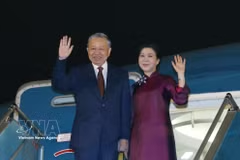
General Secretary of the Communist Party of Vietnam (CPV) Central Committee and State President To Lam and his spouse Ngo Phuong Ly are welcomed at Beijing Capital International Airport on April 14 morning. (Photo: VNA)

Top Vietnamese leader arrives in Beijing, beginning state visit to China

The state visit marks a new beginning in the bilateral relations as both countries enter a new stage of development. Vietnam is stepping into a new development era following the successful 14th National Party Congress, while China is embarking on the implementation of its 15th five-year socio-economic development plan.

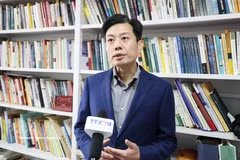
Professor Cui Shoujun of the School of International Studies at Renmin University of China in an interview with the Vietnam News Agency (VNA)'s reporters. (Photo: VNA)

Top Vietnamese leader’s visit hoped to provide fresh momentum for bilateral ties: Chinese professor

According to Professor Cui, the visit underscores the guiding role of high-level diplomacy in shaping the bilateral relations. The decision by Vietnam’s top leader to choose China for his first overseas trip shortly after assuming the presidency highlights the strategic significance of the bilateral ties and reaffirms the long-standing friendship often described as “both comrades and brothers.”

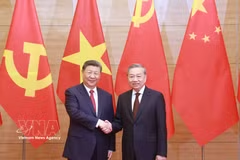
Party General Secretary To Lam (R) welcomes Party General Secretary and President of China Xi Jinping in Hanoi in April 2025. (Photo: VNA)

Vietnam–China: New momentum for trade growth

In 2025, China remained Vietnam’s largest trading partner. Conversely, Vietnam was China’s biggest trading partner in ASEAN and ranked fourth globally, with two-way trade reaching 256.4 billion USD, up 24.8% year-on-year. In the first two months of 2026 alone, trade turnover hit 66.7 billion USD, an increase of 30.2%.

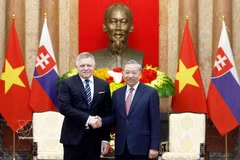
Party General Secretary and State President To Lam receives Prime Minister of Slovakia Robert Fico on April 13. (Photo: VNA)

Slovak PM concludes official visit to Vietnam

The visit by Prime Minister of Slovakia Robert Fico on April 12-14 was described as a vivid demonstration of Slovakia’s goodwill and high regard for the traditional friendship between the two countries, marking a significant milestone that opens a new phase of more stable and substantive development in bilateral ties.