Vietnam, Japan advance new-generation ODA loan to accelerate green transition

The programme loan is viewed as a next-generation ODA model, designed with simplified preparation processes, accelerated disbursement mechanism, and closer alignment with policy reforms and resource mobilisation for sustainable development.

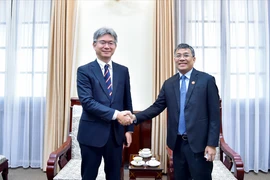
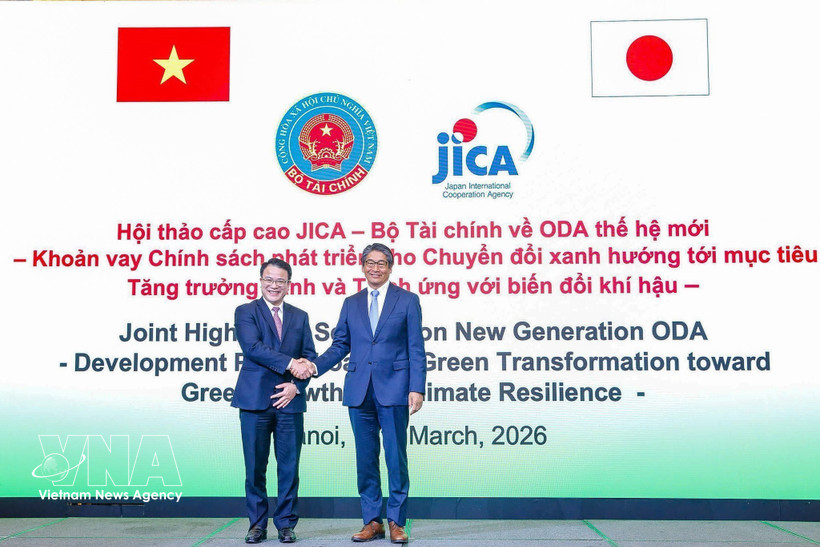
Deputy Minister of Finance Tran Quoc Phuong (left) and Japanese Ambassador to Vietnam Ito Naoki at the seminar (Photo: VNA)

Hanoi (VNA) – Japan is set to extend a new-generation official development assistance (ODA) loan worth 50 billion JPY (around 320 million USD) to Vietnam, featuring streamlined procedures and faster disbursement to support the country’s green transition efforts.

Expected to be signed in March 2026, the agreement will represent the second budget-support loan provided by the Japanese Government for Vietnam since 2023.

The programme loan is viewed as a next-generation ODA model, designed with simplified preparation processes, accelerated disbursement mechanism, and closer alignment with policy reforms and resource mobilisation for sustainable development.

Addressing a seminar on the programme loan for green transformation toward green growth and climate resilience on March 18, Japanese Ambassador to Vietnam Ito Naoki highlighted that the loan demonstrates Japan’s strong commitment to assisting Vietnam in advancing green growth, implementing its Nationally Determined Contributions (NDCs), and strengthening resilience to climate change and natural disasters.

He noted that the initiative moves beyond conventional lending by encouraging the application of advanced Japanese technologies, including artificial intelligence (AI) and satellite-based monitoring data, to support Vietnam’s green transition and disaster risk management. It is regarded as a new cooperation framework for Japan’s ODA deployment.
vnanet-potal-hoi-thao-oda-the-he-moi-khoan-vay-chinh-sach-cho-chuyen-doit-xanh-huong-toi-muc-tieu-tang-truong-xanh-va-thich-ung-voi-bien-doi-khi-hau-8648853.jpg
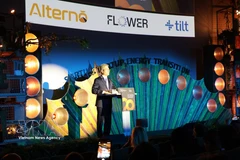
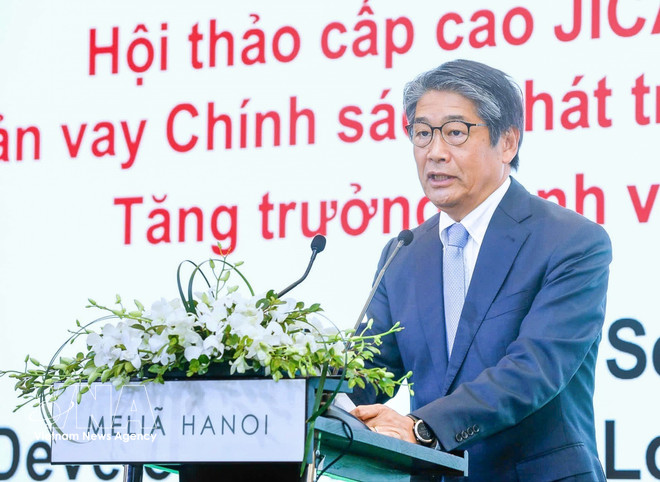
Japanese Ambassador to Vietnam Ito Naoki speaks at the seminar. (Photo: VNA)

Vietnamese Deputy Minister of Finance Tran Quoc Phuong said the loan is structured around three key pillars. The first focuses on developing and refining financial and investment incentive policies to promote wider participation in green transition areas, including carbon credit and green bond marketes. The second supports the drafting and implementation of policies linked to Vietnam’s NDC commitments. The third aims to enhance climate adaptation measures and strengthen disaster resilience and recovery capacity as Vietnam remains highly vulnerable to sea-level rise and extreme weather events.

Japan’s extensive experience in green transition and disaster risk management will help bolster Vietnam’s long-term response capacity through cooperation under the programme, Phuong noted.

The seminar, jointly organised by the Ministry of Finance and the Japan International Cooperation Agency (JICA), introduced the green transition budget-support programme and discussed policy measures supporting Vietnam’s national green growth strategy for 2021–2030, with a vision towards 2050.

At the 26th United Nations Climate Change Conference (COP26), Prime Minister Pham Minh Chinh pledged that Vietnam would achieve net-zero emissions by 2050. Since then, the country has continued refining its legal and policy frameworks to realise this commitment.

Through cooperation initiatives, including those supported by JICA, Japan has maintained active assistance for Vietnam’s green transition. JICA is currently implementing multiple technical cooperation projects covering forest conservation, disaster risk reduction, NDC implementation, and circular economy development.

During the seminar, Japanese enterprises also shared expertise, technologies, and solutions related to green transition and climate adaptation, opening up new opportunities for cooperation between government bodies and business communities of the two countries in the period ahead./.

VNA

See more

The domestic market, with over 100 million people, holds great potential for Vietnamese businesses. (Photo: VNA)

“Vietnamese Goods Vitality” event boosts domestic consumption, digital outreach

The event is among a series of initiatives planned for 2026 to stimulate the consumption of locally made products. Beyond serving as a showcase for goods, it is designed as a platform connecting businesses, consumers and key opinion leaders (KOLs), thereby enhancing the visibility of Vietnamese brands amid rapid digital transformation.

Vietnam is emerging as one of the world’s most dynamic markets for branded real estate. (Photo: VNA)

French media highlights Vietnam’s rise among global leaders in branded real estate

Citing Savills’ Branded Residences 2025–2026 report, the magazine noted that Vietnam now has more than 50 branded residential projects associated with 34 international brands, ranking fourth globally after the US, Saudi Arabia and Mexico. The development marks a notable step forward, reinforcing the country’s growing position in the global high-end property segment.

Highlands Coffee is among the coffee chains with the largest number of outlets in Vietnam. (Photo: VNA)

Vietnam’s beverage chain market exceeds 1.3 billion USD

Momentum Works' report Southeast Asia Coffee and Tea Chains 2026 shows Vietnam’s coffee chain segment reached 725 million USD last year, up 27% year-on-year, the region’s second-fastest growth after Malaysia. Tea chains were valued at 617 million USD, rising 28%, behind Thailand.

Minister of Finance Nguyen Van Thang speaks at the meeting. (Photo: Ministry of Finance)

Vietnam seeks enhanced financial, banking cooperation with China

Thang emphasised that Vietnam represents a highly attractive market for foreign investors and international banks. He encouraged ICBC to explore participation in the Vietnam International Financial Centre by sharing capital, expertise and management experience to contribute to the country's development in general and its financial market in particular.

Phu Tho province is working to attract high-quality FDI. (Illustrative photo: VNA)

Phu Tho pivots to high-quality FDI attraction

In 2026, Phu Tho aims to attract over 1.1 billion USD in FDI and around 70 trillion VND (2.66 billion USD) in domestic investment, positioning itself as a leading investment destination in the 2026–2030 period.

An overview of the meeting in Ho Chi Minh City to discuss measures to ease pressures on production and trade, and stablise the domestic market amid the escalating conflict in the Middle East. (Photo: VNA)

Measures sought to address business challenges amid Middle East conflict

Vietnam is facing a three-stage ripple effect - first on transport and fuel-dependent industries, then on sectors relying on their outputs, and ultimately on consumers. Volatility in key commodities like fuel is disrupting the entire supply chain and increasing the risk of market instability.