Top Vietnamese leader’s visit hoped to provide fresh momentum for bilateral ties: Chinese professor

According to Professor Cui, the visit underscores the guiding role of high-level diplomacy in shaping the bilateral relations. The decision by Vietnam’s top leader to choose China for his first overseas trip shortly after assuming the presidency highlights the strategic significance of the bilateral ties and reaffirms the long-standing friendship often described as “both comrades and brothers.”

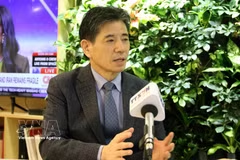
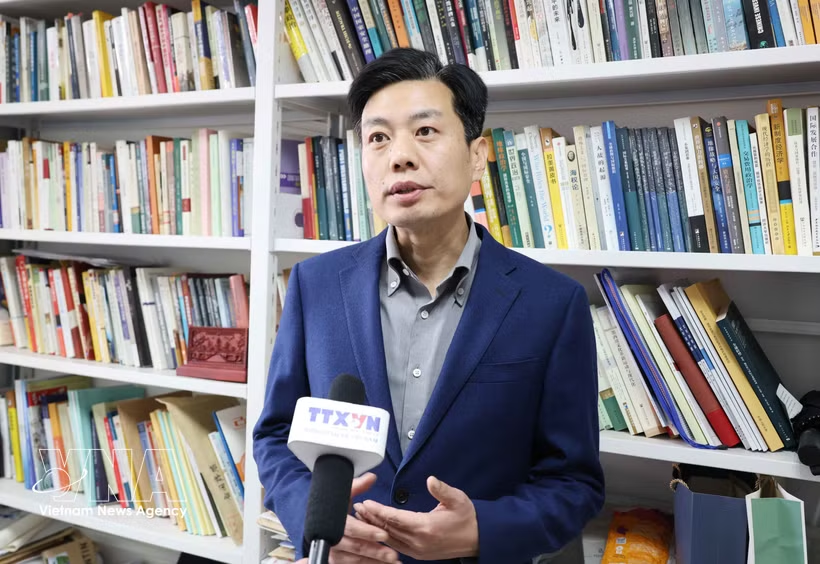
Professor Cui Shoujun of the School of International Studies at Renmin University of China in an interview with the Vietnam News Agency (VNA)'s reporters. (Photo: VNA)

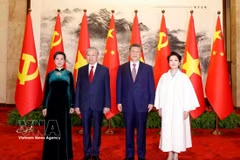
Hanoi (VNA) – The state visit to China by General Secretary of the Communist Party of Vietnam (CPV) Central Committee and State President To Lam from April 14-17 carries significantly strategic importance and opens up new avenues for substantive cooperation between the two countries amid a complex regional and global landscape.

This assessment was shared by Professor Cui Shoujun of the School of International Studies at Renmin University of China in an interview with Vietnam News Agency (VNA)'s resident correspondents in Beijing.

According to Professor Cui, the visit underscores the guiding role of high-level diplomacy in shaping the bilateral relations. The decision by Vietnam’s top leader to choose China for his first overseas trip shortly after assuming the presidency highlights the strategic significance of the bilateral ties and reaffirms the long-standing friendship often described as “both comrades and brothers.”

Amid complicated developments of the global situation, the trip and high-level talks are expected to enhance exchanges on regional and international issues, thereby contributing to international stability and security governance. With rapid advancements in emerging technologies and modern industries, both countries are well positioned to deepen cooperation in economic development, science and technology, and industrial production, generating new growth drivers and employment opportunities, Prof. Cui assessed.

Highlighting key highlights of the visit, the professor noted that its most prominent feature lies in its practical orientation and the shared commitment to improving the quality of collaboration. Strengthening alignment between development strategies and planning frameworks will provide a solid foundation for more comprehensive collaboration, he stated, adding that China’s strengths in new energy, photovoltaics, energy storage, and power generation, combined with Vietnam’s growing demand for industrialisation, make energy cooperation a priority area with tangible mutual benefits.

Regarding future prospects, the professor emphasised that significant potential remains untapped, especially in renewable energy, artificial intelligence, and infrastructure development. Efforts to enhance railway connectivity, upgrade border gate systems, and promote cross-border exchanges will play a crucial role in improving the efficiency of bilateral trade and economic cooperation.

Prof. Cui also expressed his confidence that, Vietnam–China cooperation will continue to evolve in a more substantive, effective, and in-depth manner, given the strong existing foundation and the strategic direction set by their high-ranking leaders.

The visit is widely expected to inject fresh momentum into the bilateral relations in the coming period. With political trust further consolidated and cooperation increasingly focused on quality and practical outcomes, both countries are well positioned to expand collaboration across key sectors, including economy, technology, energy, and infrastructure connectivity. In a world marked by ongoing uncertainties, closer coordination will not only support their respective development goals but also contribute positively to regional stability, cooperation, and sustainable growth./.

VNA
See more

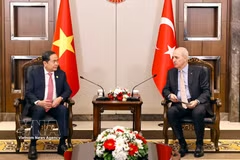
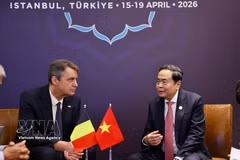
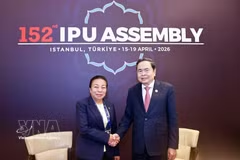
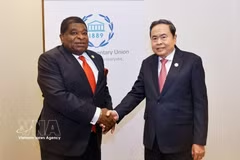
Chairman of the Vietnamese National Assembly Chairman Tran Thanh Man (left) meets with Speaker of the Grand National Assembly of Türkiye Numan Kurtulmus in Istanbul on April 17. (Photo: VNA)

Top legislators of Vietnam, Türkiye meet on sidelines of IPU-152 in Istanbul

The top Vietnamese legislator expressed his admiration for Türkiye’s cultural identity and its friendly, hospitable people, while highly valuing the European country’s growing role and position at multilateral forums and in regional mediation efforts. He affirmed that Vietnam attaches importance to strengthening ties with Türkiye.

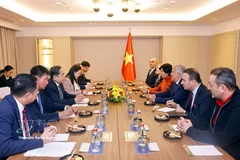
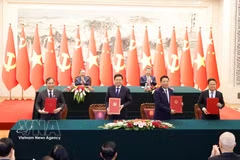
Officials sign cooperation documents in the presence of Party General Secretary and President of Vietnam To Lam, and his Chinese counterpart Xi Jinping on April 15, 2026. (Photo: VNA)

Vietnam, China sign 32 cooperation documents

The documents include a cooperation plan between the Communist Party of Vietnam (CPV) and the Communist Party of China (CPC) for the 2026–2030 period; a memorandum of understanding (MoU) on cooperation between the Organisation Commission of the CPV Central Committee and its Chinese counterpart; and a cooperation agreement between the Ministry of Foreign Affairs of Vietnam and the International Liaison Department of the CPC Central Committee.

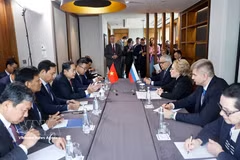
The meeting between Chairman of the Vietnamese National Assembly Tran Thanh Man and Speaker of the Federation Council of Russia’s Federal Assembly Valentina Matviyenko in Istanbul, Türkiye, on April 17 (Photo: VNA)

Parliamentary leaders hail development of Vietnam – Russia ties

The top legislator of Vietnam proposed that both sides deepen political and diplomatic connections, as well as parliamentary cooperation, through delegation exchanges, high-level meetings through various channels, and the successful organisation of a visit to Vietnam by the Speaker of Russia’s Federation Council and a trip to Russia by the NA Chairman to co-chair the 5th session of the Inter-Parliamentary Cooperation Committee in 2026.

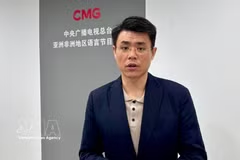
Wei Wei, a researcher on Vietnam and head of the Vietnamese-language service at the China Media Group, grants an interview to the Vietnam News Agency. (Photo: VNA)

Expert highlights new trends in Vietnam – China relations

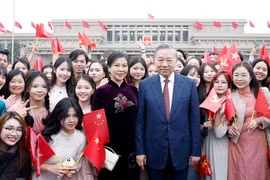
A Chinese expert has paid attention to General Secretary and President To Lam's visit to the Xiong'an New Area, meeting with youth representatives of both countries together with his Chinese counterpart Xi Jinping, and experience of high-speed rail travel.

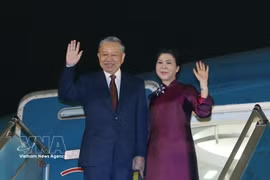
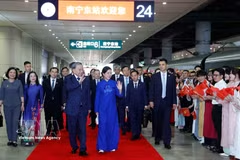
General Secretary of the Communist Party of Vietnam (CPV) Central Committee and State President To Lam and his spouse, together with a high-level Vietnamese delegation, leave Nanning on April 17, successfully concluding their state visit to China from April 14–17 (Photo: VNA)

General Secretary, State President To Lam concludes state visit to China

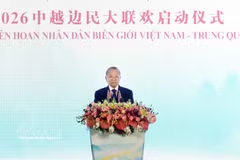
The trip also included meetings with Vietnamese diplomatic staff and the Vietnamese community in China, exchanges with relatives of Chinese generals, experts and others who had supported Vietnam-China friendship, attendance at a Vietnam - China friendship art programme, a visit to the historic Nanning Yucai School, and participation in activities launching a Vietnam–China Border People’s Festival 2026.

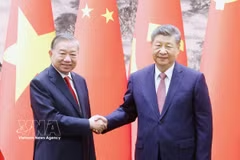
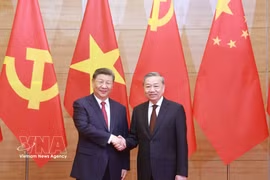
General Secretary of the Communist Party of China (CPC) Central Committee and President Xi Jinping (R) welcomes General Secretary of the Communist Party of Vietnam (CPV) Central Committee and State President To Lam (Photo: VNA)

Vietnam, China issue joint statement on deepening Comprehensive Strategic Cooperative Partnership in new era

The State visit to China by Party General Secretary and State President To Lam was a great success, positively contributing to strengthening the traditional friendship and accelerating the building of the Vietnam–China community with a shared future that carries strategic significance, thus promoting peace, stability, development, and prosperity in the region and the world.