Ho Chi Minh City (VNA) – As Vietnam accelerates digital banking and develops an international financial centre, cooperation with Australia in financial technology (fintech) and regulatory technology (regtech) is expected to unlock significant opportunities for building a modern, transparent, and globally connected financial ecosystem.
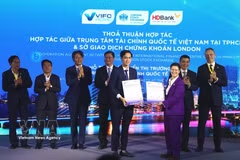
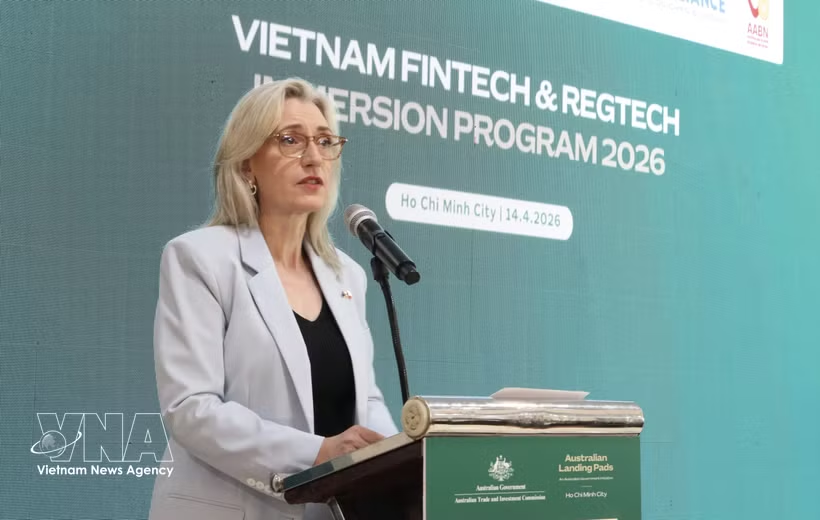
The outlook was highlighted at a conference on the strategic vision for the Vietnam International Financial Centre in Ho Chi Minh City (VIFC-HCMC) and Vietnam–Australia cooperation potential, jointly organised on April 14 by the Australian Trade and Investment Commission and the VIFC-HCMC executive authority.
Emma McDonald, Australian Senior Trade and Investment Commissioner, said Vietnam is emerging as an attractive destination for fintech development, with one of the region’s most dynamic digital banking markets. Growth is being driven by expanding digital payments, rapid adoption of mobile financial services, and rising interest in artificial intelligence and data-driven banking models.
She noted that Vietnam’s young population, stable environment, and strong GDP growth further position the country as a future regional digital leader. Government initiatives, including plans to establish international financial centres and regulatory sandbox mechanisms for areas such as credit scoring, peer-to-peer lending, and digital assets, are laying a strong foundation for further development.
According to McDonald, the development of the VIFC-HCMC reflects Vietnam’s ambition to become a globally connected financial hub. However, she stressed that success depends not only on capital or infrastructure, but on building a trustworthy, data-driven, and inclusive financial ecosystem.
Australia, meanwhile, has one of the world’s leading fintech ecosystems, ranking sixth globally and second in the Asia-Pacific, with nearly 900 active firms. Australian companies have strengths in regtech, data governance, cybersecurity, payment infrastructure, and digital assets—areas that align with Vietnam’s priorities. Their experience in highly regulated environments could help Vietnam address challenges such as financial fraud, cybercrime, and security risks.
Rich McClellan, CEO of the VIFC-HCMC, said Vietnam has moved from policy planning to operational design for its VIFC in less than 18 months, with legal frameworks, governance structures, specialised courts, and arbitration mechanisms already outlined. However, the centre remains in an “institutional activation” phase, focusing on building a solid foundation for sustainable growth.
He noted that international investors are now more concerned about infrastructure readiness, legal reliability, and safe capital flows than growth rates. Therefore, the VIFC aims not only to create a trading platform but also to establish a robust compliance and supervisory architecture.
Pham Tuan Anh, Head of Technology at the VIFC, said the centre is envisioned as an international capital transit hub, targeting large-scale investments in infrastructure such as metro systems and high-speed railways. The model includes an “offshore within onshore” approach, integrated with global financial networks like SWIFT and supported by advanced security architecture.
The VIFC is developing six core technology pillars, including application infrastructure, real-time data systems, regtech and supervisory technology, central clearing, an international-standard data centre, and blockchain-based asset digitalisation./.
VNA