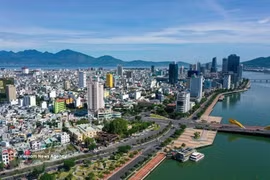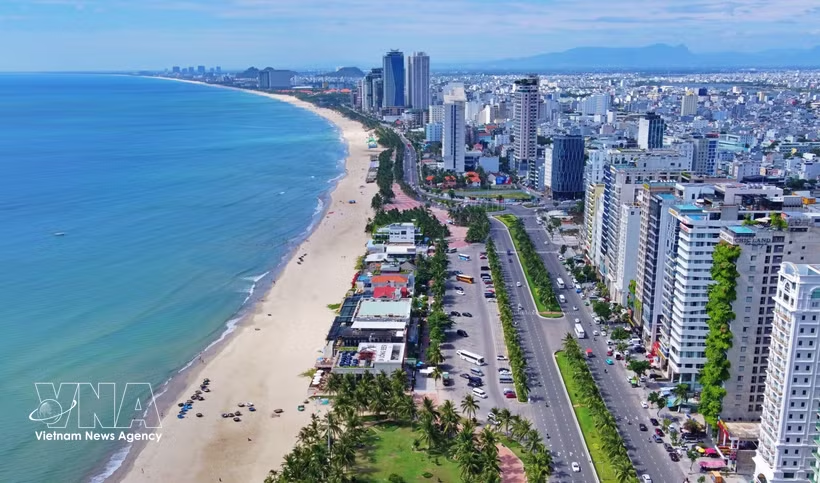
Da Nang (VNS/VNA) - Da Nang city is setting out an ambitious long-term vision to become a smart, livable urban centre and a key national hub for logistics, start-up innovation, finance, free trade, and sea-based economic growth by 2050, with a further goal of evolving into a global eco-city and desirable destination by 2075.
The city’s Master Plan for 2050–75, approved by the Government, aims to reshape the central city by merging with the former Quang Nam province, creating one of the largest urban areas among the country’s six centrally governed cities, with a total area of 11,859.59 sq.km.
The plan, signed by Deputy Prime Minister Tran Hong Ha, projects space for a population of up to six million and envisions a network of economically strong urban centers.
These include Da Nang’s downtown, the ancient town of Hoi An, Tam Ky township, the culturally rich Dien Ban town, and the logistics-focused Chu Lai open economic and industrial manufacturing zone. The Chu Lai area is expected to expand from 28,000 to 40,000 hectares in the coming decades.
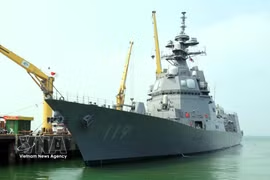
Da Nang is accelerating construction of an international logistics center, underpinned by a growing transport network that includes the Lien Chieu deep-sea port, Tien Sa and Chu Lai ports, and the international airports in Da Nang and Chu Lai.
The central hub is also expected to strengthen tourism and cultural industries, positioning them as key economic drivers. The city is home to globally recognised attractions such as the UNESCO-listed Hoi An Ancient Town and My Son Sanctuary, the Cham Islands–Hoi An World Biosphere Reserve, and the Ma Nhai cliff inscription collection at Ngu Hanh Son (Marble Mountains), which is inscribed on UNESCO’s Memory of the World Register for Asia and the Pacific.
The expanded Da Nang now includes around 500,000 hectares of protected natural areas across national parks and nature reserves. These include conservation programs for two critically endangered species, the saola (Pseudoryx nghetinhensis) and the grey-shanked douc langur (Pygathrix cinerea), as well as endangered species such as the red-shanked douc langur (Pygathrix nemaeus) and the Asian elephant (Elephas maximus).
Under a Government decision establishing the new administrative unit formed by merging Da Nang and Quang Nam, the city will comprise 94 local administrative units, including 23 wards, 70 communes, and a special administrative zone covering the Hoang Sa (Paracel) Islands.
The new Da Nang has attracted a total registered investment of 30.6 billion USD from domestic and foreign direct investment projects.
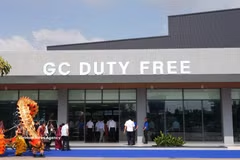
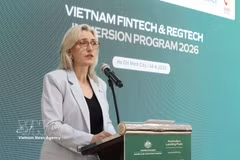
Authorities have launched Vietnam’s International Financial Centre in Da Nang (IFC Da Nang) and are moving ahead with plans for a free trade zone aimed at drawing global investment in high-tech industries, including semiconductors and artificial intelligence.
The planned 22-berth Lien Chieu Port is set to become a key logistics hub, linking north–south rail and road networks with the East–West Economic Corridor 2, which connects Thailand, Myanmar, Laos, and Vietnam through Da Nang’s port system. It is expected to operate as an international gateway port, the country’s third after Lach Huyen Port in Hai Phong and Cai Mep–Thi Vai.
The city has also proposed a 10 billion USD investment to upgrade Chu Lai International Airport to meet rising demand driven by tourism, investment, and logistics growth through 2050.
Twelve organisations and financial institutions have joined IFC Da Nang as members, including Makara Capital Vietnam Holding, Bybit Technology Vietnam, Da Nang Fintech Lab, Siglaw IFC, DTC Pay Vietnam, APEX Vietnam IFC Services, Valverde Investment Partners, Misa Novafinx, and Remi Tech.
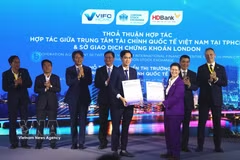
Memoranda of understanding on cooperation have also been signed with Newtechco Group, Deutsche Bank Vietnam, United Overseas Bank, JP Morgan Chase, Terne Holdings, TMC Academy Singapore, Yuan Ze University in Taiwan, the Institute of Chartered Accountants in England and Wales, and the Vietnam Blockchain Association to support the development of high-quality human resources for the IFC.
Da Nang has set a target of having at least five financial technology (FinTech) businesses with revenues of over 1 trillion VND (40 million USD) yearly, while the Free Trade Zone would contribute 17.9% to the city’s gross regional domestic product (GRDP)./.
VNA