Kuala Lumpur (VNA) – As global geopolitics undergoes profound shifts, particularly with ongoing conflicts in the Middle East impacting energy security and global economic flows, Vietnam is emerging as a standout example of resilience and adaptability, according to Shan Saeed, chief economist at Asian proptech group Juwai IQI.
In an interview granted to Vietnam News Agency correspondents in Kuala Lumpur, Saeed emphasised that in today’s era, energy is no longer merely a production input but a defining factor of national power and standing. He noted parallels with the 1970s, when geopolitical tensions were accompanied by oil price shocks, central banks accumulated gold, and the US dollar weakened, leading to high inflation and sluggish growth.
Against the current challenging backdrop, he noted, international observers view Vietnam as a model “success story” thanks to policy consistency and strong execution.
Assessing ASEAN, Saeed described the region as possessing “asymmetric resilience”, where countries with strong commodity buffers, fiscal space, and credible policies outperform others. Malaysia and Indonesia, for example, have demonstrated fiscal discipline by shifting from broad subsidies to targeted support mechanisms.
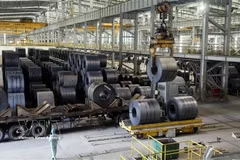
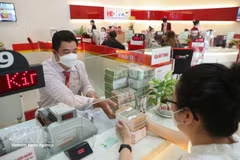
Vietnam, meanwhile, stands out for its sustained macroeconomic stability and robust industrial growth momentum. According to him, the country has maintained key fundamentals, including foreign exchange reserves, budget deficit control, debt-to-GDP ratios, and currency stability, through flexible monetary and fiscal policies. These achievements came as results of decades of the Government's skillful combination of economic tools for promoting growth.
One of Vietnam’s most notable strengths, he added, is policy consistency. Across areas such as industrialisation, energy, and education, the country has maintained a clear and stable development roadmap, boosting investor confidence.
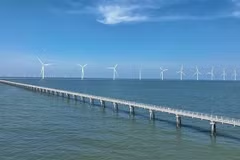
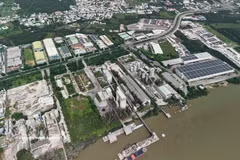
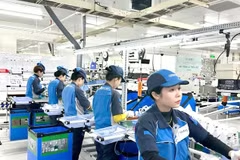
Entering a new energy era, Vietnam is approaching a critical phase where success will hinge on implementation. Under Power Development Plan VIII (PDP VIII), the country aims to increase its installed power capacity from the current 84 GW to as much as 236 GW by 2030, positioning itself among the world’s most ambitious energy investors. With cumulative foreign direct investment surpassing 500 billion USD, Vietnam is transitioning from a labour-intensive export-driven economy to a more advanced industrial and high-tech manufacturing hub.
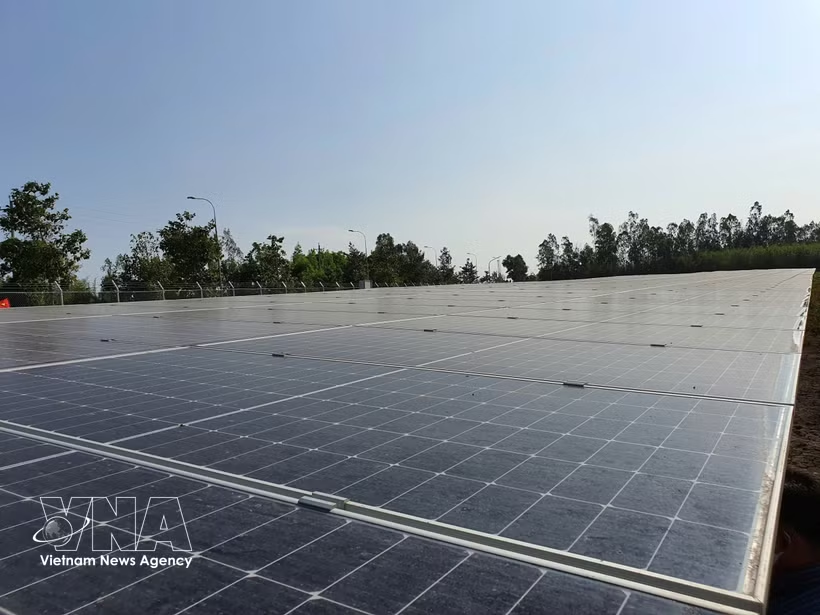
Strategic priorities such as grid modernisation, expansion of liquefied natural gas (LNG) infrastructure, and acceleration of renewable energy development are expected to serve as key growth drivers, the expert went on.
He forecast that alongside the Gulf Cooperation Council (GCC) and Africa, ASEAN – with Vietnam as a core pillar – will sustain stable growth over the next three to five years. Vietnam’s achievements over the past five to six years stand as clear evidence that sound governance can turn macroeconomic challenges into opportunities for breakthrough growth and long-term gains on the global economic map./.
Middle East tensions: ASEAN, World Bank warn of global economic fallout
Finance ministers and central bank governors of the Association of Southeast Asian Nations (ASEAN) on April 10 expressed concern over escalating tensions in the Middle East and their potentially serious impact on the global economy.