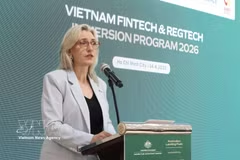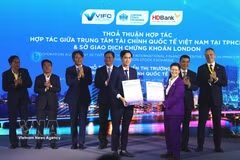
Hanoi (VNA) - A seminar held in Hanoi on April 13 by Nha Dau Tu (The Investor) magazine underscored the urgent need for Vietnam to shift from simply scaling up capital to delivering more effective, sustainable, and high-impact allocation as the economy enters its next growth phase.
Rather than acting merely as capital providers, financial entities must evolve into vital connectors within a tightly integrated ecosystem where banks, businesses, and capital markets function with far greater coordination and efficiency.
Toward an integrated financial ecosystem
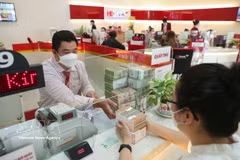
Speaking at the event, Deputy Governor of the State Bank of Vietnam Nguyen Ngoc Canh noted that as of December 31, 2025, Vietnam’s banking system comprised 127 credit institutions with total assets nearing 28.9 quadrillion VND (1.1 trillion USD), a 22% jump from late 2024 and nearly 2,000 times higher than four decades ago.
Capital mobilisation climbed 15.42% year-on-year, marking a nearly 1,300-fold hike over the nearly-40-year period. Several Vietnamese banks have also scaled up considerably and earned high international rankings.
According to Canh, economic groups remain core, reliable clients for the banking sector, which continues to finance production, trade, and especially large-scale projects of national socio-economic importance.
By the late 2025, total outstanding credit in the economy neared 18.6 quadrillion VND, up 19.07% from a year earlier and equivalent to 144% of GDP. Domestic enterprises accounted for about 48% of total credit, while economic groups and corporations made up roughly 7%.
The banking sector has stepped up adoption of sci-tech and digital transformation, rolling out modern payment solutions to broaden credit access. Meanwhile, the central bank has pursued a flexible, coordinated monetary policy to keep inflation in check, stabilise the macro-economy, and ensure capital flows reach all economic sectors.
While these efforts have kept credit flowing even in tough times, the traditional bank-based financing model is increasingly hitting its limits, particularly as demand surges for medium- and long-term funding to support strategic projects.
Vietnam’s high credit-to-GDP ratio signals heavy dependence on bank lending, while alternative channels such as corporate bonds, equity markets, and international financing have yet to fully play their roles.
From a research standpoint, Deputy Director of the Research Institute for Banking at the Banking Academy Assoc. Prof. Pham Manh Hung argued that reforming the financial system and developing capital markets are prerequisites for building economic groups capable of competing globally and regionally.
He called for a shift from a “single-channel” model to a “multi-layered, multi-channel” financial system, where all components are closely interconnected within a comprehensive ecosystem.
Directing capital to new growth drivers
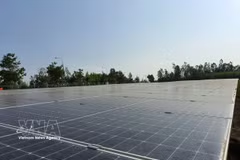
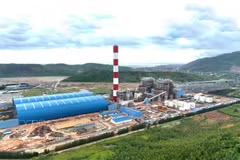
According to Vice Chairman of the Board of Directors and Deputy CEO of Saigon-Hanoi Commercial Joint Stock Bank (SHB) Do Quang Vinh, an integrated financial ecosystem would sharpen resource allocation, channeling capital into priority sectors such as infrastructure, energy, high technology, and modern agriculture, which hold strong value-added potential and growth momentum.
For the ecosystem to work effectively, capital markets must develop in tandem. Vietnam’s corporate bond market and long-term financial instruments remain constrained in scale, transparency, and depth, creating serious bottlenecks for long-term funding, Hung noted.
In his view, breaking these constraints demands bold institutional reforms, higher corporate governance standards, the rollout of robust credit rating systems, and a broader investor base. Strengthening linkages between domestic and international financial markets will also be critical to diversifying funding sources and easing pressure on the banking system.
Vietnam’s ambition for double-digit economic growth between 2026 and 2030 will require a solid, modern financial foundation to fuel new growth engines. Both state-owned and private economic groups are expected to act as powerful “engines” driving entire industries, sectors, and value chains.
Restructuring the financial system toward greater balance, modernisation, and global integration is indispensable so that Vietnamese economic groups could amass the necessary resources, sharpen their competitiveness, and gradually emerge as global and regional players, Hung added./.