Deposit rate cuts aim to balance growth support and macroeconomic stability

Under the newly announced framework, the State Bank of Vietnam is targeting inflation at around 4.5% per annum, while maintaining a flexible and accommodative monetary stance, with readiness to provide liquidity support when necessary.

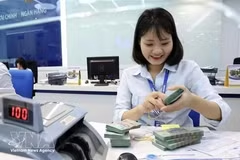
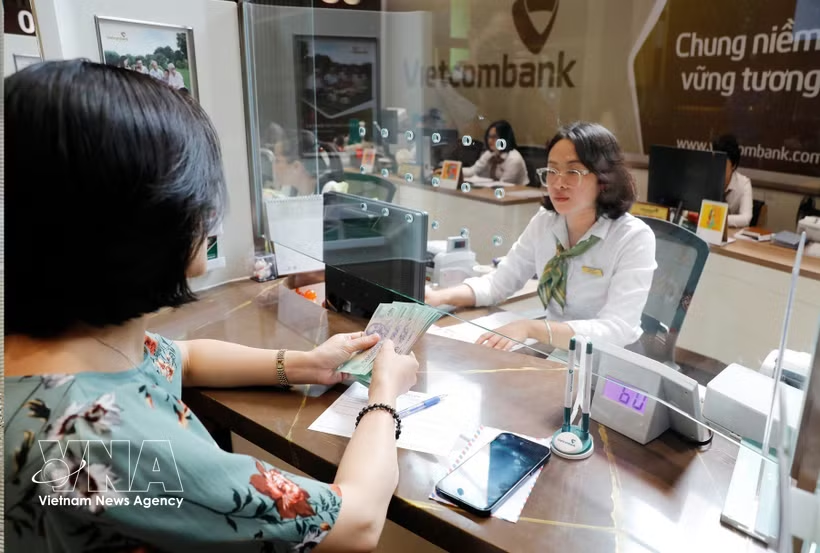
A customer conduct transactions at Vietcombank headquarters. (Photo: VNA)

Ho Chi Minh City (VNA) – A wave of deposit rate cuts is sweeping across the banking system following the direction from the State Bank of Vietnam (SBV), in a move aimed at reducing funding costs and improving access to credit for businesses and households. However, the policy shift underscores a complex balancing act, as pressures from inflation, exchange rates, and system liquidity remain.

From market distortions to a more balanced approach

Shortly after assuming office on April 9, newly appointed central bank governor Pham Duc An convened his first meeting with 46 credit institutions, outlining key monetary policy priorities for 2026.

Under the newly announced framework, the central bank is targeting inflation at around 4.5% per annum, while maintaining a flexible and accommodative monetary stance, with readiness to provide liquidity support when necessary.

Notably, commercial banks have been instructed to reduce deposit rates by 50–100 basis points on new deposits with maturities of six months or longer, effective from April 10. The move aligns with the Government’s broader economic strategy, particularly as ambitions for double-digit growth in the coming period require a more stable and sustainable interest rate environment, rather than the sharp increases seen recently.

Following the directive, several banks moved swiftly to adjust deposit rates. State-owned lenders, including Agribank and Vietcombank, cut rates by around 0.5% per annum for longer-term deposits of 24 months and above.

Joint-stock banks such as VPBank, SeABank, BVBank and Sacombank also followed suit, typically lowering rates by 0.3–0.5%, particularly for medium- and long-term terms.

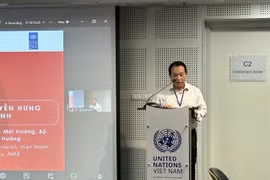
At a recent seminar, Nguyen Hung, head of TPBank, noted that the governor’s initial focus on interest rates reflected emerging market distortions. Deposit rates had surged sharply in early April, with some banks offering as much as 9% per annum for 6–12 month terms, an increase of 2–2.5 percentage points compared with the fourth quarter of 2025.

“This reflects an unusual development, given that actual capital demand has not risen significantly,” he said, attributing the spike largely to competitive rate hikes among banks seeking to attract deposits, rather than underlying economic fundamentals. With inflation at around 4%, he suggested a more appropriate deposit rate range would be 6–7%.

Flexible monetary policy management

The easing of deposit rates is gradually creating room for commercial banks to lower lending rates.

Notably, Nam A Bank has recorded one of the sharpest reductions, cutting lending rates by up to 3 percentage points per annum for individual customers from April 11. Meanwhile, KienlongBank has reduced rates by around 1 percentage point for both retail and corporate clients. Agribank has adopted a linked mechanism, whereby a 0.5-percentage-point reduction in 24-month deposit rates is mirrored by corresponding cuts in medium- and long-term lending rates.

While not yet widespread across the system, these developments signal the early stages of a broader downward trend in lending rates, in line with central bank policy.

According to Nguyen Xuan Binh, head of analysis at KBSV, deposit rates for 12-month terms are currently averaging 6–7.5% per annum, levels considered reasonable. If maintained, lending rates, including for higher-risk sectors such as real estate, could fall to around 10.5–12% per annum.

Taking a more cautious view, analysts at Mirae Asset (Vietnam) suggested that the recent coordinated rate cuts are aimed primarily at stabilising the market, rather than signalling a strong easing cycle. System liquidity continues to be managed flexibly, while credit growth remains under control.

Associate Professor, Dr. Tran Hoang Ngan, a member of the National Assembly, emphasised that monetary policy must currently pursue multiple objectives simultaneously, from inflation control and growth support to safeguarding banking system stability. Nevertheless, maintaining liquidity and overall system stability remains the top priority./.

VNA

See more

The meeting between General Secretary of the Communist Party of Vietnam Central Committee and State President To Lam and Chairman and Chief Executive Officer of Hayleys PLC Mohan Pandithage in Colombo on May 8 (Photo: VNA)

Vietnamese leader hopes for stronger ties with Sri Lanka's Hayleys PLC

General Secretary and President To Lam said that given the complementarity of the two economies and their substantial room for growth, Vietnam wishes to enhance cooperation with major Sri Lankan enterprises, especially those with regional market networks and connectivity capabilities such as Hayleys.

The export of 1.1 million doses of vaccine lumpy skin disease (LSD) to the Republic of Korea marks an important milestone for Vietnam’s veterinary vaccine industry. (Photo: nongnghiepmoitruong.vn)

Vietnamese-made LSD vaccine enters demanding RoK market

The successful research and commercialisation of the LSD vaccine, which has been widely used in the domestic market and is gradually expanding internationally, helps affirm the position of Vietnamese veterinary vaccines globally.

General Secretary of the Communist Party of Vietnam (CPV) Central Committee and State President To Lam addresses the Vietnam – Sri Lanka Trade-Investment-Tourism Cooperation Forum in Colombo on May 8. (Photo: VNA)

Top leader urges stronger Vietnam-Sri Lanka economic connectivity

Vietnam – Sri Lanka cooperation should be viewed within the broader context of the Indian Ocean, South Asia and emerging global supply chains, and the key issue now is not potential, but swift, decisive and effective action, said Vietnam's top leader To Lam.

The meeting between Vietnamese Minister of Industry and Trade Le Manh Hung and representatives from Essar Group (Photo: VNA)

Vietnam, India step up cooperation in energy, biofuels

Vietnam encourages capable investors to participate in oil and gas, energy and energy infrastructure projects in line with the national energy development strategy, while ensuring investment efficiency and compliance with Vietnamese law.

In the first four months of 2026, total FDI inflows into Vietnam reaches 18.24 billion USD, up 32% year-on-year. (Illustrative photo: VNA)

Vietnam draws stronger foreign investment inflows despite global headwinds

In the first four months of 2026, total FDI inflows into Vietnam reached 18.24 billion USD, up 32% year-on-year. Disbursed capital was estimated at more than 7.4 billion USD, an increase of 9.8% and the highest four-month disbursement level recorded in the past five years, reflecting effective implementation of many registered projects.

A Boeing 787 aircraft of Vietnam’s national flag carrier, Vietnam Airlines, lands on its first flight at Long Thanh International Airport. (Photo: VNA)

Deputy PM stresses strategic, synchronous planning for airport system

The national airport system planning was approved by the Prime Minister under Decision No. 648/QD-TTg dated June 7, 2023. Under the planning, 30 airports (14 international and 16 domestic) are to be developed during the 2021–2030 period, with a vision to 2050 expanding the network to 33 airports (14 international and 19 domestic).

Modern machinery improves labour productivity. (Photo: VNA)

Upskilling becomes key lever for Vietnamese workforce in digital era

As the economy is pivoting to a growth model fueled by knowledge, technology and innovation, the working class, or the backbone of production, demands better professional qualifications, vocational skills, industrial discipline and work habits. Timely adaptation is the only shield against being undercut by accelerating automation, artificial intelligence and increasingly fiercer global competition.

A circular organic farming model in Khanh Hoa is delivering initial economic efficiency. (Photo: VNA)

New growth potential unlocked for Vietnamese economy

Prime Minister Le Minh Hung once stressed that cutting administrative procedures and business conditions remains one of the fastest and most effective ways to stimulate growth and strengthen confidence among citizens and enterprises. He underscored that the reform process must remain continuous and responsive to practical requirements.