ITE HCMC 2026 to promote Vietnam’s tourism on global map

With its large scale, the ITE HCMC 2026 aims to promote tourism cooperation between Vietnam and priority markets such as Northeast Asia, Western Europe, North America, Southeast Asia, and Oceania while also boosting visitor arrivals from the Indian market

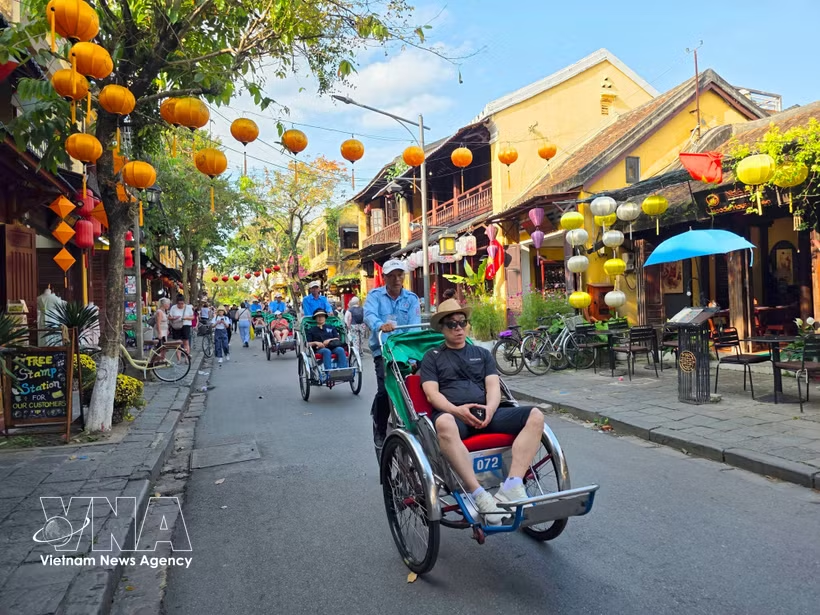
Tourists enjoy a rickshaw tour of Hoi An Ancient Town, Da Nang city. (Photo: VNA)

Ho Chi Minh City (VNA) – The Ho Chi Minh City International Travel Expo 2026 (ITE HCMC 2026) is expected to facilitate more than 20,000 business meetings with the participation of 260 international hosted buyers.

Under the theme “Vibrant Connections, Global Destinations”, the expo is scheduled to take place from August 27 to 29, 2026 at the Saigon Exhibition and Convention Centre in Ho Chi Minh City, announced the city’s Department of Tourism during the Vietnam International Travel Mart 2026 (VITM 2026) held in Hanoi.

Le Truong Hien Hoa, Deputy Director of the Ho Chi Minh City Department of Tourism, said the ITE HCMC 2026 is expected to gather more than 520 exhibitors and representatives from all 34 Vietnamese localities. Notably, the expo will attract 260 international hosted buyers from over 30 countries and territories, a 10% increase compared to 2025, and is projected to generate around 20,050 B2B meetings between Vietnamese and international tourism businesses.

With its large scale, the ITE HCMC 2026 aims to promote tourism cooperation between Vietnam and priority markets such as Northeast Asia, Western Europe, North America, Southeast Asia, and Oceania while also boosting visitor arrivals from the Indian market, he said.

The organisers pledge to help localities and enterprises expand partnership networks and improve visitor quality, thereby strengthening the position of both Vietnam’s tourism sector and Ho Chi Minh City as a dynamic destination in the region, Hoa added.

Nguyen Thi Hoa Mai, Deputy Director General of the Vietnam National Authority of Tourism, said that since October 2025, the authority has coordinated with Ho Chi Minh City to guide preparations for the event in order to elevate the expo’s international standing.

This year’s event will feature a range of activities, including a high-level tourism forum discussing smart destination management policies and green infrastructure, the Cambodia – Laos – Myanmar – Vietnam Tourism Ministers’ Meeting, the Ayeyawady – Chao Phraya – Mekong Economic Cooperation Strategy (ACMECS) Tourism Ministers’ Meeting, the Cambodia – Laos – Vietnam Tourism Ministers’ Meeting, and various destination survey programmes.

Mai emphasised that participants in ITE HCMC will not only promote tourism products or tour packages but also contribute to popularising the tourism brand of Vietnam.

Amid global geopolitical fluctuations, Ho Chi Minh City’s tourism sector is adjusting its strategy by diversifying markets and strengthening adaptability. Currently, about 55% of Vietnam’s international visitors come from Northeast Asia and 20% from Southeast Asia, while Ho Chi Minh City’s market structure is more balanced, with 44% from Northeast Asia, 15% from Southeast Asia, 14% from North America, and the remainder from other regions.

Facing regional conflicts and aviation disruptions, the city continues to maintain key markets such as Northeast Asia and the US while expanding into Western Europe, Australia, and India, which are considered markets with strong growth potential and recovery capacity.

The ITE HCMC 2026 is therefore expected to serve as a lever to boost promotion, strengthen market connections, and attract more international visitors to Vietnam.

Over its 20 editions, it has become a milestone in the development of the city’s tourism industry and helped enhance the global profile of both Ho Chi Minh City and Vietnam on the world tourism map./.

VNA

See more

A representative of Anex Tour Vietnam presents a conical hat to the first passengers arriving in Da Nang from Vladivostok. (Photo: VNA)

Da Nang welcomes first flight from Vladivostok

According to the plan, the programme will run from April 16 to October 23, connecting eight cities across Russia, the CIS, and Belarus with Da Nang. The total number of visitors is expected to reach approximately 25,500, with a maximum frequency of 36 flights per month, equivalent to around 4,800 passengers monthly.

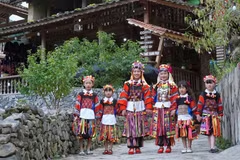
Visitors explore and experience the cultural space of Lo Lo Chai village in Lung Cu commune, Tuyen Quang province. (Photo: qdnd.vn)

Administrative expansion unlocks new momentum for tourism development

Nguyen Thi Hoai, Deputy Director of the Department of Culture, Sports and Tourism of Tuyen Quang, said the expansion of administrative boundaries has opened up new development space for the province, with key tourism products including cultural-historical tourism, ethnic cultural experiences, community-based tourism linked to scenic sites, spiritual tourism, and other distinctive experiential offerings.

At Thung Nham ecological tourism site in Ninh Binh province. (Photo: VNA)

Vietnam’s tourism defies fuel price shock with record Q1 “hat-trick”

According to data released by the National Statistics Office, foreign arrivals in March reached nearly 2.1 million, up 1.3% year-on-year. In total, Vietnam welcomed an estimated 6.76 million foreign tourists in the first quarter, a more than 12% jump from the same period in 2025 and the highest Q1 figure ever recorded.

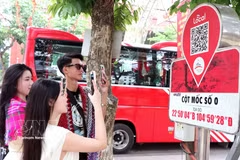
Visitors scan QR codes at Km0 Ha Giang to access tourism information. (Photo: VNA)

Technology powers tourism growth in mountainous province

Last year, Tuyen Quang welcomed over 3.9 million visitors, and is aiming to attract around 4.1 million arrivals, including around 600,000 foreigners, this year. Tourism continues to be identified as a key economic sector, with development oriented toward sustainability, green growth, and enhanced competitiveness through digitalisation.

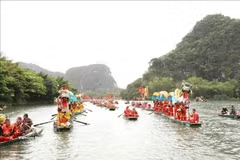
Traditional dragon procession held on the river in Ninh Binh. (Photo: VNA)

Cultural heritage drives sustainable tourism growth in Ninh Binh

In the first two months of 2026, Ninh Binh welcomed over 5.4 million visitors, up 9.9% year-on-year, generating nearly 5.84 trillion VND (221 million USD) in tourism revenue, up 15.9%. During the 2026 Lunar New Year holiday alone, the province received 2.38 million visitors, an 81.4% increase from the previous year, ranking second nationwide.

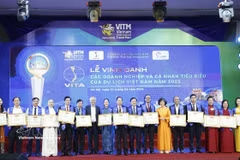
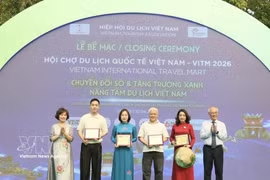
Outstanding individuals and firms honoured at VITM 2026 (Photo: VNA)

Outstanding individuals, firms honoured at Vietnam International Travel Mart 2026

In 2025, Vietnam’s tourism sector recorded its highest-ever number of visitors, welcoming more than 21.5 million international arrivals, up more than 20% from 2024, and serving over 135.5 million domestic travellers. Tourism revenue also surpassed 1 quadrillion VND (nearly 38 billion USD). The sector has become a bright spot of the economy, with Vietnam ranking among the world’s fastest-growing tourism destinations.

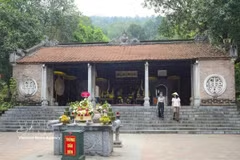
The Ba Trieu Temple in Thanh Hoa province (Photo: VNA)

Thanh Hoa taps digital transformation to boost heritage tourism

With 28 nationally-recognised intangible cultural heritage elements, Thanh Hoa province has prioritised integrating conservation with tourism development. Digital transformation, in particular, is seen as a crucial bridge connecting tradition with innovation, helping heritage sites become more accessible and engaging.

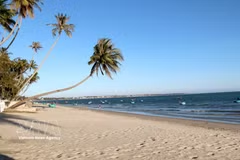
Pristine white-sand beach on Cu Lao Cham Island, Da Nang city, is a magnet for visitors. (Photo: VNA)

Vietnam – a safe destination amid global uncertainties

Despite global tourism headwinds linked to geopolitical conflicts, transport disruptions and surging travel expenses, Vietnam’s tourism sector has sustained strong growth, underscoring the destination’s resilience and rising international profile.

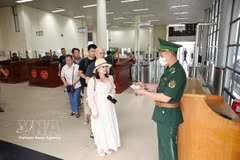
A border guard at the Mong Cai International Border Gate processes exit procedures for passengers at the Bac Luan 1 border gate in Quang Ninh province. (Photo: VNA)

Vietnam, China promote AI application in cross-border tourism cooperation

During the programme, participants will attend intensive courses delivered by AI technology experts, China–ASEAN policy researchers, and tourism specialists. The curriculum focuses on the application of big data in tourism policy planning, the development of cross-border tourism products, and the building of joint tourism brands.