Spring memories of wartime resilience at Ky Anh Tunnels

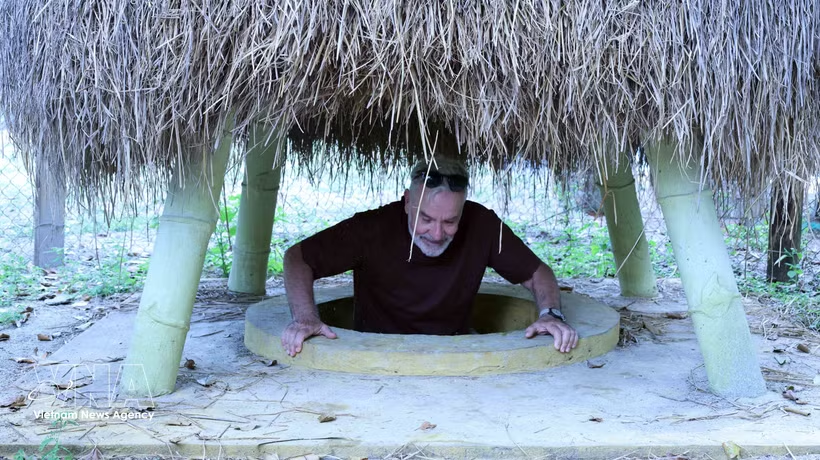
A visitor at a tunnel entrance located within a resident’s garden at the Ky Anh Tunnels. (Photo: VNA)

Da Nang (VNA) – Constructed deep inside enemy-held territory, the Ky Anh Tunnels remain a striking testament to the resilience and determination of revolutionary soldiers and residents of the former Quang Nam province (now Da Nang city) during the intense years of the resistance war against the US.

More than six decades later, memories of springtime spent around the tunnels continue to resonate among local communities, who proudly recount stories of wartime perseverance to visitors exploring the National Historical Site.
vnanet-du-kha1ch-qubbe1bf-tacm-hibbc3c3c3c3c4e18ba-91bae1b3-anh.jpg
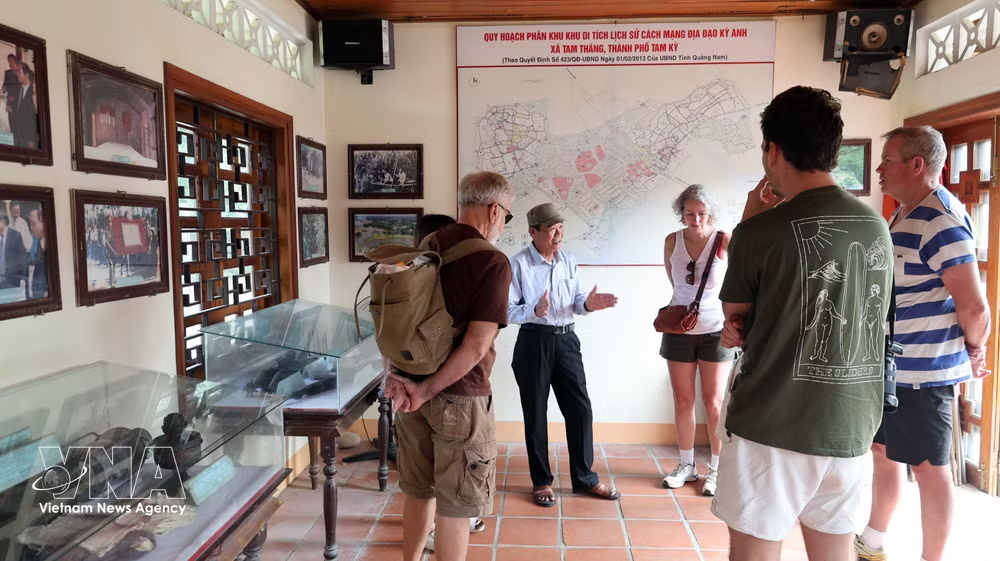
International visitors learn about the formation and history of the Ky Anh Tunnels. (Photo: VNA)

An underground stronghold

During the war, the Ky Anh Tunnels lay approximately 7km from the centre of the former Saigon administration and just 2km from a US military base. The network functioned as a crucial logistical corridor, enabling the movement of food supplies and revolutionary cadres between eastern lowland communes of Thang Binh and Tam Ky and resistance bases in the western mountainous region.

Visitors are often astonished to learn that beneath vast stretches of white sand lies a remarkably durable and well-organised underground system. Ingeniously designed, the tunnels provided shelter for revolutionaries from large-scale search-and-destroy operations conducted by US and allied forces while supporting guerrilla attacks that disrupted enemy operations.

Excavated between mid-1965 and 1967, the tunnels were built in a winding grid-like layout stretching 32km in total length. Passageways measured between 0.5 and 0.8 metres wide and nearly one metre high, concentrated mainly in Thach Tan and Vinh Binh villages.

Le Khac Phien, a resident of Thach Tan village who had recently joined the Party at the time, recalled taking part in discussions on excavation plans. With only 28 households, most of them revolutionary families, the village maintained strict secrecy throughout construction. Although the area was dominated by loose white sand, workers discovered a dense clay layer about 70cm below ground, roughly 1.2 metres thick, which proved suitable for tunnelling.

As enemy patrols were usually carried out during daylight hours, excavation work took place from evening until dawn. Residents worked in small teams, digging separate sections that were later connected into a vast underground network linking neighbouring villages.

Despite wartime hardship and shortages, the arrival of the Lunar New Year always brought hope. Local cadres and residents held a firm belief in eventual national reunification and the dream of families across North and South being reunited.
vnanet-du-kha1ch-laan-mbbe1ada-hbac6e19dn-nha0-cbbc6e19di-da2n-bbc4e18ba-91bae1b3-anh.jpg
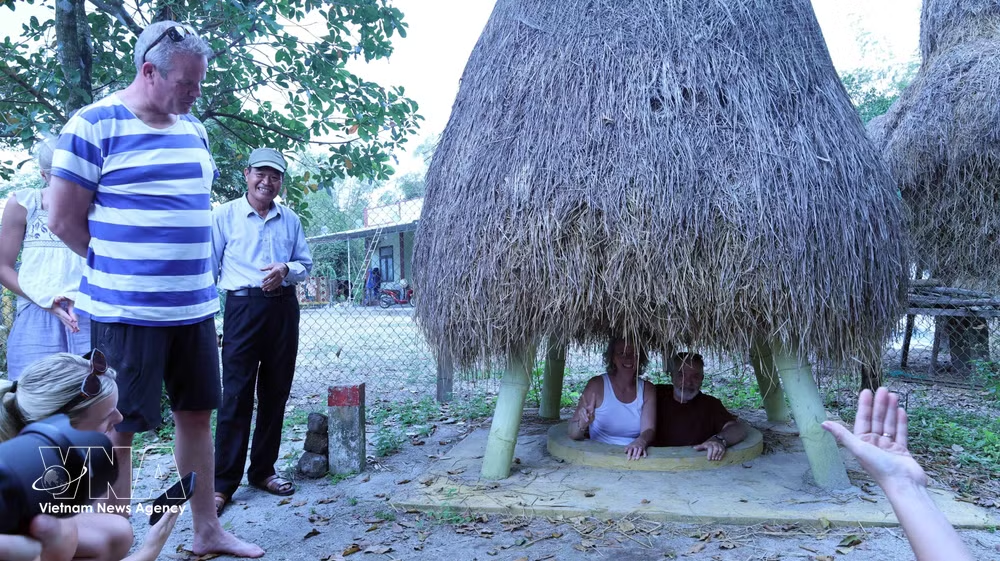
Visitors climb out through a tunnel entrance located in a resident’s garden at the Ky Anh Tunnels. (Photo: VNA)

A gateway for international understanding

After discovering information about the Ky Anh Tunnels online, Dutch visitor Sandra Woudstra chose the site as a stop during her Lunar New Year journey to Vietnam with friends.

She said the historical accounts sparked her curiosity, but the reality was even more impressive. Using only basic farming tools, residents managed to construct in secret a 32km tunnel system over several years. Life underground was cramped and often flooded, yet people endured and continued fighting - a reflection, she noted, of their unity, resilience and deep patriotism.

Over time, some sections of the tunnels collapsed or were buried by sand. Authorities have since restored several segments, allowing visitors to descend underground and re-emerge through hidden exits along roadsides or beneath straw stacks in villagers’ gardens.

Italian tourist Mario Valerio Dattola described his experience walking through the tunnels, where water still flows beneath visitors’ feet, as both exciting and moving. He highlighted the ingenuity of communication methods between villagers above ground and revolutionary forces below, including signals transmitted through wells and candlelight cues, illustrating the close cooperation between civilians and resistance fighters during enemy sweeps.

Huynh Kim Ta, a local guide who shares stories of the tunnels with visitors daily, said international tourists commonly express admiration for the Vietnamese people’s determination, desire for peace and unwavering courage in their struggle for national independence and reunification against a far stronger adversary.

Today, the Ky Anh Tunnels National Historical Site attracts between 12,000 and 15,000 domestic and international visitors each year. The site is also frequently chosen by organisations, schools and institutions for educational tours, historical research and Party membership induction ceremonies.

Da Nang authorities are working to enhance tourism development at the site, aiming to transform the Ky Anh Tunnels into a distinctive experiential tourism product in the city’s southern area. The initiative is expected to promote community-based tourism while offering international visitors deeper insight into Vietnam’s historic struggle for independence and reunification./.

VNA

See more

At Noi Bai International Airport in Hanoi (Photo: VNA)

Air travel demand holds steady during Hung Kings, April 30-May 1 holidays

Despite volatility in aviation fuel prices triggered by tensions in the Middle East, flexible Government policies, particularly measures by the Ministry of Construction to cut fuel-related taxes, fees and infrastructure costs, helped maintain stable operations across the sector. As a result, no broad ticket shortages emerged.

A representative of Anex Tour Vietnam presents a conical hat to the first passengers arriving in Da Nang from Vladivostok. (Photo: VNA)

Da Nang welcomes first flight from Vladivostok

According to the plan, the programme will run from April 16 to October 23, connecting eight cities across Russia, the CIS, and Belarus with Da Nang. The total number of visitors is expected to reach approximately 25,500, with a maximum frequency of 36 flights per month, equivalent to around 4,800 passengers monthly.

Visitors explore and experience the cultural space of Lo Lo Chai village in Lung Cu commune, Tuyen Quang province. (Photo: qdnd.vn)

Administrative expansion unlocks new momentum for tourism development

Nguyen Thi Hoai, Deputy Director of the Department of Culture, Sports and Tourism of Tuyen Quang, said the expansion of administrative boundaries has opened up new development space for the province, with key tourism products including cultural-historical tourism, ethnic cultural experiences, community-based tourism linked to scenic sites, spiritual tourism, and other distinctive experiential offerings.

At Thung Nham ecological tourism site in Ninh Binh province. (Photo: VNA)

Vietnam’s tourism defies fuel price shock with record Q1 “hat-trick”

According to data released by the National Statistics Office, foreign arrivals in March reached nearly 2.1 million, up 1.3% year-on-year. In total, Vietnam welcomed an estimated 6.76 million foreign tourists in the first quarter, a more than 12% jump from the same period in 2025 and the highest Q1 figure ever recorded.

Visitors scan QR codes at Km0 Ha Giang to access tourism information. (Photo: VNA)

Technology powers tourism growth in mountainous province

Last year, Tuyen Quang welcomed over 3.9 million visitors, and is aiming to attract around 4.1 million arrivals, including around 600,000 foreigners, this year. Tourism continues to be identified as a key economic sector, with development oriented toward sustainability, green growth, and enhanced competitiveness through digitalisation.

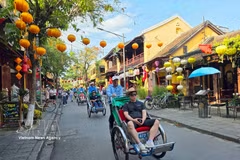
Tourists enjoy a rickshaw tour of Hoi An Ancient Town, Da Nang city. (Photo: VNA)

ITE HCMC 2026 to promote Vietnam’s tourism on global map

With its large scale, the ITE HCMC 2026 aims to promote tourism cooperation between Vietnam and priority markets such as Northeast Asia, Western Europe, North America, Southeast Asia, and Oceania while also boosting visitor arrivals from the Indian market

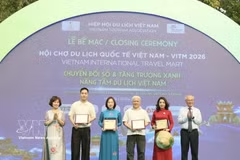
The organisers of VITM 2026 honour sponsors. ( Photo: VNA)

VITM 2026 boosts tourism demand ahead of peak season

According to the organisers, around 4,500 representatives from Vietnamese and international tourism enterprises attended the event, generating more than 25,000 business meetings and partnership exchanges. Approximately 15,000 discounted tours and travel products were offered to visitors.

Traditional dragon procession held on the river in Ninh Binh. (Photo: VNA)

Cultural heritage drives sustainable tourism growth in Ninh Binh

In the first two months of 2026, Ninh Binh welcomed over 5.4 million visitors, up 9.9% year-on-year, generating nearly 5.84 trillion VND (221 million USD) in tourism revenue, up 15.9%. During the 2026 Lunar New Year holiday alone, the province received 2.38 million visitors, an 81.4% increase from the previous year, ranking second nationwide.

Outstanding individuals and firms honoured at VITM 2026 (Photo: VNA)

Outstanding individuals, firms honoured at Vietnam International Travel Mart 2026

In 2025, Vietnam’s tourism sector recorded its highest-ever number of visitors, welcoming more than 21.5 million international arrivals, up more than 20% from 2024, and serving over 135.5 million domestic travellers. Tourism revenue also surpassed 1 quadrillion VND (nearly 38 billion USD). The sector has become a bright spot of the economy, with Vietnam ranking among the world’s fastest-growing tourism destinations.

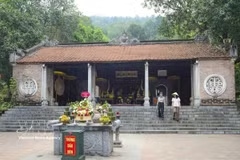
The Ba Trieu Temple in Thanh Hoa province (Photo: VNA)

Thanh Hoa taps digital transformation to boost heritage tourism

With 28 nationally-recognised intangible cultural heritage elements, Thanh Hoa province has prioritised integrating conservation with tourism development. Digital transformation, in particular, is seen as a crucial bridge connecting tradition with innovation, helping heritage sites become more accessible and engaging.