Thanh Hoa taps digital transformation to boost heritage tourism

With 28 nationally-recognised intangible cultural heritage elements, Thanh Hoa province has prioritised integrating conservation with tourism development. Digital transformation, in particular, is seen as a crucial bridge connecting tradition with innovation, helping heritage sites become more accessible and engaging.

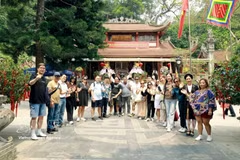
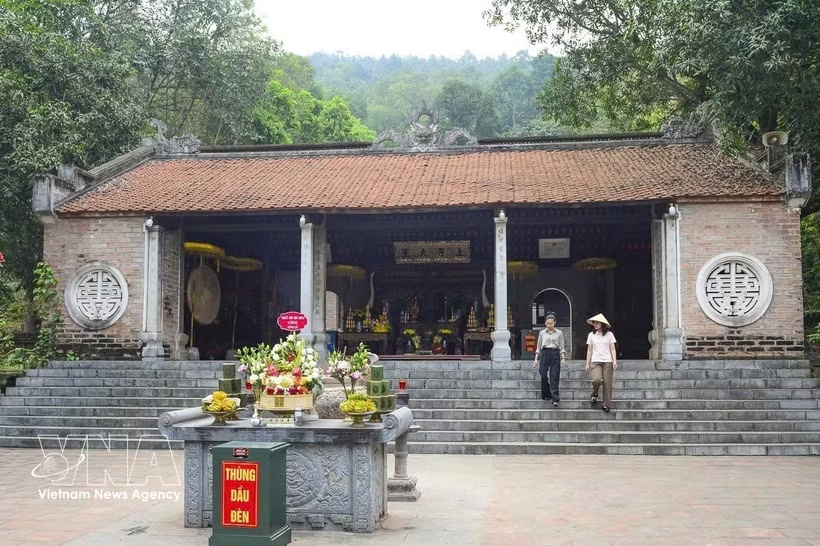
The Ba Trieu Temple in Thanh Hoa province (Photo: VNA)

Thanh Hoa (VNA) – Embracing Resolution No. 80-NQ/TW of the Politburo on developing Vietnamese culture, the north-central province of Thanh Hoa is leveraging modern technology to enhance tourism appeal, shifting from the mindset of “preservation” to managing heritage as a special endogenous resource for sustainable socio-economic development.

With 28 nationally-recognised intangible cultural heritage elements, the province has prioritised integrating conservation with tourism development. Digital transformation, in particular, is seen as a crucial bridge connecting tradition with innovation, helping heritage sites become more accessible and engaging.

Increasing destinations’ appeal

The Ba Trieu national special relic site, dedicated to national heroine Trieu Thi Trinh, is among Thanh Hoa’s most prominent attractions. Housing nearly 300 artefacts dating from the late 17th to early 20th centuries, the site serves not only as a cultural destination but also as a venue for educating young people about patriotism and history.

Closely associated with the site, the Ba Trieu Temple Festival has long been a hallmark cultural event in the province, drawing large numbers of visitors seeking spiritual experiences and traditional cultural activities.

At the 2026 festival, organisers have incorporated modern technologies to deepen visitor engagement. At exhibition spaces, tourists can use 3D glasses to explore national treasures related to Trieu Thi Trinh, creating more interactive and immersive experiences.

Digital transformation drives tourism development

Digitalisation is viewed as an inevitable trend and a vital tool for preserving and promoting heritage sustainably. For a national special site like Ba Trieu Temple, the application of digital technology is essential to both conservation and development.

The provincial People’s Committee is implementing a project to innovate management and tourism development at the Ba Trieu relic site for the 2021–2030 period, with a focus on strengthening IT application in promotion and visitor services.

Infrastructure has been improved with the installation of Wi-Fi and 4G systems across the site and surrounding areas, ensuring seamless connectivity for visitors. At the same time, heritage content has been standardised and digitised, allowing accurate and user-friendly dissemination of information. Through official fanpages and social media channels such as YouTube, Facebook and TikTok, visitors can access images, audio guides and videos introducing the site and its related activities before arrival.

These efforts have helped the Ba Trieu relic site overcome spatial and temporal limitations, presenting heritage in a vivid and intuitive manner. In 2025, the site welcomed more than 75,000 visitors, including tens of thousands of students participating in educational tours to learn about history and traditional culture.

Truong Hoai Nam, Deputy Director of the Management Board of the Ho Dynasty Citadel World Heritage Site and key historical relic sites of Thanh Hoa, said future priorities include further restoration, gradual digitalisation of heritage management, enhanced training for guides, and stronger cooperation with travel agencies to expand tour connections.

Greater emphasis will also be placed on data standardisation and engaging youths in heritage promotion, seen as key to bringing cultural values closer to contemporary life while fostering new creative spaces in the digital era, he added.

The upcoming Ba Trieu Temple Festival, opening on April 9, is expected to highlight these innovations. By harmonising digital technology with cultural heritage, Thanh Hoa aims to not only preserve historical memory but also transform it into a dynamic resource, contributing to promoting modern, professional and sustainable tourism development in line with Resolution 80-NQ/TW./.


VNA

See more

Traditional dragon procession held on the river in Ninh Binh. (Photo: VNA)

Cultural heritage drives sustainable tourism growth in Ninh Binh

In the first two months of 2026, Ninh Binh welcomed over 5.4 million visitors, up 9.9% year-on-year, generating nearly 5.84 trillion VND (221 million USD) in tourism revenue, up 15.9%. During the 2026 Lunar New Year holiday alone, the province received 2.38 million visitors, an 81.4% increase from the previous year, ranking second nationwide.

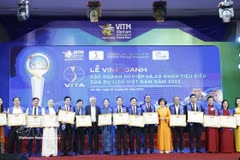
Outstanding individuals and firms honoured at VITM 2026 (Photo: VNA)

Outstanding individuals, firms honoured at Vietnam International Travel Mart 2026

In 2025, Vietnam’s tourism sector recorded its highest-ever number of visitors, welcoming more than 21.5 million international arrivals, up more than 20% from 2024, and serving over 135.5 million domestic travellers. Tourism revenue also surpassed 1 quadrillion VND (nearly 38 billion USD). The sector has become a bright spot of the economy, with Vietnam ranking among the world’s fastest-growing tourism destinations.

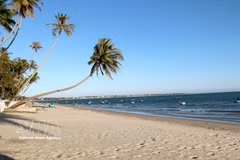
Pristine white-sand beach on Cu Lao Cham Island, Da Nang city, is a magnet for visitors. (Photo: VNA)

Vietnam – a safe destination amid global uncertainties

Despite global tourism headwinds linked to geopolitical conflicts, transport disruptions and surging travel expenses, Vietnam’s tourism sector has sustained strong growth, underscoring the destination’s resilience and rising international profile.

A border guard at the Mong Cai International Border Gate processes exit procedures for passengers at the Bac Luan 1 border gate in Quang Ninh province. (Photo: VNA)

Vietnam, China promote AI application in cross-border tourism cooperation

During the programme, participants will attend intensive courses delivered by AI technology experts, China–ASEAN policy researchers, and tourism specialists. The curriculum focuses on the application of big data in tourism policy planning, the development of cross-border tourism products, and the building of joint tourism brands.

The sea area off the southern coast of Phu Quoc Island. (Photo: VNA)

UK newspaper praises Phu Quoc’s unspoilt charm amid tourism boom

Phu Quoc is positioned as a compelling alternative – even a potential rival to Phuket – for travellers seeking authenticity in Southeast Asia. Its appeal lies not only in scenic beauty and fresh seafood, but also in the harmonious coexistence of modern tourism and enduring local culture.

At an elevation of 1,700 metres above sea level, the summit of Pu Luong is increasingly emerging as an ideal destination for trekking - a form of adventure tourism that combines hiking with nature exploration and physical as well as mental endurance. (Photo: VNA)

Vietnam eyes becoming region’s leading tourism destination

Vietnam has in recent years undergone a notable transformation in its tourism development strategy, placing a strong emphasis on nature-based and eco-tourism. This shift is not merely aligned with global trends, but represents a necessary step towards safeguarding valuable natural resources, while appealing to a growing segment of environmentally conscious travellers.

Foreign tourists in a photo with local residents. (Photo: VNA)

Vietnam serves 6.76 million foreign arrivals in Q1

China and the Republic of Korea (RoK) continued to lead as Vietnam’s largest source markets in the quarter, with 1.4 million and 1.3 million visitors respectively, accounting for around 40% of total arrivals.

Cua Viet beach is a magnet for both locals and visitors during holidays. (Photo: VNA)

Quang Tri seeks to unlock potential of marine tourism’s “golden triangle”

Cua Tung, Cua Viet and Con Co special zone are identified as three key destinations of marine tourism, and to transform this “tourism triangle” into premium and peaceful resorts, a new strategy is needed to enhance attractiveness to high-end travellers seeking private spaces as the strength of these places lies in their pristine and tranquil beauty.

A corner of the Phu Quy special zone in Lam Dong province (Photo: VNA)

Phu Quy moves to unlock potential as premier marine tourism hotspot

Under a resolution of the provincial Party Congress for the 2025–2030 term, the locality prioritises spatial planning of the marine economy, focusing on emerging sea-based industries linked with environmental protection and national defence. Located 56 nautical miles offshore, Phu Quy is a central pillar of this vision.

Khanh Hoa province pioneers green, sustainable tourism

Khanh Hoa province pioneers green, sustainable tourism

With its comprehensive transport infrastructure, world-class bays, and a diverse tourism ecosystem, Khanh Hoa is regarded as one of Vietnam’s leading coastal tourism hubs. To rise into the ranks of top destinations in the region and globally, the central province is working to complete strategic infrastructure while attracting investment to develop in-depth and high-end tourism products.