Mindset shift drives Quang Ninh’s heritage-based tourism development

Quang Ninh province aims to build culture as a core driving force of development, with cultural industries and the creative economy contributing around 9% of GRDP by 2045.

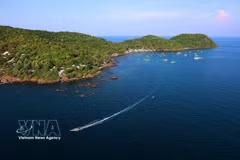
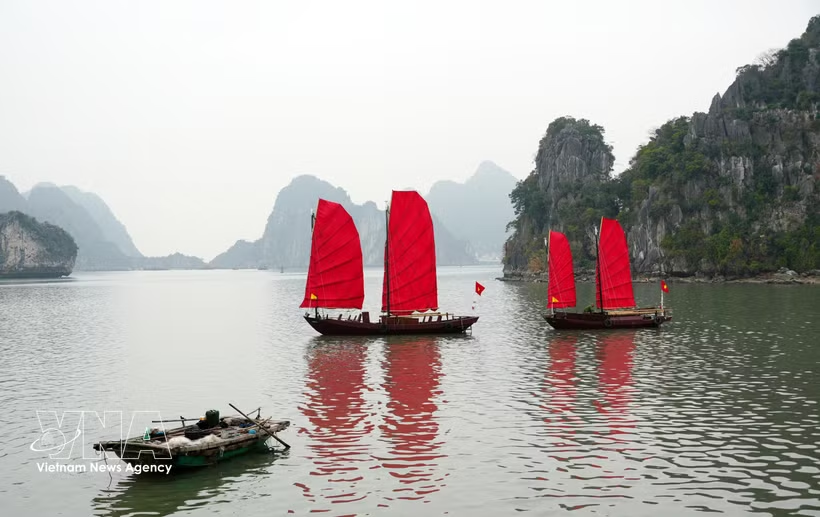
A corner of Ha Long Bay in Quang Ninh province (Photo: VNA)

Quang Ninh (VNA) – Transforming large-scale concerts into distinctive tourism products is not only an economic challenge but also a solid step towards affirming Quang Ninh position as a hub for cultural industries linked with the heritage of the mining region.

The northern coastal province is advancing a development model that integrates cultural industries with heritage economy and sustainable tourism.

Transformation in mindset

Guided by the Politburo’s Resolution No. 80-NQ/TW on the development of Vietnamese culture, Quang Ninh is translating cultural development policies into concrete actions, with a focus on integrating cultural industries, heritage-based economy and sustainable tourism.

The province aims to build culture as a core driving force of development, with cultural industries and the creative economy contributing around 9% of GRDP by 2045.

Vice Chairwoman of the provincial People’s Committee Nguyen Thi Hanh said the locality is developing a modern cultural ecosystem where people are at the centre and serve as both the subject and driving force of development; and cultural values are embedded across all aspects of society, contributing to improved governance and public well-being. The province also targets becoming a regional cultural and artistic hub and an attractive destination in Asia and the world.

Quang Ninh also plans to allocate at least 2% of its annual budget to culture and promote stronger public–private investment in modernising cultural infrastructure.

Innovation in heritage tourism development

In 2025 and early 2026, the province hosted a series of large-scale concerts, including Ha Long Concert 2025, Quang Ninh – Heroic Mining Land, Countdown 2026, attracting tens of thousands of spectators per event. Most tickets were offered free to residents and visitors.

Each concert is designed as a cultural narrative reflecting Quang Ninh’s history, cultural identity, and people. Events such as “Quang Ninh – Heroic Mining Land” marking the 89th anniversary of the traditional day of mine workers and the coal-mining sector, music served as a bridge connecting the heroic past of miners with the rhythms of modern life.

Director of the provincial Department of Culture, Sports and Tourism Nguyen Viet Dung said the concerts have drawn large numbers of domestic and international visitors, while staging events by Ha Long Bay has created a unique cultural space, where the values of the World Natural Heritage site are celebrated through modern sound and lighting technology, as well as boundless artistic creativity.

To transform concerts into sustainable tourism products, local authorities have demonstrated professionalism in operations. The entire ticket registration system has been digitised with QR code verification, combined with cross-checking through citizen identification cards and the VNeID application to prevent fraud and ensure fairness for audiences.

Quang Ninh is also strengthening human resources, with a target that 80% of cultural officials will be trained in digital transformation and cultural industry by 2026. This has helped build confidence among cultural investors and major artists in choosing Quang Ninh as a destination for their performance tours.

A key highlight in implementing Resolution 80 is Quang Ninh’s commitment to financial resources. The locality plans to allocate at least 2% of its annual state budget expenditure to the cultural sector, with gradual increases in line with practical needs. This serves as an important “lever” for implementing major initiatives such as projects for developing heritage economy and night-time economy, enhancing the value of Ha Long Bay heritage.

Looking ahead, the province aims to attract 22 million tourists in 2026 and become a leading cultural and artistic destination in Asia by 2030. Upcoming events, including the “Thanh am ky nguyen moi” (Sound of a new era) concert, are expected to further boost tourism ahead of the summer season.

Quang Ninh is not simply hosting events to increase visitor numbers, but building a cultural ecosystem where heritage becomes a resource, art becomes a driver, and tourism serves as a bridge to global audiences, Hanh stated./.

VNA

See more

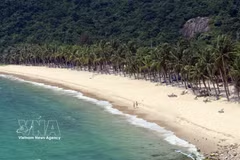
Pristine white-sand beach on Cu Lao Cham Island, Da Nang city, is a magnet for visitors. (Photo: VNA)

Vietnam – a safe destination amid global uncertainties

Despite global tourism headwinds linked to geopolitical conflicts, transport disruptions and surging travel expenses, Vietnam’s tourism sector has sustained strong growth, underscoring the destination’s resilience and rising international profile.

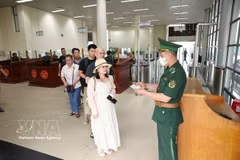
A border guard at the Mong Cai International Border Gate processes exit procedures for passengers at the Bac Luan 1 border gate in Quang Ninh province. (Photo: VNA)

Vietnam, China promote AI application in cross-border tourism cooperation

During the programme, participants will attend intensive courses delivered by AI technology experts, China–ASEAN policy researchers, and tourism specialists. The curriculum focuses on the application of big data in tourism policy planning, the development of cross-border tourism products, and the building of joint tourism brands.

The sea area off the southern coast of Phu Quoc Island. (Photo: VNA)

UK newspaper praises Phu Quoc’s unspoilt charm amid tourism boom

Phu Quoc is positioned as a compelling alternative – even a potential rival to Phuket – for travellers seeking authenticity in Southeast Asia. Its appeal lies not only in scenic beauty and fresh seafood, but also in the harmonious coexistence of modern tourism and enduring local culture.

At an elevation of 1,700 metres above sea level, the summit of Pu Luong is increasingly emerging as an ideal destination for trekking - a form of adventure tourism that combines hiking with nature exploration and physical as well as mental endurance. (Photo: VNA)

Vietnam eyes becoming region’s leading tourism destination

Vietnam has in recent years undergone a notable transformation in its tourism development strategy, placing a strong emphasis on nature-based and eco-tourism. This shift is not merely aligned with global trends, but represents a necessary step towards safeguarding valuable natural resources, while appealing to a growing segment of environmentally conscious travellers.

Foreign tourists in a photo with local residents. (Photo: VNA)

Vietnam serves 6.76 million foreign arrivals in Q1

China and the Republic of Korea (RoK) continued to lead as Vietnam’s largest source markets in the quarter, with 1.4 million and 1.3 million visitors respectively, accounting for around 40% of total arrivals.

Cua Viet beach is a magnet for both locals and visitors during holidays. (Photo: VNA)

Quang Tri seeks to unlock potential of marine tourism’s “golden triangle”

Cua Tung, Cua Viet and Con Co special zone are identified as three key destinations of marine tourism, and to transform this “tourism triangle” into premium and peaceful resorts, a new strategy is needed to enhance attractiveness to high-end travellers seeking private spaces as the strength of these places lies in their pristine and tranquil beauty.

A corner of the Phu Quy special zone in Lam Dong province (Photo: VNA)

Phu Quy moves to unlock potential as premier marine tourism hotspot

Under a resolution of the provincial Party Congress for the 2025–2030 term, the locality prioritises spatial planning of the marine economy, focusing on emerging sea-based industries linked with environmental protection and national defence. Located 56 nautical miles offshore, Phu Quy is a central pillar of this vision.

Khanh Hoa province pioneers green, sustainable tourism

Khanh Hoa province pioneers green, sustainable tourism

With its comprehensive transport infrastructure, world-class bays, and a diverse tourism ecosystem, Khanh Hoa is regarded as one of Vietnam’s leading coastal tourism hubs. To rise into the ranks of top destinations in the region and globally, the central province is working to complete strategic infrastructure while attracting investment to develop in-depth and high-end tourism products.

Ngu Ha River (Photo: huengaynay.vn)

Hue city to launch inland water tourism route in Imperial Citadel

The Ngu Ha River, an artificial waterway dating back to the Nguyen Dynasty (1802–1945), runs through the heart of the Imperial City and historically served as a transport route, defensive line, and key landscape axis. In recent years, it has mainly functioned for drainage and environmental regulation. The reopening of the waterway is expected not only to restore its transport role but also to unlock its cultural and scenic value as a heritage river.

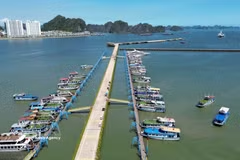
Tourist boats anchored at Ha Long International Cruise Port in Quang Ninh province. (Photo: VNA)

Sea tour launched to connect Ha Long, Lan Ha bays

The new passenger transport scheme, jointly implemented by the two localities, is designed to facilitate seamless travel across the heritage zone and materialise their cooperation commitments following UNESCO’s recognition of the Ha Long Bay–Cat Ba Archipelago complex.

The Hue City People’s Committee holds a ceremony to announce Hue Festival 2026 on January 1, 2026. (Photo: VNA)

Hue unveils vibrant summer festival series to draw April holiday crowds

From April 24 to May 2, the “Imperial Cuisine Space” at the Hue Imperial Citadel will open each afternoon, offering visitors an immersive culinary experience combining royal court gastronomy with traditional local flavours. The venue is expected to become a popular stop before evening tours of the citadel.