Hanoi (VNA) – The Ministry of Industry and Trade (MoIT) has held a consultation workshop on a draft plan to develop outlet and duty-free store models in Vietnam through 2030, with a vision to 2045, as the country’s fast-growing retail market still lacks modern, market-leading formats.
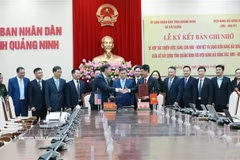
Organised by the MoIT’s Agency for Domestic Market Surveillance and Development, the event brought together representatives from many localities nationwide and major retailers such as Central Retail, WinCommerce, MM Mega Market, BRG, Vincom Retail, Vietjet Air Cargo and IPPG.
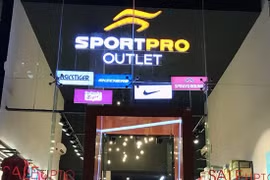
According to the MoIT, Vietnam’s retail sector maintained an annual growth rate of 8–10% over 2015–2025, but still lacks modern and market-shaping models. Notably, outlet retailing -widely used globally as a strategic distribution channel - remains underdeveloped, with only fragmented and small-scale operations. Meanwhile, shifting consumer demand is becoming more pronounced. By 2030, Vietnam is expected to have over 50 million middle-class consumers who are both brand-conscious and price-sensitive - an ideal customer base for outlet models, where brands sell surplus, off-season or slightly imperfect goods at discounts of 30–70%.
Tran Huu Linh, head of the agency, stressed that developing outlet and duty-free models is not only about expanding distribution channels but also about transitioning toward a modern retail ecosystem, with spillover effects on logistics, tourism and services.
Tourism spending is another untapped area. International visitors to Vietnam currently spend about 1,050–1,150 USD per trip, significantly lower than in Thailand and Singapore, indicating substantial room to increase value through shopping - an essential pillar of modern tourism strategies, he noted.
Globally, outlet retail has proven its scale and impact. The US generates around 65 billion USD annually from hundreds of outlet centres, while Europe recorded 21.4 billion EUR in outlet revenue in 2023, surpassing pre-pandemic levels. Across Asia, countries such as Japan, China and Thailand have successfully integrated outlet “villages” into tourism offerings, combining shopping with entertainment, dining and cultural experiences.
Under the draft project, Vietnam aims to establish at least five outlet centres linked to tourism by 2030 in major hubs such as Hanoi, Ho Chi Minh City, Da Nang, Quang Ninh and An Giang. By 2045, the country plans to develop premium outlet “villages” across the nation.
Two main outlet formats are proposed. The first is large-scale premium outlet villages designed as integrated complexes combining shopping, entertainment and cultural experiences, targeting mid- to high-end customers and serving as tourism destinations. The second includes smaller urban or suburban outlet centres with more flexible scale, focusing on mid-range and mass-market brands suited to local infrastructure conditions.
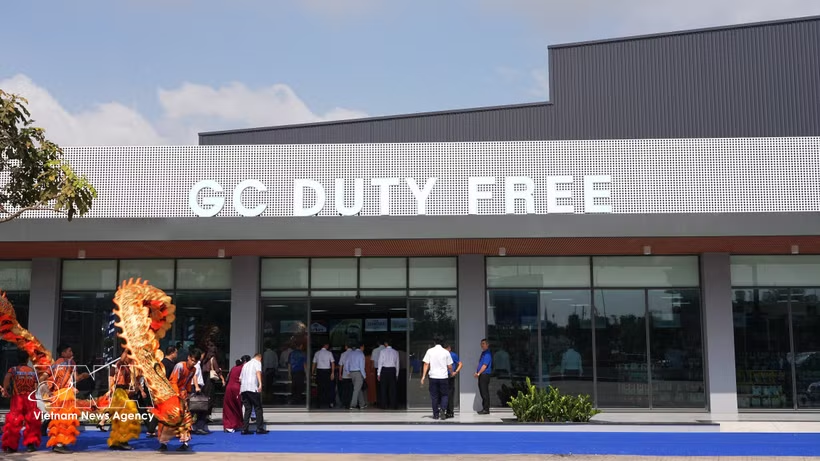
For duty-free retail, the goal is to cover all international airports and major border gates, while expanding into downtown areas in key tourism cities. Notably, the model would allow services for both domestic customers and eligible duty-free shoppers, broadening consumption space.
The project also targets increasing the share of Vietnamese products in outlets and duty-free stores to 30–40%, alongside developing internationally standardised “national gift” product lines to promote local brands and boost on-site exports.
Despite strong potential, participants pointed to policy and regulatory gaps as the main bottleneck hindering investment. Delegates highlighted the need for clearer legal frameworks and more competitive incentives to attract global brands. Proposals included land allocation mechanisms for strategic investors with incentives similar to industrial zones, tailored discount policies reflecting outlet characteristics, and on-site electronic VAT refunds to enhance tourist experience. For duty-free stores, businesses called for expansion beyond airports into free trade zones, alongside e-commerce integration and international payment systems.
Ho Chi Minh City has positioned itself as a frontrunner, proposing large-scale outlet villages and pilot downtown duty-free shopping under a “buy locally, collect at the airport” model. The city is preparing land, infrastructure and investment conditions to roll out projects once the scheme is approved.
Experts stressed that, beyond tax and land incentives, a transparent, stable and feasible legal framework will be critical to attracting investment and ensuring sustainable development.
If effectively implemented, the proposed outlet and duty-free models could generate an estimated 579 trillion VND (nearly 22 billion USD) in direct revenue, equivalent to around 10% of Vietnam’s retail market growth./.
VNA