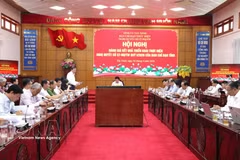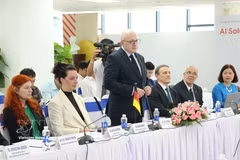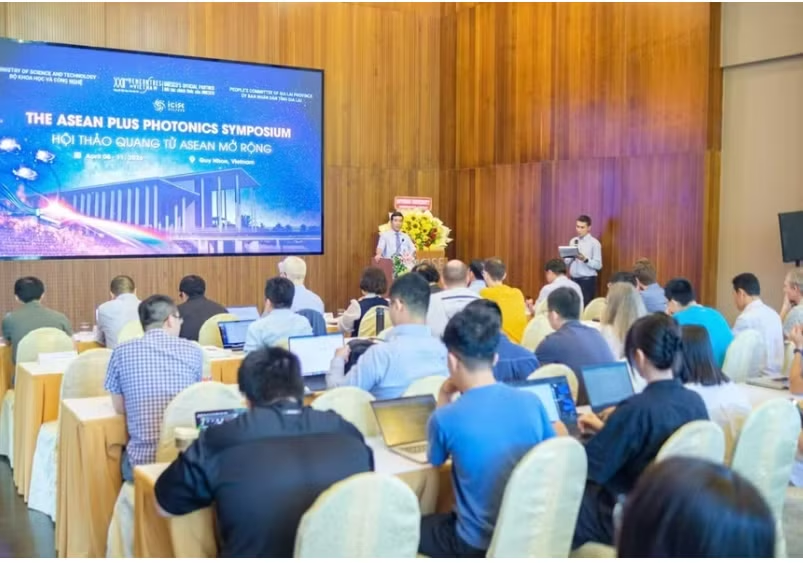
Gia Lai (VNA) – Nearly 40 international scientists gathered at the ASEAN Plus Photonics Symposium on April 8 in Gia Lai province to exchange the latest research advances, emerging trends and future prospects in photonics and light–matter interactions, highlighting the field’s growing strategic importance in science and technology.
The workshop was co-organised by the Rencontres du Vietnam Association and the International Centre for Interdisciplinary Science and Education (ICISE), in collaboration with École Centrale de Lyon (ECL) and the University of Lyon (France), as well as the School of Electrical and Electronic Engineering at Nanyang Technological University of Singapore.
Delegates included professors, researchers, early-career scientists and doctoral candidates from France, Germany, Belgium, the UK, India, China, the Republic of Korea, Malaysia, Singapore and Australia.
Participants presented and discussed a wide range of advanced topics shaping the future of photonics, including nanophotonics and metasurfaces; topological and non-Hermitian photonics; photonic crystals and optical lattices; light–matter interactions and polariton systems; quantum and nonlinear optics; integrated and silicon photonics; ultrafast and terahertz photonics; photonic devices, lasers and emerging materials; as well as applications in sensing, imaging and information processing.
According to Dr Nguyen Huu Ha, Deputy Director of the provincial Department of Science and Technology, the workshop updates participants on cutting-edge developments and opens up promising research directions. He noted that the topics discussed represent key technological frontiers underpinning many advanced applications, particularly in data transmission and processing, sensing technologies and smart system development.
The symposium is expected to contribute to advancing photonics in Vietnam while enhancing ASEAN’s standing in the global scientific map, Ha said.
Organisers emphasised that photonics is a core scientific and technological field of the 21st century, playing a foundational role in critical areas such as optical communications, precision sensing and measurement, information processing, advanced materials, biomedicine, energy and quantum technologies. In the context of the 4th Industrial Revolution, along with ongoing digital and green transitions, and sustainable development photonics is increasingly recognised as a strategic pillar for both fundamental research and high-tech applications.
ASEAN, meanwhile, is emerging as a dynamic hub for scientific research and innovation, driven by rapid growth in human resources, improved research infrastructure and expanding international cooperation in photonics.
However, organisers noted that in-depth, systematic academic exchange platforms linking the region with global networks remain limited, especially forums for emerging areas such as topological photonics, non-Hermitian systems, quantum photonics, integrated photonics and advanced studies of light–matter interactions, which require stronger collaboration and knowledge sharing./.