Hanoi (VNA) – Artificial intelligence (AI) is increasingly seen as a key driver of business growth in the new era as Vietnamese enterprises accelerate digital transformation and harness AI to improve efficiency, cut costs and unlock new revenue streams.
Amid sweeping digitalisation, AI is being rapidly deployed across core business functions, from customer service and operations to risk management and product development.
Irreversible trend
According to a report by Amazon Web Services (AWS) Vietnam, about 61% of Vietnamese businesses either expect or have already recorded improvements in operations and revenue growth thanks to AI, while 58% anticipate or have achieved cost savings through its adoption.
Domestic firms report that AI applications are now widely used across sectors. Common use cases include chatbots and virtual assistants providing 24/7 customer support, automated call centres classifying requests, electronic Know Your Customer (eKYC) systems, and optical character recognition (OCR) for automated data extraction.
As a major AI solutions provider, the Vietnam Posts and Telecommunications Group (VNPT) said AI is playing an increasingly critical role in modernising the banking sector.
Beyond reducing costs and processing time, AI enhances accuracy and efficiency in complex tasks such as big data analytics, credit risk forecasting and personalised services. Leading banks can improve business performance by 27–35% through AI adoption. AI is also proving highly effective in fraud detection and prevention, helping cut up to 90% of fraudulent account-opening cases.
VNPT AI has deployed facial recognition (Face ID) solutions for many major domestic and international banks, processing nearly two billion authentication requests to date.
Meanwhile, FPT Corporation has partnered with global firms to develop AI agents capable of assisting users anytime and anywhere. In customer service centres, AI systems now handle around 70% of common inquiries and service requests, leaving the remaining 30% to human staff. As a result, labour productivity per employee has tripled.
According to a representative of Viettel AI under the Military Industry and Telecoms Group (Viettel), AI is no longer confined to large and capital-intensive companies but is now widely adopted across businesses. Common applications include customer service, network operations and internal management. Customers can interact with chatbots or voicebots to request services or report issues, while many free AI tools are increasingly used by individuals as personal assistants—effectively acting as a “second brain.”
Pillar of growth and development
As AI reshapes the future of the economy, mastering core AI development capabilities has become vital for every nation. Recognising this trend, many companies are aiming to develop sovereign AI to address Vietnam-specific challenges.
VNPT General Director Huynh Quang Liem said the group began making strong and systematic investment in AI seven years ago, developing large-scale models capable of nationwide deployment. Alongside infrastructure, VNPT AI now brings together more than 200 well-trained AI and data science experts.
To date, VNPT has built over 100 specialised AI models, processed more than two billion requests and served around 40 million users, while partnering with over 200 enterprises and many state agencies. In late 2025, the group established VNPT AI, underscoring its determination and commitment to consolidating AI capabilities and advancing a “Data-Driven, AI-First” transformation strategy.
Analysis by Viettel AI shows Vietnam ranks among the countries with the world’s most active users of social media and digital platforms, generating vast volumes of data—an abundant resource for AI development. However, much of this data is held by foreign technology giants. Building strategies to leverage such data for AI training could enable the creation of models better tailored to local users while boosting domestic technological capacity.
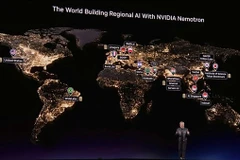
Viettel is therefore developing a sovereign AI ecosystem, focusing on high-performance computing infrastructure and foundational AI models, supported by advanced platforms such as those from Nvidia, the firm said.
At FPT, AI is one of the five strategic pillars for future growth. Le Hong Viet, CEO of FPT Smart Cloud, said the group aims to master AI for Vietnam and has developed the AI Factory platform.
Initially designed for non-technical staff, the platform enables individuals to build their own virtual assistants. It also supports developers and researchers in creating, fine-tuning and commercialising AI models.
FPT has therefore proposed that the Government introduce mechanisms to accelerate AI adoption across businesses, ensuring that not only tech firms but all enterprises can leverage AI based on their readiness and needs. It also called for stronger public – private partnerships to expand access to computing power for people from all social strata, researchers and companies./.
See more
Biometric verification required for mobile device changes from April 15
The policy is designed to enhance security, particularly in cases where users lose their SIM cards but fail to promptly deactivate them, creating opportunities for fraud or illegal activities.
Vietnam reports 2025 strides at ASEAN working group’s meeting on IP
Vietnam recorded positive results, clearing nearly 250,000 backlogged applications and lifting the rights establishment efficiency rate to 74% from a year earlier, even as new filings jumped roughly 20%.
Gia Lai province hosts ASEAN Plus Photonics Symposium
Participants presented and discussed a wide range of advanced topics shaping the future of photonics, including nanophotonics and metasurfaces; topological and non-Hermitian photonics; photonic crystals and optical lattices; light–matter interactions and polariton systems.
Vietnam, Brazil to strengthen cooperation in science, technology
Ambassador Bui Van Nghi expressed Vietnam’s interest in strengthening cooperation with Brazil in areas such as renewable energy and environmental technologies, as well as high-tech sectors including artificial intelligence (AI), quantum technology, and the semiconductor industry.
Results become benchmark for science-technology governance
The transition to facilitative governance marks not only an operational reform but also a shift in development thinking. With expanded autonomy and controlled risk acceptance, science, technology, innovation and digital transformation are expected to become key drivers of rapid and sustainable growth in the years ahead.
Sun Group partners with SITA to build digital foundations for integrated aviation - tourism ecosystem
Under the agreement, SITA will work alongside Sun Group to deploy technology platforms across its aviation ecosystem, including Phu Quoc and Van Don International Airports, as well as Sun PhuQuoc Airways. The focus will be on digitising passenger processes, optimising operations, and building an integrated data platform that connects all touchpoints across the travel journey.
National strategy on innovative start-ups unveiled
By 2030, the strategy targets a total of 5 million business entities, including at least 10,000 innovative start-ups.
Cybersecurity needs heightened attention in the age of AI
While boosting efficiency in the banking sector, the application of artificial intelligence (AI) also changes the nature of cyber risks and poses great challenges to cybersecurity in Vietnam.
AI powers sweeping overhaul of Vietnam’s education system
Nguyen Son Hai, Deputy Director General of the Department of Information and Communication Technology under the Ministry of Education and Training (MoET), said the sector has made rapid strides in digital transformation, from online classes during the COVID-19 pandemic to nationwide platforms covering the national education database, registration for high school graduation exam, and online university admissions.
Digital transformation gathers pace nationwide
Adopted by the Politburo in late 2024, Resolution 57 positions science – technology development, innovation, and digital transformation as a top important breakthrough and strategic pillar for Vietnam’s development in the new era. Early implementation shows a clear shift toward data-driven governance and technology-enabled public services.
Drone Soccer 2026 debuts as innovative tech playground for Tay Ninh students
The Zone 1 competition, part of the 2026 Science, Technology, Innovation and Digital Transformation Week, drew the strong participation from students, contributing to the promotion of STEM education and sparking interest in technology among local youths.
Plan issued to implement Vietnam–France agreement on science-technology cooperation
Under the plan, the Ministry of Science and Technology will take the lead, in coordination with relevant ministries and agencies, in directing, guiding, monitoring and inspecting the implementation of the agreement. The ministry will also prepare reports on the signing and implementation progress for submission to the Ministry of Foreign Affairs for consolidation and reporting to competent authorities as required.
Tay Ninh moves to accelerate digital transformation
In science, technology and innovation, Tay Ninh has identified six major priorities: development of the digital economy, a carbon credit market, a Halal ecosystem, renewable energy, enterprise innovation support, and applications of artificial intelligence and big data.
IP mechanisms need refinement to facilitate strategic technologies
As strategic technologies evolve, IP is no longer seen solely as a legal shield but increasingly as a tool to unlock market value.
Vietnam accelerates 5G rollout, paving the way for 6G development
Vietnam’s approach of deploying 5G rapidly and extensively reflects a consistent development philosophy aligned with international experience: infrastructure must come first.
Sci-tech revenue up 17% in March
The sci-tech sector contributed 133.5 trillion VND to the country’s gross domestic product (GDP) in March, a 28% increase from the same period last year.
Controlled piloting of Starlink satellite Internet service to last for five years
As part of its deployment plan, Starlink will build four gateway stations in Phu Tho, Da Nang, and Ho Chi Minh City to ensure stable connectivity while complying with Vietnam’s cybersecurity requirements.
Digital technology narrows gaps in governance, public services
From smart urban governance solutions to grassroots-level online public services, digital technologies are steadily narrowing the gap between authorities and enterprises.
Project aims to enhance capacity of national cybersecurity protection force
The project aims to strengthen overall capabilities and develop an elite and modern cybersecurity force able to proactively prevent and effectively respond to all cyber risks and threats, safeguarding national security, social order and safety, and the rights and lawful interests of organisations and individuals in cyberspace.
Da Nang boosts hi-tech partnership with Germany’s Chemnitz City
Authorities in Da Nang hope Chemnitz and German partners will continue to accompany and support the city in accessing advanced technologies, connecting experts, integrating into innovation ecosystems, and attracting high-tech enterprises and supporting industries to explore investment and long-term cooperation opportunities.