Ho Chi Minh City (VNA) – A new pilot policy scheme designed to promote the commercialisation of research outcomes and intellectual property with funding from the State budget is expected to address long-standing bottlenecks and help bridge the gap between research and real-world application in Ho Chi Minh City.
In recent years, the city has achieved notable progress in supporting innovation and startups. Since 2016, the Ho Chi Minh City Innovation and Startup Centre has assisted more than 500 startup projects, around 150 of which have begun commercialising their products and generating economic value. However, only about 20% of these projects have managed to connect with venture capital funds or major enterprises, largely due to the lack of clear and effective support mechanisms.
Similarly, between 2010 and 2022, the Saigon Hi-Tech Park attracted more than 200 high-tech projects with total registered investment exceeding 12 billion USD. Several products such as semiconductor chips and smart sensors have generated hundreds of millions of dollars in annual revenue. Yet only around 10% of domestic research results have been integrated into these projects, mainly because of weak linkages and the absence of effective intermediary organisations connecting research institutions with businesses.
Statistics from the municipal Department of Science and Technology show that during the 2014–2018 period, only 13% of State-funded science and technology projects were successfully commercialised, while many research outcomes remained ready for transfer but had not reached the market. At present, the overall commercialisation rate of research and innovation results is estimated at around 5% of completed projects.
According to the department, these limitations stem from several factors, including complicated procedures for valuing intellectual assets, difficulties in transferring rights, and risk-averse attitudes in implementation. In addition, the cooperation among the State, scientists and enterprises has not been strong enough, while mechanisms to encourage businesses to participate from the early stages of research remain limited.
To address these challenges, Ho Chi Minh City has introduced a pilot scheme aimed at encouraging the commercialisation of research results and intellectual property. The programme is expected to create a strong policy push to bring research products from laboratories to the market.
Under the scheme, the State may provide financial support covering up to 50% of the cost of completing and commercialising research products, thereby sharing risks with enterprises. The programme also introduces mechanisms to expand the rights to exploit research results, promote transparency in management and create intermediary activities that connect technology with markets and businesses.
Enterprises are placed at the centre of the commercialisation process, with new mechanisms designed to encourage their participation from the early stages and ensure that research activities are closely aligned with market demand.
Just over two weeks after its launch, the scheme attracted 29 organisations registering for the first round with 54 science and technology products. The total projected funding for this round exceeds 500 billion VND (19 million USD), including more than 200 billion VND from the State budget.
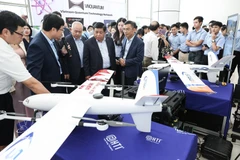
The participating projects focus on several key technology areas, including unmanned aerial vehicles and the low-altitude economy, artificial intelligence, digital transformation and smart cities, biotechnology and pharmaceuticals, high-tech agriculture, industrial manufacturing technologies and smart urban infrastructure.
During the pilot period from 2026 to 2028, the city aims to bring at least 10 science and technology products to market, increase the commercialisation rate to 8–10%, and strengthen cooperation among the State, research institutes, universities and enterprises, thereby promoting innovation and supporting the development of a sustainable knowledge-based economy./.
See more
Resolution 57 charts directions for Vietnam’s technology ecosystem
Vietnam's sci-tech sector must evolve from a manufacturing base toward mastering technologies and ultimately developing original products independently, which requires shifting away from outsourcing and assembly models to one where domestic scientists lead in design, development and ownership of core technologies.
European experts highlight potential for AI cooperation with Vietnam
Experts believe that as demand for technological innovation grows and international partnerships expand, Vietnam has big opportunities to deepen cooperation with European partners in high-tech agriculture, healthcare, digital transformation and artificial intelligence.
AI – unmissable opportunity for Vietnam: Experts
AI also emerges as a key enabler for Vietnam's ambition to build financial and technology hubs. Applications can boost efficiency, automate workflows, cut costs, and sharpen data analytics, which are essential pillars of a modern financial system.
PM calls for accelerated space technology development in Vietnam
Vietnam aims by 2030 to achieve a mid-level position in space science and technology development within Southeast Asia, and after 2030 to build national capabilities to independently develop satellite technologies and apply space data to address global challenges and national security needs.
Vietnam I4 Impact Awards 2026 to honour tech solutions driving digital economy
The Vietnam I4 Impact Awards 2026 ceremony will celebrate standout achievements in sci-tech and digital transformation with demonstrable positive societal effects. Solutions that reshape business models, streamline governance, or elevate quality of life are poised to emerge as top contenders.
National AI ethics framework issued to guide safe, responsible rollout
According to the circular taking effect on March 10, the framework imposes specific obligations on entities and individuals involved in AI activities. In particular, the AI use must ensure safety, reliability, while preventing harm to human life, health, dignity, honour, and mental well-being.
Vietnam, EU well placed to expand AI cooperation: expert
With their complementary advantages in infrastructure, talent and policy environments, Vietnam and the EU are well positioned to build effective AI cooperation models in the future.
Party chief urges stronger, result-oriented implementation of Resolution 57
Turning science, technology, innovation and digital transformation into the main drivers of a new growth model requires substantial efforts. In the coming period, the focus must shift from merely carrying out tasks to delivering tangible and measurable outcomes, while concentrating resources on addressing strategic national challenges, said Party General Secretary To Lam.
High-level forum advances Vietnam–US technological cooperation
The ambassador highlighted that Vietnam and the US are highly complementary. Vietnam offers a dynamic economy, a young and increasingly skilled workforce and rapidly growing innovation ecosystem, while the US offers frontier technologies, world class research institutions, capital and leading global companies.
Vietnam promotes science, technology, energy cooperation with French businesses
With a population of more than 100 million people, strong economic growth, and an increasingly favourable investment environment, Vietnam is regarded as one of the most dynamic markets in Asia.
Resolution 57: Infrastructure investment for strategic technologies
Vietnam is ramping up investment in research infrastructure for strategic technologies to implement the Politburo's Resolution 57-NQ/TW, aiming to drive rapid, sustainable economic growth through breakthroughs in science, technology, and digital transformation.
Vietnam steps up international cooperation in nuclear energy
Vietnam’s participation in the World Nuclear Energy Summit reflected its support for international initiatives promoting the development and peaceful use of atomic energy, particularly nuclear power.
Vietnam becomes vital player in global semiconductor value chain: Deputy PM
Vietnamese companies have also gradually joined the global value chain by improving their capabilities in chip design, production and related services. Notably, a semiconductor chip manufacturing plant project developed by the Viettel Military Industry and Telecoms Group (Viettel) has already commenced.
Resolution 57: Science communication expanded on digital platforms
The Ministry of Science and Technology has launched a Facebook page “Thong tin Khoa hoc va Cong nghe” (Information about Science and Technology), designed as a supplementary communication channel alongside its official fanpage.
Digital technology helps enhance transparency, trust in elections
The use of technology in this election is not merely a short-term measure but reflects Ho Chi Minh City’s broader commitment to comprehensive digital transformation and smart urban governance, reinforcing public trust in the democratic process and administration.
5G commercialisation helps drive in-depth development of digital economy
The deployment and development of 5G networks in Vietnam not only bring technological benefits but also drive sustainable economic growth, enhance national competitiveness, and support industrialisation and modernisation.
Technology breakthrough ensures voters' access, rights
Digital platforms such as the national population database and the VNeID application have been widely applied to streamline election management and improve accuracy in voter registration, helping citizens exercise their civic rights more conveniently.
3.9-magnitude earthquake recorded in Mang But, Quang Ngai
According to the Vietnam Earthquake Information and Tsunami Warning Centre under the Institute of Earth Sciences, the tremor occurred at 11:35:06 (Hanoi time) with coordinates of 14.864 degrees North latitude and 108.210 degrees East longitude, at a depth of about 8.1 km. The event was assessed as having a level-0 disaster risk.
China's Guangxi eyes stronger AI cooperation with Vietnamese localities
Cooperation among enterprises has continued to expand, while several AI application scenarios have already been implemented in Vietnam, contributing to industry development. Collaboration between universities has also deepened, alongside stronger exchanges in talent training.
OV intellectuals in Europe step up AI cooperation with Vietnam
The workshop featured four in-depth discussion sessions with nearly 20 speakers from Vietnam and Europe, covering AI applications in digital transformation, economic development, trade, energy, nuclear medicine and biotechnology.