Hanoi (VNA) – Prime Minister Pham Minh Chinh has asked for faster development of space science and technology, stressing the need to explore space, master technologies, strengthen cooperation, pursue sustainable development and ensure a peaceful cosmos.
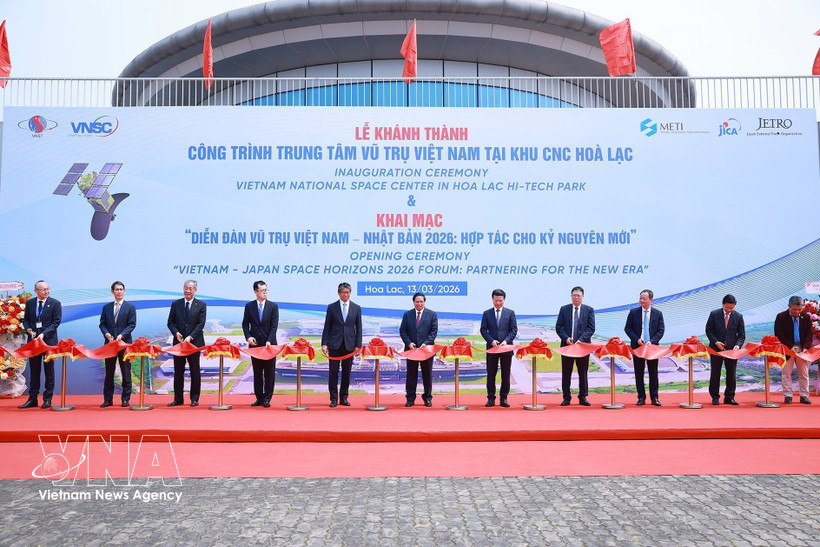
Speaking at the opening of the Vietnam–Japan Space Horizons 2026 Forum themed “Partnering for the New Era” and the inauguration of the Vietnam Space Centre (VNSC) at Hoa Lac Hi-Tech Park in Hanoi on March 13, the PM emphasised that Vietnam’s space development must be driven by innovation, international cooperation and the principles of "three accelerations" and "three together".
The forum, held from March 12–15, gathers representatives from the Vietnamese of Science and Technology, the Japanese Embassy in Vietnam, the Vietnam Academy of Science and Technology, and those from other Japanese agencies and organisations, international partners, scientists and businesses from the two countries operating in the space sector.
It aims to deepen cooperation between Vietnam and Japan in space technology and foster the formation of a space economy ecosystem in Vietnam, while marking a new step forward in the extensive strategic partnership between Vietnam and Japan in the era of science, technology and innovation.
In his remark, PM Chinh highlighted the significance of the inauguration of the VNSC and the forum, saying that they mark an important milestone in the development of Vietnam’s space science and technology sector and open a new chapter of deeper, more substantive and effective cooperation between Vietnam and Japan.
Noting that the VNSC is a modern infrastructure complex with a scale and technological level among the most advanced in Southeast Asia, the PM expressed high appreciation and sincere thanks to the Japanese government, organisations and businesses for their valuable contributions. Their support, he said, has helped the Vietnamese Government, enterprises and people achieve fruitful cooperation outcomes in recent years, laying a solid foundation for Vietnam and Japan to continue reaching new heights together for prosperous development of each country and for peace, cooperation and development in the region and the world.
The Vietnamese people have long dreamed of exploring the universe, he said, adding that that dream came true in modern times when Vietnam was the first Asian country to send a citizen into space with the flight of hero Pham Tuan in 1980.
In 2006, the Government approved the national strategy for research and application of space technology, aiming to support the country’s industrialisation and modernisation. Vietnam subsequently launched its first telecommunications satellites VINASAT-1 in 2008 and VINASAT-2 in 2012. The country has also made notable progress in satellite development. PicoDragon, Vietnam’s first domestically developed satellite, was launched in 2013. MicroDragon, jointly developed by Vietnam and Japan, was launched in 2019 for earth observation missions. In 2021, NanoDragon, fully developed by Vietnamese engineers, was successfully placed into orbit. Meanwhile, the radar satellite LOTUSat-1 has been completed and is awaiting launch, demonstrating Vietnam’s growing capacity to master advanced technologies.
PM Chinh stressed that Vietnam consistently pursues the development of space technology for peaceful purposes, in line with the UN conventions and international law, while ensuring national independence and self-reliance alongside effective international cooperation.
Vietnam aims by 2030 to achieve a mid-level position in space science and technology development within Southeast Asia, and after 2030 to build national capabilities to independently develop satellite technologies and apply space data to address global challenges and national security needs.
To realise these goals, the Government leader has defined an action motto of exploring space, mastering technology, strengthening cooperation, pursuing sustainable development, and ensuring a peaceful cosmos.
According to the PM, space science and technology must contribute directly to national development.
Vietnam will continue to improve institutions, mechanisms and policies governing space activities, moving toward the development of a national space law, he said, adding that the country will mobilise and efffectively use resources for space development with the contributions from the State, businesses, and research institutions and scientists, thus gradually forming a satellite data services market and a space technology application ecosystem.
The country also plans to implement major national programmes to enhance earth observation capabilities; build shared satellite data infrastructure; strengthen strengthening real-time analysis, forecasting and operational support; and develop high-quality human resources in space science and technology.
The PM assigned the VAST to operate the VNSC effectively and sustainably, ensuring that it performs functions in research, integration, testing, operations, data exploitation, training and technology transfer so that it can truly become a core national infrastructure for space science and technology. The Government leader stressed the need to deepen international collaboration, particularly between Vietnam and Japan. He called for translating high-level agreements between the two countries into concrete projects and cooperation programmes with clear responsibilities, timelines and measurable outcomes.
Priority areas for cooperation include high-quality human resource training, technology transfer, satellite operation, remote sensing applications, data analysis, technical standard development and building a space industry ecosystem, he said.
Vietnam and Japan should coordinate closely to launch the LOTUSat-1 satellite by the end of 2027 and ensure its effective operation, while expanding cooperation to build Vietnam’s long-term capacity in earth observation, satellite data application, and the gradual development of small satellite systems.
The PM also encouraged stronger connections among ministries, research institutions, universities and enterprises in both countries, urging businesses to participate more deeply in the global space industry value chain.
The two sides should continue to leverage dialogue mechanisms, forums and bilateral, regional and international cooperation programmes to further deepen Vietnam–Japan cooperation in this field, he added.
He affirmed that Vietnam will continue creating more favourable conditions for international organisations, development partners and domestic and foreign business communities to support and accompany the country in advancing space science and technology. He expressed his belief that with the attention of the Party and State leadership, the determination of ministries and localities, the dedication of scientists and engineers, and the close partnership of Japan and international friends, the VNSC will become a strategic launch pad, enabling Vietnam’s space science and technology sector to advance rapidly and reach new frontiers.
Japanese delegates highlighted that the Comprehensive Strategic Partnership for Peace and Prosperity in Asia and the World between Vietnam and Japan is entering a new phase of development, with cooperation in science-technology, innovation and digital transformation, including space science, play a key role in enabling the two countries to achieve rapid and sustainable development.
They also spoke highly of Vietnam’s development strategy based on science, technology and innovation, expressing confidence that bilateral cooperation in space technology will continue to expand without limits. The Japanese side reaffirmed its commitment to supporting Vietnam in expanding cooperation in space technology for peaceful purposes, particularly in disaster prevention, climate change response and socio-economic development.
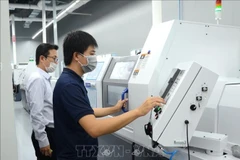
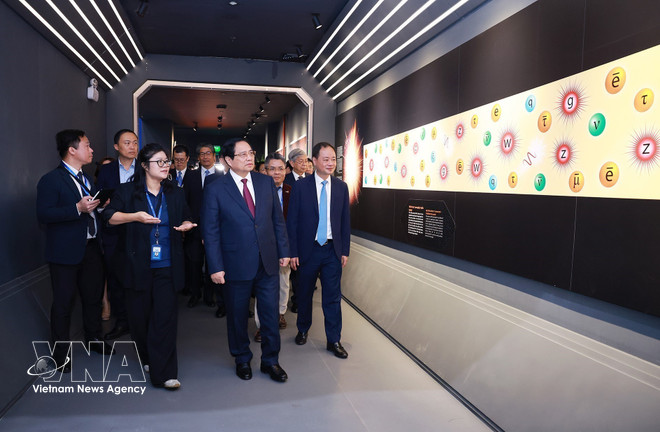
Before attending the forum, PM Chinh and delegates toured the satellite control and operation centre at the VNSC, which monitors satellites in orbit, plans control operations, receives and processes satellite data, and provides products for ministries, local authorities and national security needs.
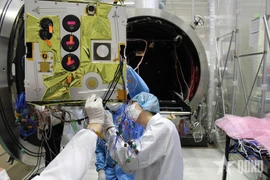
The PM also visited the satellite research and development area, which includes clean rooms for satellite integration, testing equipment and simulated space environments used to verify satellite performance before launch.
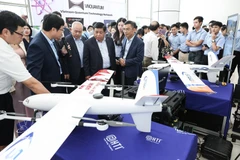
Delegates also viewed the MicroDragon-2 satellite, weighing about 50 kg, designed both to monitor forest changes and to test Vietnam’s ability to design and manufacture satellites domestically, thereby building technological self-reliance.
The VNSC is the first high-tech science project in Vietnam implemented with an ODA loan from the Japanese Government, with a total investment of over 7 trillion VND (over 266.2 million USD).
Covering an area of 9 ha, the project provides infrastructure to receive the transfer of earth observation satellite technology, including training personnel and manufacturing and launching the LOTUSat-1 satellite. It aims to enhance capacity for disaster prevention, climate change response, resource management and environmental monitoring through remote sensing data to support socio-economic development and national security./.