National AI ethics framework issued to guide safe, responsible rollout

According to the circular taking effect on March 10, the framework imposes specific obligations on entities and individuals involved in AI activities. In particular, the AI use must ensure safety, reliability, while preventing harm to human life, health, dignity, honour, and mental well-being.

Students control robots at the FPT Schools AI & Robotics Challenge (Photo: VNA)

Hanoi (VNA) - The Minister of Science and Technology has signed a circular issuing the National Artificial Intelligence Ethics Framework, designed to steer the research, development, and deployment of AI systems toward outcomes that are safe, responsible, and beneficial to individuals, communities, and society at large.

According to the circular taking effect on March 10, the framework imposes specific obligations on entities and individuals involved in AI activities. In particular, the AI use must ensure safety, reliability, while preventing harm to human life, health, dignity, honour, and mental well-being.

Developers and operators bear responsibility for embedding safety features from the design stage, anticipating potential harmful scenarios, and adopting suitable preventive controls. They must also establish clear quality criteria for data, models, and outputs, alongside internal processes for testing, validation, and verification prior to any deployment.

The framework mandates human oversight and intervention capabilities for all AI-driven decisions and actions, calibrated to the system's potential impact level. Entities and individuals must set up mechanisms to gather feedback, detect errors, initiate corrections, and maintain contingency plans in cases of malfunction or misuse. Robust security protocols must detect and mitigate threats, including unauthorised access, system hijacking, data or model poisoning, adversarial attacks, vulnerability exploitation, data breaches, or other forms of misuse, thereby ensuring the confidentiality, integrity, and availability of data, models, algorithms, and supporting infrastructure.

Emphasis is placed on respect for human and civil rights, with commitments to fairness, transparency, and non-discrimination throughout AI development and use. Entities and individuals must apply appropriate review processes to prevent infringements on privacy, personal data protection, freedom of choice, access to information, the right to equal treatment, and other rights enshrined in law.

Efforts are required to detect and mitigate biases in data, models, and operations, with particular attention to effects on vulnerable groups such as children, the elderly, those with disabilities, and other disadvantaged groups. Entities and individuals must provide clear notifications about AI involvement, delivering reasonable details on system goals, scope, data sources, general operating principles, and known limitations to prevent misconceptions about capabilities.

Moreover, the framework encourages AI use that advances social welfare, inclusivity, and sustainable progress. Entities and individuals should evaluate energy use, computing resources, and environmental footprints across the full AI lifecycle, favouring energy-efficient technologies and low-emission processes. AI system design must follow social ethical norms and Vietnam's cultural identity, while avoiding discriminatory outputs or adverse impacts on community interests.

Innovation and corporate social responsibility receive encouragement under the framework. Responsible experimentation is endorsed, along with open research and knowledge dissemination in accordance with legal regulations, and protection of intellectual property rights.

The framework will undergo periodic review and updates every three years, or sooner in response to major changes in technology, legislation, or management practices.

The issuance reinforces the implementation of the Politburo’s Resolution No. 57-NQ/TW on breakthroughs in sci-tech, innovation, and national digital transformation. It also supports the enforcement of the Law on AI, which entered into force on March 1, 2026./.


VNA

See more

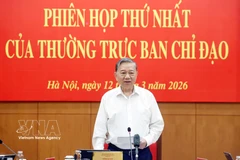
Party General Secretary To Lam speaks at the first meeting in 2026 of the Central Steering Committee for the Development of Science, Technology, Innovation and Digital Transformation on March 12. (Photo: VNA)

Party chief urges stronger, result-oriented implementation of Resolution 57

Turning science, technology, innovation and digital transformation into the main drivers of a new growth model requires substantial efforts. In the coming period, the focus must shift from merely carrying out tasks to delivering tangible and measurable outcomes, while concentrating resources on addressing strategic national challenges, said Party General Secretary To Lam.

Vietnamese Ambassador to the US Nguyen Quoc Dung addresses the forum. (Photo: VNA)

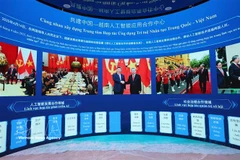
High-level forum advances Vietnam–US technological cooperation

The ambassador highlighted that Vietnam and the US are highly complementary. Vietnam offers a dynamic economy, a young and increasingly skilled workforce and rapidly growing innovation ecosystem, while the US offers frontier technologies, world class research institutions, capital and leading global companies.

Participants at the first meeting of the National Steering Committee on Semiconductor Industry Development in 2026 (Photo: VNA)

Vietnam becomes vital player in global semiconductor value chain: Deputy PM

Vietnamese companies have also gradually joined the global value chain by improving their capabilities in chip design, production and related services. Notably, a semiconductor chip manufacturing plant project developed by the Viettel Military Industry and Telecoms Group (Viettel) has already commenced.

Young voters in Ho Chi Minh City scan an QR code to participate in an online quiz about the Election Law. (Photo: VNA)

Digital technology helps enhance transparency, trust in elections

The use of technology in this election is not merely a short-term measure but reflects Ho Chi Minh City’s broader commitment to comprehensive digital transformation and smart urban governance, reinforcing public trust in the democratic process and administration.

Information about candidates for the Khanh Hoa provincial People's Council for the 2026-2031 term is published on digital information channels, making it convenient for voters to explore. (Photo: VNA)

Technology breakthrough ensures voters' access, rights

Digital platforms such as the national population database and the VNeID application have been widely applied to streamline election management and improve accuracy in voter registration, helping citizens exercise their civic rights more conveniently.

Mang But commune area in Quang Ngai province. (Photo: VNA)

3.9-magnitude earthquake recorded in Mang But, Quang Ngai

According to the Vietnam Earthquake Information and Tsunami Warning Centre under the Institute of Earth Sciences, the tremor occurred at 11:35:06 (Hanoi time) with coordinates of 14.864 degrees North latitude and 108.210 degrees East longitude, at a depth of about 8.1 km. The event was assessed as having a level-0 disaster risk.

Illustrative photo: AFP

AI Law takes effect, anchors national governance framework

Taken together, the new AI Law and its implementation roadmap not only complete Vietnam’s legal architecture for AI, but also lay a structured foundation for risk management, innovation and ecosystem development, aiming to ensure coherent and effective enforcement in the years ahead.

Viettel Networks and Ericsson sign their cooperation agreement on the sidelines of the Mobile World Congress 2026. (MWC 2026)

Viettel Networks, Ericsson partner to advance autonomous telecom networks

Under a newly signed cooperation agreement, Ericsson will provide network automation platforms and artificial intelligence (AI) technologies while working with Viettel to conduct real-world trials. The collaboration marks a new step forward, combining Viettel’s large-scale network operation expertise with Ericsson’s strengths in automation solutions and advanced technologies.

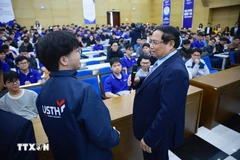
Prime Minister Pham Minh Chinh speaks with students at Hanoi University of Science and Technology (Photo: VNA)

Resolution 57: Developing high-quality sci-tech human resources key to master strategic technologies

After one year of implementing Resolution No. 57-NQ/TW of the Politburo, alongside notable achievements, the Central Steering Committee for science and technology development, innovation, and digital transformation has identified persistent shortcomings and bottlenecks requiring urgent attention - most notably a shortage of high-quality human resources in strategic technology fields.

The Saigon Hi-Tech Park (Photo: VNA)

Vietnam advances toward mastering UAV technology

Products are already making their way into the US market, but this is not merely a story of applying new technology in practice, but a gradual process of mastering core details and affirming international capabilities in the UAV industry, one of Vietnam’s strategic high-tech sectors.