Hanoi (VNA) - The Party has underscored human resource development in science and technology (S&T), including those engaged in research, innovation, teaching, management, and the operation of science and technology activities, as a decisive task, viewing it as the foundation for mastering and advancing strategic technologies in the period ahead.
After one year of implementing Resolution No. 57-NQ/TW of the Politburo, alongside notable achievements, the Central Steering Committee for science and technology development, innovation, and digital transformation has identified persistent shortcomings and bottlenecks requiring urgent attention - most notably a shortage of high-quality human resources in strategic technology fields.
Shortage of high-level scientists
Nearly four decades after the Doi moi (renewal) process, Vietnam’s S&T workforce has expanded significantly in both number and quality. Several fundamental science disciplines have built research teams approaching regional and international standards.
However, as the country shifts toward a growth model driven by science, technology and innovation, the current pool of scientists remains thin, with a notable shortage of top-tier experts, particularly in strategic and high-tech sectors.
Academician Professor Le Truong Giang, Vice President of the Vietnam Academy of Science and Technology (VAST), cited a 2025 study by the Ministry of Science and Technology, together with statistics from the Ministry of Education and Training, saying that Vietnam has only about 1,300 researchers per million people, a modest figure compared to many regional peers.
Although the number of professors and associate professors has increased, it is still disproportionate to the scale of higher education and the demands of S&T development. The average number of senior scientists per research sub-discipline remains limited, reflecting a lack of core experts to lead research, training and generational succession.
This shortfall not only constrains the development of new research directions but also creates structural imbalances within the scientific workforce. Some basic science fields are witnessing a decline in successors, raising concerns over potential disruptions and the gradual erosion of key disciplines.
Training efforts and emerging challenges
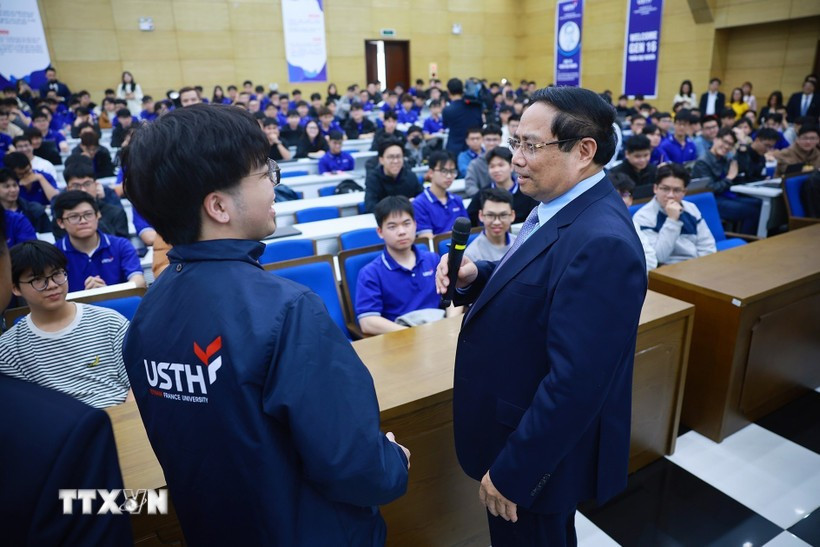
During 2020–2025, training at the VAST expanded markedly in both scale and quality. The University of Science and Technology of Hanoi stands out as a model of internationalised education, with over 4,000 students, all programmes taught in English, seven international dual-degree schemes, and a strong focus on strategic fields such as semiconductors, space technology and aviation. Its close integration of training with laboratories and international research projects enables students to participate directly in major scientific work.
Meanwhile, Graduate University of Science and Technology, operating under an institute–university model within VAST, offers 48 doctoral and 18 master’s programmes, enrolling about 500 PhD candidates and 200 master’s students annually. Many PhD theses are defended with at least two international publications, while the Institute of Mathematics and two UNESCO-affiliated centres continue to act as important hubs for international academic cooperation, attracting students and experts from around the world.
However, according to VAST Vice President Tran Tuan Anh, the training of science and technology human resources, both at the Academy and nationwide, continues to face significant challenges. Enrollment in science and technology disciplines is still limited, falling short of the demand for strategic technology development. Amid digital transformation and the 4th Industrial Revolution, demand for talent in semiconductors, AI, advanced materials and renewable energy is rising rapidly, yet domestic training capacity has not kept pace in either quantity or quality.
At the same time, the absorption and effective use of high-quality domestic talent remain problematic. The innovation ecosystem is not yet strong enough to create seamless linkages between training, research and production. As a result, some highly skilled professionals have not fully realized their potential, or have moved to the private sector or overseas.
Another bottleneck lies in governance mechanisms, particularly autonomy in managing and exploiting assets derived from scientific research, including intellectual property, equipment and facilities. These constraints reduce the attractiveness of the research environment and directly affect the ability to attract and retain top S&T talent, Anh said.
Ways to remove bottlenecks hindering development of S&T human resources
Limitations in developing the scientific workforce have been acknowledged in various Party and State resolutions. Issues related to remuneration policies, financial mechanisms, working conditions, research infrastructure and linkages within the S&T ecosystem require further reform.
Anh noted that without decisive changes, Vietnam risks facing a persistent paradox: soaring demand for high-tech talent but limited enrollment in science and technology fields; well-trained personnel but insufficient enterprise capacity to absorb them; valuable research outputs but weak commercialisation due to institutional barriers.
He said that mastering strategic technologies requires bold, coordinated reforms, with training aligned to well-funded national programmes, stronger State–scientist–enterprise cooperation from research planning to commercialisation, and the removal of institutional bottlenecks to ensure real autonomy and clear benefits for scientific institutions and researchers.
In the current context, developing a high-calibre S&T workforce is pivotal for Vietnam to master strategic technologies and achieve sustainable growth. Strong, coordinated and systemic solutions will determine the effective implementation of Resolution No.57, making tangible contributions to sustainable development, from research institutions and enterprises to the national level./.