Vietnam's Internet evolution: From connectivity to trusted digital backbone

Since 2020, Vietnam has achieved a 97% protection rate for its Internet address space. Additionally, 14,000 domain names have been secured to ensure digital identity safety.

Party General Secretary To Lam visits a booth at a national conference on breakthroughs in sci-tech, innovation and national digital transformation. (Photo: VNA)

Hanoi (VNA) - After nearly three decades, the Internet has become integral to Vietnam’s socio-economic life, modernising rapidly and delivering service quality approaching advanced global standards.

New shifts in Vietnam’s Internet landscape

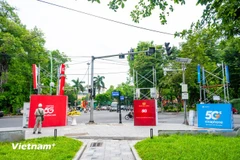
According to the Ministry of Science and Technology and recent international rankings, Vietnam's fixed broadband speeds placed the country in the global top tier as of October 2025, ranking 10th worldwide, while mobile broadband ranked 15th. Following commercialisation, 5G networks now cover 59% of the population, providing a critical foundation for the development of digital economy, digital government, and digital society.

Deputy Minister of Science and Technology Pham Duc Long said Vietnam’s Internet is shifting along five key trends closely tied to development realities. The first shift concerns governance. The sector is moving from a space largely driven by self-regulation among stakeholders toward one governed by clearer institutional framework, laws, and standards, matching its growing societal role.

The second concerns information's role. Vietnam’s Internet is evolving beyond mere content delivery into a powerful force that molds behaviour and directly influences social decisions. Algorithms and AI-driven platforms increasingly guide consumer patterns, public opinion, and personal choices. In response, the recent promulgation of an Artificial Intelligence Law demonstrates Vietnam’s balanced approach that fosters innovation and enforces risk-based controls rooted in ethics, transparency, and human-centric principles.

Next is the data shift. The Internet is moving from fragmented data use toward treating data as a strategic asset demanding responsible stewardship. Digital platforms must balance exploitation for value creation with safeguards for citizens’ rights and national interests, consistent with modern governance norms.

Another pivotal change repositions Vietnam’s Internet from basic connectivity infrastructure to comprehensive digital infrastructure powering the digital economy. It must extend beyond transmission pipes to encompass connectivity, computing power, data, platforms, and security, becoming central to productivity gains, competitiveness, and economic self-reliance.

Finally, development goals are pivoting from sheer expansion toward sustainable, inclusive advancement, with a focus on narrowing digital divides across regions and demographics. Governance is shifting from reactive incident management to proactive, risk-oriented prevention with a long-term horizon.

Developing safe, humane, and trustworthy Internet

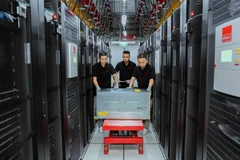
Nguyen Truong Giang, Acting Director of the Vietnam Internet Network Information Centre (VNNIC) under the Ministry of Science and Technology, noted that Vietnam’s Internet now faces multiple complex risk groups, including physical infrastructure incidents such as cable disruptions or data centre outages, cyberattacks and routing attacks, resource abuse and surging online fraud.

Sharing a similar view, Vu Hoang Lien, Chairman of the Vietnam Internet Association, stressed that the darker side of technological advances, such as AI and big data, is increasingly being exploited for warfare, psychological manipulation, and illicit profit with growing sophistication. Many victims of online fraud are among Vietnam’s nearly 80 million Internet users.
b.jpg
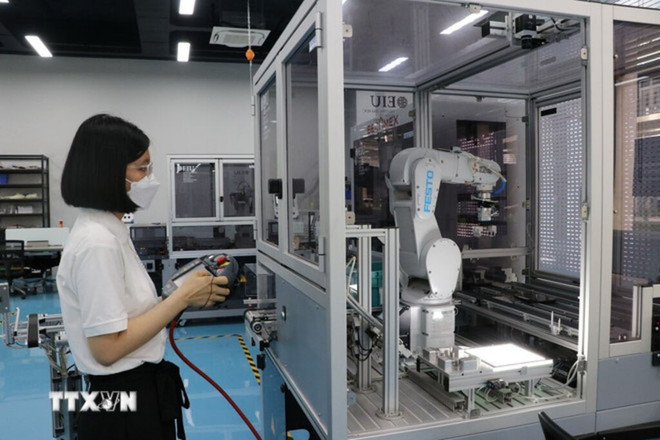
Operating a robot to boost factory capacity (Photo: VNA)

Vietnam’s forward-looking Internet strategy centres on cultivating a safe, humane, and trustworthy digital environment that supports socio-economic progress, built on trust, fueled by innovation, and underpinned by robust institutional framework. This aligns with the guiding principles of Resolution 57, now concretised through digital transformation and AI legislation, with ongoing enforcement.

To build a safe and sustainable Internet space, Lien underscored digital culture as a core factor. Beyond technical proficiency, it includes awareness, attitudes, and responsible conduct in the online realm. Empowered users who combine access with understanding can safeguard their rights, contribute constructively, and create shared societal value.

From the corporate viewpoint, Nguyen Huu Cuong, Product Manager for Personal Information Security at VNPT Cyber Immunity, said amid increasingly sophisticated online scams and AI-driven attacks, individual users are becoming the most vulnerable group in cyberspace. Risks are amplified for vulnerable groups, including the elderly, children, those with limited digital access, and general users.

In response, the VNNIC has adopted technical measures to protect the Internet at its roots. These include Internet resource management, enhanced routing and domain name security, and the deployment of authentication and resource-protection technologies to minimise risks. Broader "Internet cleanup" efforts feature domain protection mechanisms, AI and machine learning for abuse detection and early warnings, and a community reporting system for swift violation identification and response, thus shielding users and enterprises.

Since 2020, Vietnam has achieved a 97% protection rate for its Internet address space. Additionally, 14,000 domain names have been secured to ensure digital identity safety./.


VNA

See more

Prime Minister Pham Minh Chinh meets students of the University of Science and Technology of Hanoi. (Photo: VNA)

VAST – core force in national science system: Prime Minister

The Party, the State, and the Government identify science, technology, and innovation as both a fundamental pillar and a central engine of growth, as well as a direct productive force driving rapid and sustainable development, Prime Minister Pham Minh Chinh said, stressing that VAST stands as a crucial “fortress” of knowledge that concentrates the intellectual resources and limitless creativity of the Vietnamese people.

Experiencing digital transformation at a forum on supporting businesses in digital transformation and e-commerce development (Photo: VNA)

Resolution No.57: driving shift to knowledge- and technology-based growth

With the official launch of the Hanoi Technology Exchange (HanoTEX) and the Digital Transformation Market (DTMarket) - combined with the development of hard infrastructure - Hanoi aims to become a place where technology is translated into practical value, directly contributing to the city’s GRDP growth target of at least 11% in 2026.

A banking chatbot addresses urgent operational needs in digital transformation. (Photo: VNA)

Central bank moves to tighten AI use in banking

Under the draft, banks and intermediary payment service providers must inform customers before deploying AI-powered tools such as virtual assistants, automated hotlines and chatbots in customer communications.

Viettel Digital Talent and Viettel Future Changemakers are open for registration until March 15, 2026. (Photo: Viettel)

Viettel launches talent search to develop young workforce for core technologies

Unlike conventional internship or management trainee schemes, both programmes are designed and implemented directly by Viettel, integrating training with real-world work in a global technology group. Participants are entrusted with solving major challenges that directly impact Viettel’s research, production and business operations.

A close-up view of the UAVs used in the Can Gio - Vung Tau delivery route on Fenruary 12, 2026 in Ho Chi Minh City (Photo: CT UAV)

Vietnam’s first cross-sea UAV delivery route inaugurated

The event marked the debut of the country’s first cross-sea unmanned postal route, representing a pioneering step in smart mobility solutions aimed at boosting the digital economy and easing pressure on road transport infrastructure in Ho Chi Minh City.

According to the Vietnam National Authority of Tourism (VNAT), which cited the Google–Temasek–Bain & Company e-Conomy SEA 2025 report, tourism remains one of the key drivers of Vietnam’s economy. (Photo: VNA)

Digital transformation in tourism for comprehensive, sustainable growth

Vietnam is well positioned to become a leading digital tourism destination in the region. By capitalising on current growth momentum and implementing targeted support measures for small and medium-sized enterprises, the country can build a smart and sustainable tourism ecosystem aligned with global digital transformation trends.

Party General Secretary To Lam ( second, from left) visits an exhibition showcasing the government's achievements in science, technology, innovation, and digital transformation. (Photo: VNA)

Fund mechanisms positioned to unlock greater resources for innovation

Resolution No. 57-NQ/TW of the Politburo defines fund-based mechanisms as the core financial tool for advancing science, technology and innovation. Under the resolution, State budget funding for research and development is prioritised for allocation through funds, alongside reforms in financial management, expanded autonomy, streamlined procedures, and acceptance of the risks and time lags inherent in research activities. It also calls for the establishment of venture capital funds and science and technology development funds to steer, mobilise and unlock social resources for innovation.

UAV Cup PV GAS 2025 looks for solutions to boost the low-altitude economy (Photo: qdnd.vn)

Digital economy helps power breakthrough growth

The application of digital technologies, big data, artificial intelligence, e-commerce and digital platforms is creating new opportunities for businesses and citizens across production, business activities and social governance. Sectors such as e-commerce, digital finance, smart logistics and digital platform-based services are generating significant added value, while online public services, cashless payments, digital education and digital healthcare are increasingly improving quality of life and the transparency and efficiency of state management.

Camera manufacturing at Sunny Opotech Vietnam Co., Ltd. in Yen Binh Industrial Park in Thai Nguyen province. (Photo: VNA)

Resolution No. 57: Vietnam moves to create favourable legal framework for technology transfer

The Ministry of Science and Technology has sought feedback on a draft decree amending the Government's Decree No. 76/2018/ND-CP, aiming to strengthen the legal framework for technology appraisal and transfer, improve support policies for participating entities, and enhance risk management to ensure sustainable development, environmental protection and public health.