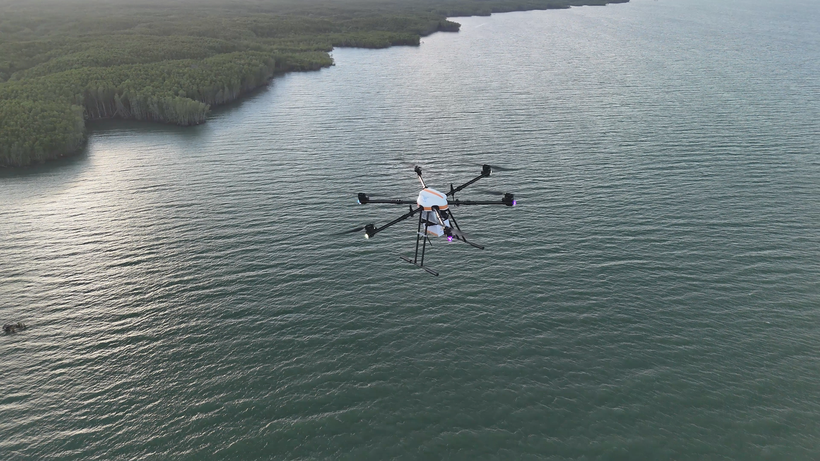
Vietnam’s first cross-sea UAV delivery route inaugurated

The event marked the debut of the country’s first cross-sea unmanned postal route, representing a pioneering step in smart mobility solutions aimed at boosting the digital economy and easing pressure on road transport infrastructure in Ho Chi Minh City.

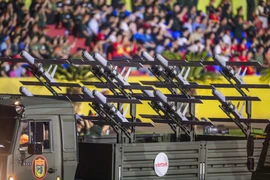
A close-up view of the UAVs used in the Can Gio - Vung Tau delivery route on Fenruary 12, 2026 in Ho Chi Minh City (Photo: CT UAV)

HCM City (VNA) – The Department of Science and Technology of Ho Chi Minh City, in coordination with Vietnam Post and CT UAV JSC, launched a UAV-based delivery route connecting Can Gio and Vung Tau on February 12.

The event marked the debut of the country’s first cross-sea unmanned postal route, representing a pioneering step in smart mobility solutions aimed at boosting the digital economy and easing pressure on road transport infrastructure in Ho Chi Minh City.

The launch was supported by many agencies, including the municipal High Command, the Region 1 Defence Command, the 370th Air Division, and local authorities of Can Gio commune and Vung Tau ward, forming a multi-stakeholder model.

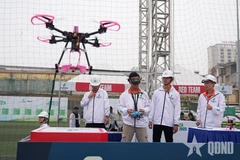
A highlight of the ceremony was a UAV flight, during which an actual postal parcel was transported from Can Gio to Vung Tau under the observation of officials and invited guests.

The operation was carried out in accordance with Decree No. 288/2025/ND-CP, Circular No. 146/2025/TT-BQP, and a flight permit No. 805/TC-QC issued by the Operations Department under the General Staff of the Vietnam People's Army (VPA) on January 19, 2026.
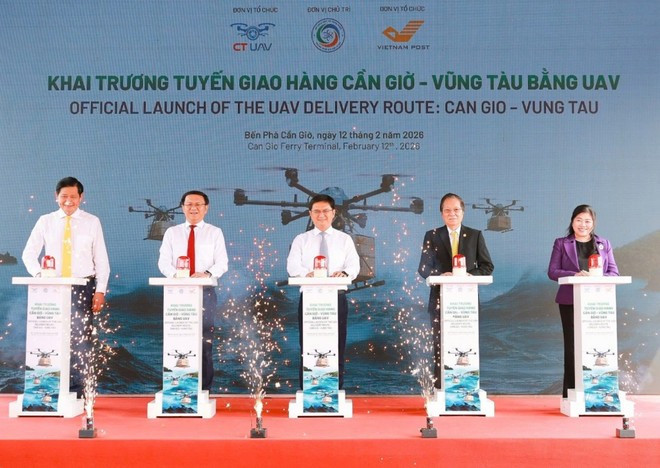
hinh-4-2.jpg
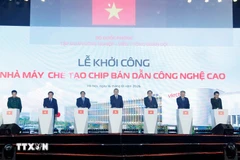
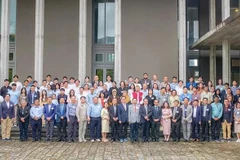
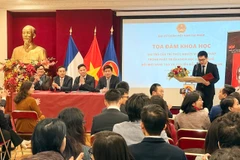
Delegates at the launching ceremony of UAV delivery route in Ho Chi Minh City on February 12, 2026 (Photo: Vietnam Post)

Under the project, Vietnam Post acts as the delivery service provider, responsible for designing operational procedures, setting quality standards, and organising the receipt and delivery of goods.

The flight route has been established to enhance the quality of Vietnam Post’s delivery services, with the entire process integrated into its logistics system to ensure a seamless “one code – one journey” experience.

In the initial phase, Vietnam Post will prioritise small parcels weighing under 5kg, including documents and e-commerce packages.

The UAV-based postal route is expected to significantly shorten delivery time between the two geographically distinct localities, while offering customers faster shipping options with real-time tracking. It also enhances service capacity during traffic disruptions and contributes to promoting a controlled pilot model, providing regulators with data to refine policies on smart logistics and low-altitude economic development.

To ensure public safety and airspace security, flight parameters have been carefully calculated, with a maximum altitude of 200 metres, a 300-metre-wide flight corridor, and a 500-metre operational radius at takeoff and landing sites. The UAV fleet comprises drones specifically designed for transport and logistics operations.

All UAVs are equipped with journey-monitoring cameras and intelligent autonomous systems, enabling the transport of postal items, essential goods, pharmaceuticals and documents in line with each drone’s operational configuration. Aviation safety and ground security are given top priority. The municipal Department of Science and Technology will coordinate with the municipal High Command to supervise daily operations after the launch. Vietnam Post will gradually integrate UAV deliveries into its network and report on efficiency and service quality to refine and expand the model.

Having previously piloted UAV transport for medical supplies, Vietnam Post is now extending the service to cargo, particularly on sea and island routes, in compliance with regulations and with safety as a top priority.

The Can Gio–Vung Tau UAV postal route is expected to help management agencies assess the possibility of expanding the model to emergency medical transport, disaster response and smart urban management. It also supports the city’s goal of building a green and smart logistics network and lays the foundation for low-altitude air transport infrastructure to better serve logistics, post and public services in the future.

Pham Huynh Quang Hieu, Deputy Director of the municipal Department of Science and Technology, said the route marks a breakthrough step, demonstrating not only technological maturity but also the city’s capacity to organise and implement low-altitude air transport models in real conditions.

The introduction of UAVs into logistics opens opportunities for domestic tech firms to master modern drones, from manufacturing to operation, thereby fostering economic development through UAV applications./.
VNA

See more

Prime Minister Pham Minh Chinh (C) and delegates cut a ribbon to innaugurate the Vietnam National Space Centre (VNSC) at Hoa Lac Hi-Tech Park in Hanoi on March 13 (Photo: VNA)

PM calls for accelerated space technology development in Vietnam

Vietnam aims by 2030 to achieve a mid-level position in space science and technology development within Southeast Asia, and after 2030 to build national capabilities to independently develop satellite technologies and apply space data to address global challenges and national security needs.

Students control robots at the FPT Schools AI & Robotics Challenge (Photo: VNA)

National AI ethics framework issued to guide safe, responsible rollout

According to the circular taking effect on March 10, the framework imposes specific obligations on entities and individuals involved in AI activities. In particular, the AI use must ensure safety, reliability, while preventing harm to human life, health, dignity, honour, and mental well-being.

Party General Secretary To Lam speaks at the first meeting in 2026 of the Central Steering Committee for the Development of Science, Technology, Innovation and Digital Transformation on March 12. (Photo: VNA)

Party chief urges stronger, result-oriented implementation of Resolution 57

Turning science, technology, innovation and digital transformation into the main drivers of a new growth model requires substantial efforts. In the coming period, the focus must shift from merely carrying out tasks to delivering tangible and measurable outcomes, while concentrating resources on addressing strategic national challenges, said Party General Secretary To Lam.

Vietnamese Ambassador to the US Nguyen Quoc Dung addresses the forum. (Photo: VNA)

High-level forum advances Vietnam–US technological cooperation

The ambassador highlighted that Vietnam and the US are highly complementary. Vietnam offers a dynamic economy, a young and increasingly skilled workforce and rapidly growing innovation ecosystem, while the US offers frontier technologies, world class research institutions, capital and leading global companies.

Participants at the first meeting of the National Steering Committee on Semiconductor Industry Development in 2026 (Photo: VNA)

Vietnam becomes vital player in global semiconductor value chain: Deputy PM

Vietnamese companies have also gradually joined the global value chain by improving their capabilities in chip design, production and related services. Notably, a semiconductor chip manufacturing plant project developed by the Viettel Military Industry and Telecoms Group (Viettel) has already commenced.

Young voters in Ho Chi Minh City scan an QR code to participate in an online quiz about the Election Law. (Photo: VNA)

Digital technology helps enhance transparency, trust in elections

The use of technology in this election is not merely a short-term measure but reflects Ho Chi Minh City’s broader commitment to comprehensive digital transformation and smart urban governance, reinforcing public trust in the democratic process and administration.

Information about candidates for the Khanh Hoa provincial People's Council for the 2026-2031 term is published on digital information channels, making it convenient for voters to explore. (Photo: VNA)

Technology breakthrough ensures voters' access, rights

Digital platforms such as the national population database and the VNeID application have been widely applied to streamline election management and improve accuracy in voter registration, helping citizens exercise their civic rights more conveniently.

Mang But commune area in Quang Ngai province. (Photo: VNA)

3.9-magnitude earthquake recorded in Mang But, Quang Ngai

According to the Vietnam Earthquake Information and Tsunami Warning Centre under the Institute of Earth Sciences, the tremor occurred at 11:35:06 (Hanoi time) with coordinates of 14.864 degrees North latitude and 108.210 degrees East longitude, at a depth of about 8.1 km. The event was assessed as having a level-0 disaster risk.

Illustrative photo: AFP

AI Law takes effect, anchors national governance framework

Taken together, the new AI Law and its implementation roadmap not only complete Vietnam’s legal architecture for AI, but also lay a structured foundation for risk management, innovation and ecosystem development, aiming to ensure coherent and effective enforcement in the years ahead.