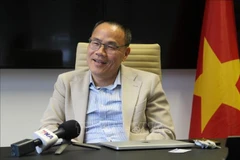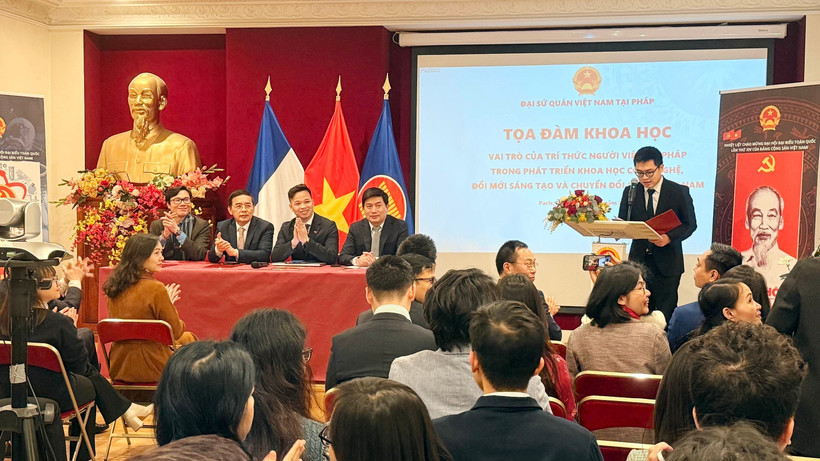
Paris (VNA) - The Vietnamese Embassy in France on January 31 hosted a scientific seminar highlighting the role of Vietnamese intellectuals in France in the development of science and technology, innovation and digital transformation in Vietnam.
The event, held in both in-person and online formats, drew the participation of Vietnamese scientists, experts and intellectuals living, working and studying in France, as well as several other European countries.
Held amid the nationwide efforts to implement the Resolution of the 14th National Party Congress and the Politburo’s Resolution No. 57-NQ/TW on breakthroughs in science, technology, innovation, and national digital transformation, the seminar served not only as an academic forum but also as a platform reflecting the sense of responsibility, intellectual engagement and aspiration to contribute among overseas Vietnamese intellectuals in the nation’s new development era.
Presentations and discussions demonstrated the strong alignment of Vietnamese intellectuals in France with the Party and State’s strategic goals, particularly the view that science and technology, innovation and digital transformation constitute a leading breakthrough and the main driving force for rapid and sustainable development. Many concrete and practical recommendations were put forward, aiming to accelerate the implementation of Resolution 57 and generate substantive outcomes.
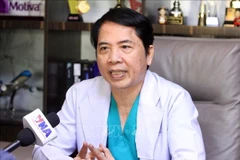
In his presentation, Dr. Vo Toan Trung, head of the Neurological Rehabilitation Department at Bullion Hospital, stressed that Vietnam must move decisively from a traditional growth model towards a knowledge-based economy to realise its aspiration of becoming a developed country by 2045. He called for a comprehensive, long-term strategy closely linking research with application and commercialisation, with focused investment in high value-added sectors that improve people’s quality of life.
From the perspective of engaging overseas intellectuals, Dr. Ung Quoc Hung, Chief Engineer at Setec Nucléaire and Vice Chairman of the Vietnamese Nuclear Energy Experts Network Abroad (VietNuc), noted that mobilising overseas Vietnamese expertise requires a more flexible and practical approach. He suggested expanding forms of remote and project-based participation, rather than focusing solely on physical return, in order to better leverage international experience and networks.
Sharing lessons from Europe and France for Vietnam’s AI strategy, Dr. Le Huu Dien Khue, Director of Research and Development at GetVocal AI, underlined the State’s leading role in driving AI development through proactive industrial policies, investment in computing infrastructure and data, and a reliable legal framework. He recommended treating computing capacity and data as essential infrastructure and linking AI development with key sectors such as healthcare, education, transport and urban management.
Addressing the responsibility of overseas Vietnamese, Associate Professor Tran Le Hung of Gustave Eiffel University highlighted the concept of “brain circulation” in an era of deep global integration. He proposed a “five-party ecosystem” involving the State, universities, scientists, investors and enterprises to facilitate research, application and commercialisation.
Meanwhile, Dr. Nguyen Van Tuan, a postdoctoral researcher at Chimie ParisTech under PSL University, emphasised the importance of scientific integrity and quality management. He called for a transparent academic environment based on international standards, unified academic identification systems and stronger independent peer review to ensure effective and sustainable use of scientific investment.
Concluding the seminar, a representative of the Vietnamese Embassy in France affirmed that the recommendations reflected strong responsibility towards the homeland and would serve as valuable input for policy building, particularly in implementing Resolution 57. The embassy pledged to continue acting as a bridge to help Vietnamese intellectuals abroad contribute more effectively to national development.
The seminar concluded in a spirit of solidarity, responsibility and confidence, reaffirming the commitment of Vietnamese intellectuals in France to contribute their knowledge and dedication to making science and technology a firm foundation for Vietnam’s rapid and sustainable development in the new phase./.
See more
STEM Innovation Petrovietnam helps cultivate knowledge in technological era
The programme connected three sites in Hanoi, Nguyen Hue High School in Lao Cai, and Chau Thanh High School in Ho Chi Minh City, bringing together educators, students, representatives of businesses, and industry–energy engineers, and those directly supporting schools in implementing STEM (science, technology, engineering, and mathematics) education in practice.
Top 10 university start-ups in Vietnam secure innovation backing
The selected projects share a strong technology-driven orientation, particularly in artificial intelligence (AI), digital solutions and advanced materials. Their innovations address large-scale, real-world issues across sectors including healthcare, education, legal services, agriculture, energy, environmental protection and public governance.
VinFuture opens call for excellent scientific breakthroughs for 6th season
The evaluation process is scheduled to be completed by September 2026, with the 6th VinFuture Prize Award Ceremony slated for early December 2026. Nominations submitted after April 17, 2026, will automatically be considered for the 2027 season.
Science - technology paves way for “second wave of Doi moi”: expert
Assoc. Prof. Dr. Tran Le Hung, lecturer at the ESIEE Paris - an engineering school of University Gustave Eiffel, said future “Make in Vietnam” science and technology products will not only directly serve domestic demands, improve the people’s livelihoods, and boost labour productivity, but also have the potential to compete in international markets.
High-quality training key to Vietnam’s technological self-reliance: VietNuc
Training must undergo a fundamental overhaul, with quality as the core focus. Curricula should be updated to international standards and developed in a comprehensive manner, said members of the executive board of the network of overseas Vietnamese nuclear energy experts (VietNuc)
Vietnam promotes On-chain financial infrastructure cooperation at Davos 2026
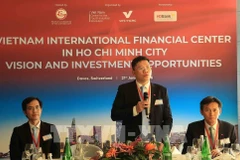
Jointly organised by the municipal People’s Committee, the Centre for the Fourth Industrial Revolution (C4IR) in the city (HCMC C4IR) and the Vietnam International Financial Centre in Ho Chi Minh City (VIFC-HCMC), the event was part of a series of activities showcasing the vision for building VIFC-HCMC, while expanding cooperation with global partners in finance, technology and innovation.
Trio of core drivers of new growth model highlighted at 14th National Party Congress
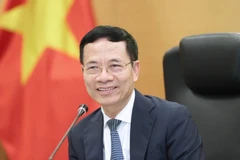
Member of the Party Central Committee and Minister of Science and Technology Nguyen Manh Hung emphasised that in moving from middle-income to high-income status, Vietnam must rely on science and technology, innovation, and digital transformation. These three drivers have been expanded and redefined by the Party under a new approach, creating broader development space and unlocking new resources for growth. With this trio, Vietnam has the potential to achieve double-digit growth.
AI strategy seen as engine for innovation-driven growth in Vietnam: scholar
Vietnam is standing at a historic moment to achieve a meaningful breakthrough based on science, technology and innovation.
Gov’t rolls out communication scheme for nuclear energy development
By 2027 around 60% of leaders, managers, civil servants and public employees in relevant ministries and localities will acquire basic knowledge of nuclear energy development and application. In parallel, the professional capacity of reporters, editors and information officers covering the sector will be strengthened.
Science, technology and innovation elevate Vietnam’s standing in new era
The most significant achievement in recent years has not been a single technological success, but a fundamental shift in awareness, mindset and ways of doing. Vietnam has established a new framework in which science, technology, innovation and digital transformation are judged by outcomes, with socio-economic effectiveness as the core benchmark.
New growth model helps position Vietnam on global technology map: expert
Heng LiHong, who is also a member of the Standing Board of the Business Association of Overseas Vietnamese (BAOOV), expressed his confidence that this new growth model will help Vietnam move beyond a development path reliant on low-cost labour and resource extraction, enabling the country to gradually climb to higher levels in the global value chain.
Vietnam, UN pledge to deepen cooperation on global technology governance
Vietnam considers capacity-building and greater self-reliance in science, technology, innovation and digital transformation a strategic priority, said Deputy Minister of Foreign Affairs Dang Hoang Giang.
Vietnam advances cybersecurity, digital transformation partnership with UN
The Ministry of Public Security places great emphasis on close cooperation with UN agencies to enhance capacities in combating transnational crime, peacekeeping, promoting gender equality and women’s empowerment, and counter-terrorism, Quang stated.
ASEAN Digital Ministers' Meeting adopts Hanoi Declaration on digital cooperation
The Hanoi Declaration places special emphasis on strengthening intra-bloc digital cooperation to promote economic growth, social progress, and cultural development in the region through joint efforts based on equality and partnership, aiming to lay a solid foundation for a prosperous and peaceful ASEAN Community.
Vietnam seeks stronger sci-tech cooperation with international partners
Informing the UN official about some of Vietnam’s achievements in sci-tech development, innovation, and digital transformation, Deputy PM Nguyen Chi Dung highlighted that the country and the UN have recorded progress in their sci-tech relations, with cooperation in strategic areas matching global trends and bilateral cooperation demand.
Vietnam, Singapore eye stronger cooperation in 5G, AI governance
Hung said that Vietnam has developed a complete 5G ecosystem - from network infrastructure such as base stations and core networks to applications, hoping that Singapore would support this ecosystem.
A new era beckons as Vietnam’s digital economy gathers momentum: UN Special Envoy
Vietnam’s digital economy is growing at a remarkably strong pace, extending its reach beyond the regional to the global stage. Its current growth rate is estimated to be three times faster than that of the broader economy, positioning Vietnam among the world’s leading digital economies.
Vietnam wins three awards at ASEAN Digital Awards 2026
In the digital startup category, MedCAT’s Idus platform, developed by MedCAT, won the gold award. Designed for reading, classifying and structuring documents, the platform has been applied in banking, public administration and healthcare, supporting automated insurance claims processing, smart healthcare services and the development of personal electronic health records.
Mobile app on information and education, mass mobilisation affairs made debut
The app, developed by Viettel, serves as the official, unified platform for the information and education, and mass mobilisation sector, helping the public verify information about the Party's policies and guidelines.
Hanoi breaks ground on digital technology, mixed-use park
The digital technology and mixed-use park in Hanoi is envisioned as a key nucleus of the capital’s innovation ecosystem, aligned with its goal of becoming a major national hub for science, technology and the digital economy.