New York (VNA) – UN Under-Secretary-General and UN Secretary-General's Special Envoy for Digital and Emerging Technologies Amandeep Singh Gill highlighted Vietnam’s role and standing in digital transformation, and artificial intelligence (AI) strategy, as well as the UN’s commitment to cooperation with the country during an interview recently granted to the Vietnam News Agency.
Gill said Vietnam’s digital economy is growing at a remarkably strong pace, extending its reach beyond the regional to the global stage. Its current growth rate is estimated to be three times faster than that of the broader economy, positioning Vietnam among the world’s leading digital economies.
However, he said ASEAN is facing major challenges, including uneven progress among member states and insufficiently interoperable digital infrastructure. Against this backdrop, the decision by ASEAN digital ministers at their recent meeting in Hanoi to give high priority to these issues under the ASEAN Digital Masterplan 2026–2030 is widely seen as a positive and timely step forward.
As AI is among the 11 strategic technologies identified by the Vietnamese and State as priorities for development, Gill hailed it as a highly accurate strategic choice, noting that in the digital era, not any national strategy for socio-economic transformation can afford to overlook the AI’s role.
He was particularly impressed by the Politburo’s Resolution 57, which targets breakthroughs in sci-tech, innovation and national digital transformation, saying that it is expected to unlock the vast creative potential of the Vietnamese people in the digital age.
Reflecting on the ASEAN Digital Ministers’ Meeting where he delivered a speech, Gill stressed that where there is close and sustained attention from national leaders, digital transformation tends to progress far more quickly and effectively. Vietnam, he noted, offers a clear example of this dynamic in practice.
According to him, AI is a powerful technology with vast potential for positive impact, but it can also be misused. A human-centred approach is therefore essential. Safeguarding people’s rights and safety must remain the top priority, with privacy and data security fully respected. AI development should not lead to excessive concentration of wealth and power, nor should it leave certain communities behind.
At the UN, he affirmed stance that AI must serve all of humanity, amplifying human creativity and productivity rather than displacing people from the future economy.
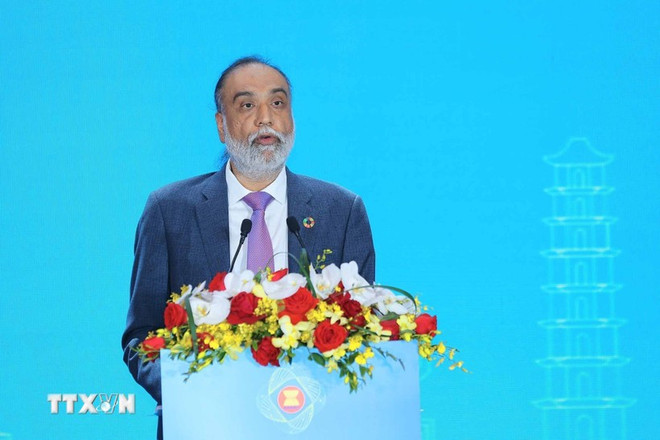
Commenting on Vietnam’s whole-of-political system effort to build the institutional and infrastructure foundations for a humane, people-centred digital ecosystem, Gill called it as the right approach. Human-centric development, he explained, must begin with infrastructure. Without access to high-performance computing for model training, sufficient data infrastructure for inference and deployment, AI cannot deliver meaningful real-world impact. Vietnam’s focus on infrastructure, talent cultivation and quality datasets for AI training therefore represents a sound and strategic course.
Beyond digital infrastructure, energy infrastructure is equally critical. Energy availability has become a major constraint on AI infrastructure globally. Gill observed that Vietnam is placing strong emphasis on diversifying energy sources to support the expansion of AI capabilities.
On the UN’s concrete commitments to Vietnam in advancing ethical, human-centred AI, Gill pointed out two key pillars. First is the creation of global AI governance mechanisms, a process in which Vietnam and all other UN member states have committed to join. Second is the active exchange of national experiences. Vietnam’s recent progress in AI governance and its evolving legal frameworks, he noted, could offer invaluable lessons for other nations during global dialogues on AI governance.
Finally, Gill highlighted the Vietnamese scientists' contributions to advancing cutting-edge AI technologies, affirming the UN’s strong support for their engagement in independent international scientific councils on AI./.