Au Lac Grand Prize launched to honour Vietnamese-made AI

The competition is open to all Vietnamese citizens, regardless of age, place of residence or professional background, provided the submitted product or solution is legally protected intellectual property developed and owned by Vietnamese individuals or entities and used in compliance with the law.

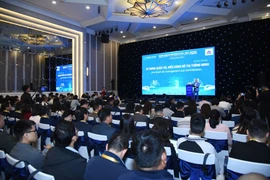
The Au Lac AI Alliance officially announces the inaugural Au Lac Grand Prize on January 12. (Photo: VNA)

Hanoi (VNA) – The Au Lac Grand Prize has been launched to recognise artificial intelligence (AI) products and solutions developed and mastered by Vietnamese innovators that deliver strong and lasting socio-economic impact.

Organisers said the prize will focus on AI products and solutions that have been fully developed and applied in real-world settings. Entries will be assessed against a clear set of criteria, including impact, innovation, sustainability, scalability and adherence to ethical AI principles.

The competition is open to all Vietnamese citizens, regardless of age, place of residence or professional background, provided the submitted product or solution is legally protected intellectual property developed and owned by Vietnamese individuals or entities and used in compliance with the law. Online registration is expected to open in March and last until July, with the award ceremony scheduled for November 2026.

The top-performing AI product or solution will receive a prize of 1 million USD, together with strategic and technical mentorship and support in accessing international markets from the Au Lac AI Alliance, FPT Corporation and partner organisations.
giai-thuong-au-lac-3.jpg
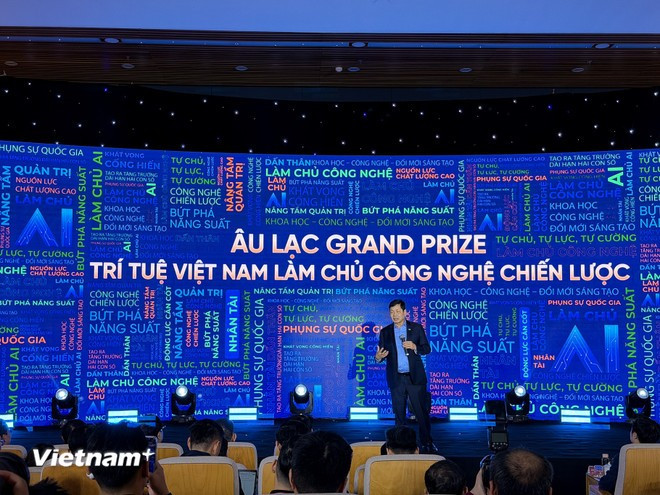
Truong Gia Binh, Chairman of the Au Lac AI Alliance and Chairman of FPT Corporation, speaks at the launch of the Au Lac Grand Prize. (Photo: VNA)

At the launch ceremony on January 12, Truong Gia Binh, Chairman of the Au Lac AI Alliance and Chairman of FPT Corporation, emphasised the need for Vietnam to develop sovereign AI to boost productivity, turn ideas into reality and safeguard national interests. Through the Au Lac Grand Prize, the alliance aims to energise the Vietnamese technology community to develop and deploy AI responsibly, while fostering a spirit of technological self-reliance, addressing major national challenges and helping Vietnam keep pace with advanced economies.

The prize is designed to promote technological mastery and reinforce Vietnam’s intellectual presence on the global technology map. It is expected to be awarded over three consecutive years, starting in 2026.

Under the Prime Minister's Decision No. 1131/QD-TTg, dated June 12, 2025, on the list of strategic technologies and strategic technological products, AI ranks first among 11 groups of strategic technologies. These are defined as breakthrough technologies with strong spillover effects that play a decisive role in enhancing technological autonomy, strengthening national competitiveness, and ensuring defence and security.

The Au Lac AI Alliance was established on June 20, 2025. Its founding members include leading technology corporations and start-ups such as MobiFone, VNPT, FPT, CMC, BKAV, Misa, MoMo, VNPAY, Zalo, AI For Vietnam, AI Hay, N2TP and Finhay, along with a number of universities and academies, including the Ho Chi Minh National Academy of Politics, Hanoi University of Science and Technology, the Posts and Telecommunications Institute of Technology, the Academy of Cryptography Techniques, HCM City University of Technology and Education, Ton Duc Thang University, HCM City University of Law, and FPT University.

The alliance aims to develop large language models capable of processing Vietnamese accurately and naturally, in line with the country’s culture and identity, thereby raising public knowledge and driving economic development. It also seeks to build an open and transparent AI ecosystem enabling individuals, organisations and businesses to freely access and use shared assets such as source code, data and models, even for commercial purposes, to spur innovation, expand AI adoption and advance national AI sovereignty./.


VNA

See more

An expert speaks at the International Conference on Semiconductors (ICOS) 2026 (Photo: VNA)

ICOS 2026 highlights pathways for Vietnam’s semiconductor development

This was the first international, specialised semiconductor conference held in central Vietnam and the first time the country hosted a large-scale academic forum dedicated exclusively to this sector. Organised in line with international standards, it featured plenary sessions, technical presentations and industry forums, reflecting major research trends shaping the semiconductor sector.

In Vietnam, 5G technology infrastructure has begun to be widely deployed by domestic network operators (Photo: VNA)

5G technology expansion expected to boost Vietnam’s digital economy

The Ministry of Science and Technology reported that by 2025, 5G had been commercialised nationwide, covering more than 90% of the population. Viettel alone has deployed 30,000 5G base stations, achieving 90% outdoor coverage and 70% indoor coverage, exceeding its commitments to the Government.

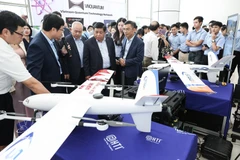
At a display of UAVs (Photo: VNA)

HCM City pilots UAVs for delivery services

HCM City aims to promote UAV use in urban delivery - a promising field contributing to smart logistics and postal services for e-commerce, smart cities and high-tech public services, while fostering UAVs as a strategic technology sector underpinning the innovation ecosystem.

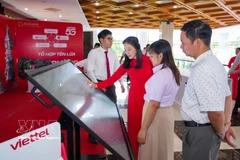
Viettel's virtual assistant for searching administrative units helps shorten time and simplify searches for people. (Photo: Viettel)

Viettel’s virtual assistant among Top 10 technology products

The accolade recognises the mastery of core technologies by the Viettel Artificial Intelligence and Data Services Centre (Viettel AI), while reaffirming the group’s capacity to successfully deploy “Make in Vietnam” artificial intelligence solutions in international markets.

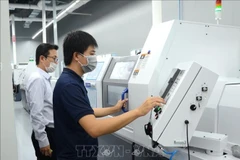
Workers are operating a robotic wafer conveyor assembly line in the semiconductor industry. (Illustrative image. Photo VNA)

Innovation – Driver for new development phase

The draft action programme of the Party Central Committee to implement the Resolution of the 14th National Party Congress identifies the shift to a new growth model, economic restructuring, and accelerated industrialisation and modernisation, with science, technology, innovation and digital transformation as the core engines, as key tasks.

Participants at the 5th ASEAN Digital Ministers Meeting (ADGMIN) in Thailand. (Photo: VNA)

Hanoi to host 6th ASEAN Digital Ministers’ Meeting in January

Held annually on a rotating basis among ASEAN member states, the meeting plays a key role in shaping strategic orientations, formulating policies and promoting digital cooperation within ASEAN, while strengthening collaboration with partners and international organisations amid rapid digital and digital-economy transformation globally.

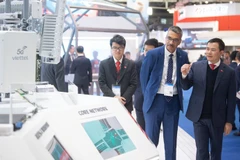
(Illustrative photo: Viettel)

Viettel records breakthrough in first 5G Advanced trial

The achievement, marked as Vietnam’s first 5G Advanced trial, was made possible by carrier aggregation (CA) technology, enabling mobile devices to operate across multiple frequency bands simultaneously instead of a single band.

A biotechnology laboratory of the International University at Vietnam National University-Ho Chi Minh City. (Photo: VNA)

Resolution 57: Role of intellectuals in advancing science and technology research

Prof. Dr. Tran Dai Lam, Director of the Institute of Materials Science at the Vietnam Academy of Science and Technology (VAST), emphasised that intellectuals should nurture national responsibility and ambition, be ready to take on challenges, evaluate research outcomes by international standards, and engage in collaboration across different sectors.

Professor Vu Minh Khuong, of the Lee Kuan Yew School of Public Policy (right), talks to a Vietnam News Agency correspondent in Singapore. (Photo: VNA)

Resolution 57 - catalyst for scientific and technological breakthroughs

The resolution also seeks to create stronger mechanisms to mobilise social and private resources and support an innovation ecosystem; link digital transformation in the public sector with the modernisation of national governance; and prioritise the development of elite human resources and internationally-standard research infrastructure.