Hanoi (VNA) – In the digital era, copyright and related rights are no longer the concern of individual creators or organisations. They have become vital to the sustainable development of a knowledge-based economy and cultural industries of Vietnam.
From legal reform to tangible outcomes
The 2017–2025 period marked significant progress for Vietnam in aligning its laws with international commitments. According to a review by the Copyright Office of Vietnam, the legal corridor on copyright protection has been substantially perfected, highlighted by the Intellectual Property Law, amended in 2022, and the 2025 law amending and supplementing several articles of the Intellectual Property Law, which will take effect on April 1, 2026.
These reforms ensure the consistency with major trade agreements such as the Comprehensive and Progressive Agreement for Trans-Pacific Partnership (CPTPP) and the EU – Vietnam Free Trade Agreement (EVFTA).

As of December 2025, authorities had issued 86,687 copyright and related-rights registration certificates. In parallel, more than 108,000 registration files dating back to the 1986–2022 period were digitised, forming a national database to support management and online access.
Enforcement efforts have also intensified. Over the past eight years, more than 680 inspection missions were conducted nationwide, resulting in administrative fines totalling approximately 7.6 billion VND (290,000 USD). Between 2017 and March 2025, authorities blocked and removed more than 16,200 websites and links illegally streaming sports events and films.
Collective rights management has shown strong growth. The Vietnam Centre for Protection of Music Copyright (VCPMC) now represents 7,102 musicians. In the first 11 months of 2025 alone, music royalty collections reached 381.3 billion VND, up 9% year-on-year. Notably, revenue from live performances and concerts surged by 273%, reflecting growing respect for copyright across society.
Digital risks and the AI challenge
Despite progress, protecting copyright in the digital environment remains a formidable challenge. Vietnam currently has nearly 79.8 million Internet users, equivalent to 78.8% of the population, creating fertile ground for sophisticated infringements, including illegal livestreaming, anonymous hosting services and cryptocurrency-based payments to evade responsibilities.
The piracy website Fmovies illustrates these difficulties. Of the identified 30 works suffering from infringements, damage to 13 could not be determined due to gaps in the digital asset valuation mechanism. Since July 2024 alone, the VCPMC has requested the removal of around 4,400 infringing music links on digital platforms.
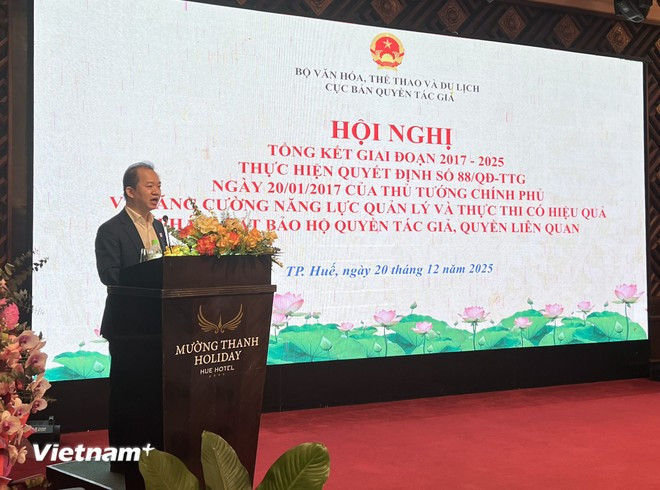
The emergence of artificial intelligence presents an unprecedented test. Assoc. Prof. Dr. Bui Hoai Son, Standing Member of the National Assembly’s Committee for Cultural and Social Affairs, emphasised that policy reviews must aim forward.
Copyright, he said, should not only be protected, but transformed into a driver of creativity, innovation and sustainable development.
Looking ahead to 2026–2030, the Copyright Office aims to elevate copyright governance and position it as a core resource of Vietnam’s digital economy. Among the proposed breakthrough measures is to develop a standalone Copyright Law to comprehensively address AI and digital data issues.
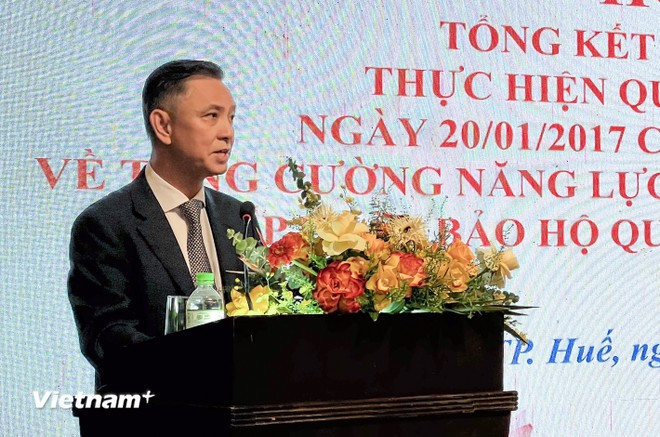
Authorities are also considering a national digital copyright registration system linking multiple ministries, alongside the application of technologies such as blockchain for ownership verification and AI for automated infringement monitoring.
Director of the Copyright Office of Vietnam Tran Hoang noted the overarching goal is to strengthen enforcement efficiency and turn copyright into a core resource for developing cultural industries and the digital economy. Ultimately, only with a strong copyright “shield” can Vietnam’s creative community thrive and confidently integrate into the global cultural landscape./.