Vietnam, Singapore eye stronger cooperation in 5G, AI governance

Hung said that Vietnam has developed a complete 5G ecosystem - from network infrastructure such as base stations and core networks to applications, hoping that Singapore would support this ecosystem.

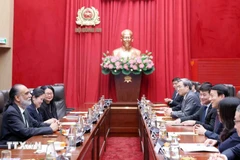
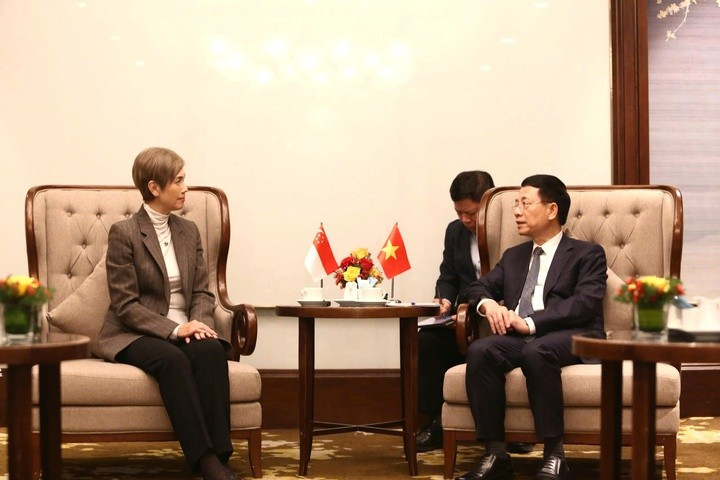
Minister of Science and Technology Nguyen Manh Hung (R) meets with Singaporean Minister for Digital Development and Information Josephine Teo in Hanoi on January 16. (Photo: mst.gov.vn)

Hanoi (VNA) – Minister of Science and Technology Nguyen Manh Hung and Singaporean Minister for Digital Development and Information Josephine Teo discussed measures to boost cooperation between the two countries in 5G development and artificial intelligence (AI) governance at their meeting in Hanoi on January 16 on the sidelines of the 6th ASEAN Digital Ministers Meeting (ADGMIN).

Hung said that Vietnam has developed a complete 5G ecosystem - from network infrastructure such as base stations and core networks to applications, hoping that Singapore would support this ecosystem. Vietnam is the fifth country in the world to achieve this and the first in the Association of Southeast Asian Nations (ASEAN) to operate a domestically controlled telecommunications network. Vietnam stands ready to support Singapore in its role in leading ASEAN’s efforts in AI, he said.

Evaluating Vietnam–Singapore digital cooperation, Hung said it is time for changes to deliver more tangible results, urging each ASEAN country to focus on a key sector and develop model initiatives that can be shared regionally and globally, with Vietnam potentially leading in 5G.

For her part, the Singaporean minister valued Vietnam for efficiently hosting the 6th ADGMIN, highlighting that proactive and responsible participation by ASEAN member states is crucial for achieving concrete outcomes beyond policy discussions.

She also congratulated Vietnam on its rapid 5G rollout, praising not only its network coverage but also the development of a complete 5G device ecosystem.

For AI cooperation, Josephine Teo said Singapore currently chairs the Working Group on AI Governance (WG‑AI) under ADGMIN. Singapore is advancing more specific AI governance measures, including the development of tools for measurement, assessment, and testing. It has launched a national AI evaluation and testing programme in response to the technology’s growing deployment.

She noted that this approach will be even more valuable if expanded across ASEAN, thus helping the region strengthen AI governance in a coordinated manner.

The Vietnamese National Assembly has recently passed the Law on Artificial Intelligence, which defines AI as an “intelligent infrastructure,” an important component of the national digital infrastructure, Hung said, noting that Vietnam approaches AI as a tool to address specific challenges.

According to the Vietnamese minister, AI should be tested not only technically but also in real-world scenarios under controlled conditions. With its large population and diverse practical challenges, Vietnam is well-positioned to serve as a testing ground for AI.

Expressing her admiration for Vietnam’s “Problem first, AI second” approach, Josephine Teo said that AI must address real-world challenges - not just showcase technology - to achieve sustainable development.

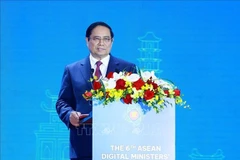
The 6th ADGMIN themed “ASEAN Adaptive: From Connectivity to Connected Intelligence,” was held in Hanoi from January 12–16. As a key ministerial-level cooperation mechanism in the digital sector, the meeting reviewed the progress of regional digital cooperation frameworks and initiatives and discussed future directions for collaboration.

It focused on key issues including digital transformation, digital economy, infrastructure connection and digital platforms, data governance, artificial intelligence, cybersecurity, and strengthening cooperation between ASEAN with dialogue partners and international organisations./.

VNA

See more

Deputy Prime Minister Nguyen Chi Dung receives a delegation of Seoul Semiconductor Co., Ltd. led by its CEO Lee Chung-hoon in Hanoi on January 16. (Photo: Government Portal)

Vietnam seeks stronger sci-tech cooperation with international partners

Informing the UN official about some of Vietnam’s achievements in sci-tech development, innovation, and digital transformation, Deputy PM Nguyen Chi Dung highlighted that the country and the UN have recorded progress in their sci-tech relations, with cooperation in strategic areas matching global trends and bilateral cooperation demand.

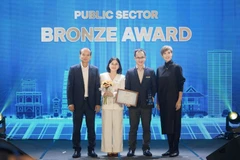
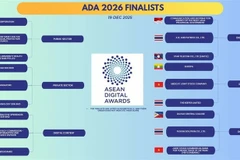
The ASEAN Digital Awards 2025 ceremony is held in Hanoi on January 15 (Photo: VietnamPlus)

Vietnam wins three awards at ASEAN Digital Awards 2026

In the digital startup category, MedCAT’s Idus platform, developed by MedCAT, won the gold award. Designed for reading, classifying and structuring documents, the platform has been applied in banking, public administration and healthcare, supporting automated insurance claims processing, smart healthcare services and the development of personal electronic health records.

Illustration of part of the digital technology and mixed-use park project in Hanoi Tay Tuu and Phu Dien wards. (Photo: FPT)

Hanoi breaks ground on digital technology, mixed-use park

The digital technology and mixed-use park in Hanoi is envisioned as a key nucleus of the capital’s innovation ecosystem, aligned with its goal of becoming a major national hub for science, technology and the digital economy.

Illustrative photo (Photo: Ampshireflag)

Promoting cooperation aligned with ASEAN digital priorities

The sixth ASEAN Digital Senior Officials’ Meeting (ADGSOM) and related meetings took place from January 12 to 14 in Hanoi. Delegations exchanged views and reviewed progress in priority cooperation areas, focusing on enhancing coordination and harmonisation of digital policies across ASEAN.

The Au Lac AI Alliance officially announces the inaugural Au Lac Grand Prize on January 12. (Photo: VNA)

Au Lac Grand Prize launched to honour Vietnamese-made AI

The competition is open to all Vietnamese citizens, regardless of age, place of residence or professional background, provided the submitted product or solution is legally protected intellectual property developed and owned by Vietnamese individuals or entities and used in compliance with the law.

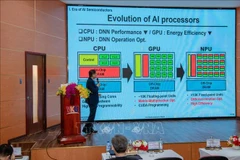
An expert speaks at the International Conference on Semiconductors (ICOS) 2026 (Photo: VNA)

ICOS 2026 highlights pathways for Vietnam’s semiconductor development

This was the first international, specialised semiconductor conference held in central Vietnam and the first time the country hosted a large-scale academic forum dedicated exclusively to this sector. Organised in line with international standards, it featured plenary sessions, technical presentations and industry forums, reflecting major research trends shaping the semiconductor sector.

Resolution No.57: People should be put at centre of AI governance

Resolution No.57: People should be put at centre of AI governance

Assessing the role of AI, Minister of Science and Technology Nguyen Manh Hung emphasised that it is an “intellectual infrastructure.” More than an applied technology, AI is increasingly becoming a form of national infrastructure, comparable to electricity, telecommunications or the Internet.

In Vietnam, 5G technology infrastructure has begun to be widely deployed by domestic network operators (Photo: VNA)

5G technology expansion expected to boost Vietnam’s digital economy

The Ministry of Science and Technology reported that by 2025, 5G had been commercialised nationwide, covering more than 90% of the population. Viettel alone has deployed 30,000 5G base stations, achieving 90% outdoor coverage and 70% indoor coverage, exceeding its commitments to the Government.